



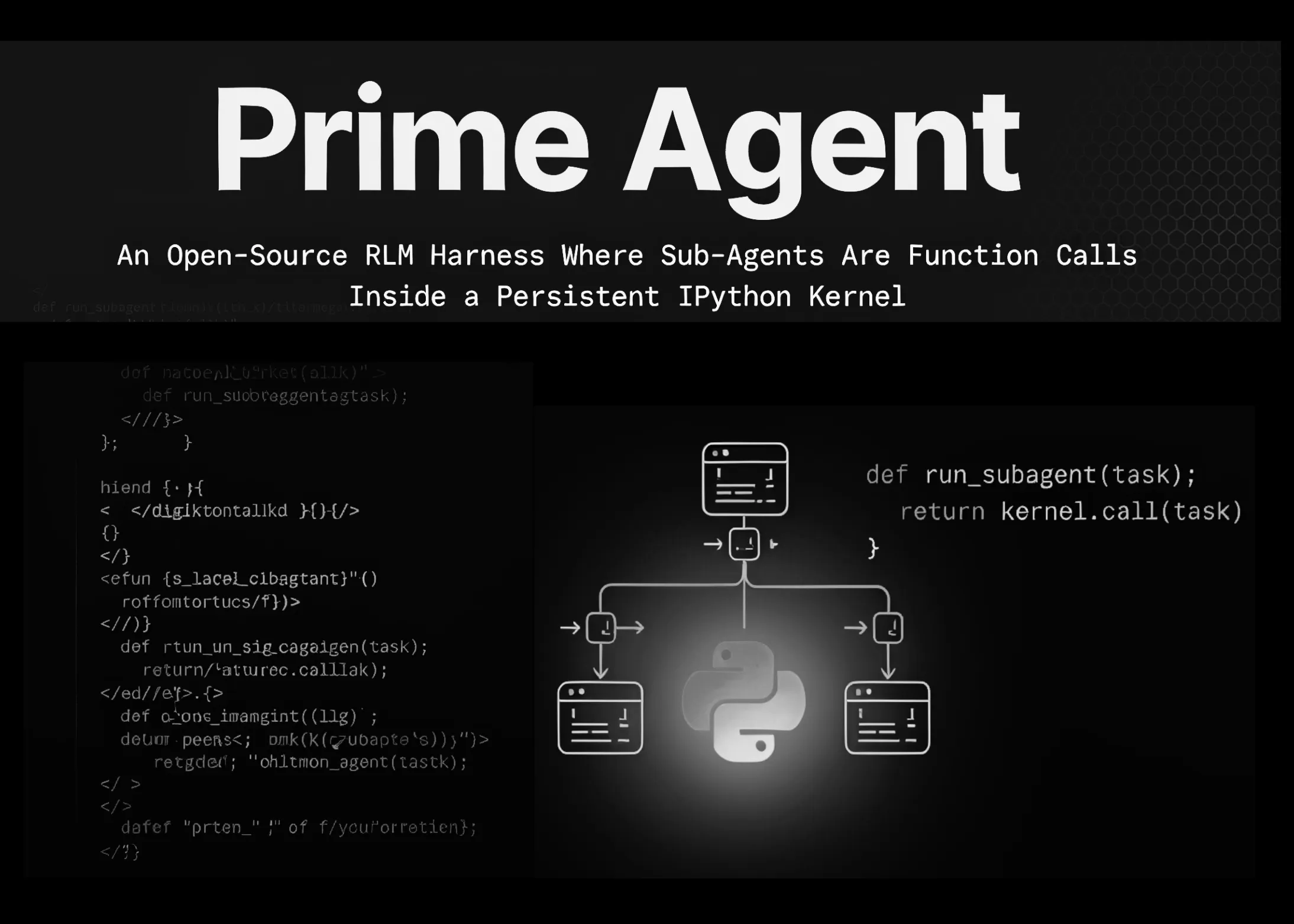
# Prime Agent: AI Repository and Execution Harness
Prime Intellect has open-sourced **Prime Agent**, a self-improving coding harness built around two core abstractions: the **Recursive Language Model (RLM)** and the **Continual Harness**. Designed for demanding engineering workflows, Prime Agent uses fixed tool schemas and context compaction to force models to work around their own scaffolding, replacing traditional prompt-based approaches with a persistent Python REPL and a rewritable harness. With Opus 5, Prime Agent achieves **95.5% on ARC-AGI-3**, surpassing the reported human expert baseline of 95.4%. The project is released under the MIT license.
—
## What Prime Intellect Shipped
### Two Core Abstractions
1. **Recursive Language Model (RLM):** Treats context as a variable and sub-agent delegation as function calls inside a REPL.
2. **Continual Harness:** Formalizes harness state as **H = (ρ, G, K, M)** — prompt, sub-agents, skills, and memory — all exposing create, read, update, and delete operations.
### Deployment and Integration
Prime Agent installs on Linux or macOS with a single command and supports a wide range of execution backends:
– Subscription logins (Codex, Claude Pro/Max, GitHub Copilot)
– API keys (Anthropic, OpenAI, Google, Groq, Fireworks, Prime Inference, and others)
– Azure OpenAI and Amazon Bedrock
– Self-hosted endpoints (vLLM, Ollama, LM Studio)
– Open-weights models (e.g., GLM-5.2) for on-premise deployment
> **Note:** Worker and kernel processes are not a security sandbox. Production deployments should use disposable clones or restricted environments.
### Performance Highlights
– **ARC-AGI-3:** 95.5% RHAE (Best@1), outperforming the human expert baseline of 95.4%
– **Reliability:** 99.97% Best@3 across 183/183 levels completed
– **Multi-run results:** Consistent performance across multiple test runs (95.0%, 95.2%, 95.5%)
—
## Interactive Feature Overview
The interactive explainer visualizes how Prime Agent manages:
– **Sub-agent delegation and memory retention**
– **Harness state management via /refine and rollbacks**
– **Autonomous operation with bounded turn, token, and time budgets**
These capabilities make Prime Agent suitable for:
– Overnight refactors behind test gates
– Spec-driven builds from scratch
– Kernel optimization
– Long-horizon agent evaluation
– Autoresearch workflows
—
## FAQ
**Q: Can I deploy Prime Agent on my own infrastructure?**
A: Yes. Prime Agent supports self-hosting with open-weights models such as GLM-5.2, allowing code to remain within your network.
**Q: What are the hardware requirements?**
A: The harness is designed for mid-size to large engineering environments and HPC teams. Solo developers can also install it, though the benefits are more pronounced for multi-hour tasks.
**Q: Does Prime Agent work with self-hosted models?**
A: Yes. It supports self-hosted endpoints such as vLLM, Ollama, and LM Studio.
**Q: Is there any security sandboxing for agent processes?**
A: No. Worker and kernel processes are not considered a security sandbox. Secure deployments require disposable clones or restricted environments.
**Q: What does the RLM abstraction enable?**
A: The RLM treats context as a variable and sub-agents as function calls inside a persistent REPL, enabling recursive delegation and dynamic code execution.
**Q: How does the Continual Harness manage state? **
A: It treats prompts, sub-agents, skills, and memory as mutable state, allowing the agent to create, read, update, and delete its own trajectory over time.
—
## Conclusion
Prime Agent represents a significant step forward in AI-assisted development and autonomous agent workflows. By combining recursive language modeling with a continually adaptable harness, it delivers consistent, high-performance results on complex benchmarks like ARC-AGI-3. With open-source availability and broad deployment options, Prime Agent is positioned as a powerful tool for developer teams, AI research labs, and high-performance computing environments looking to push the boundaries of what AI agents can achieve in software engineering and beyond.
