



Forecasting the FIFA World Cup has exploded into the biggest market in prediction platforms. One tournament-winner pool on Polymarket alone carries $2 billion in wagers, while Kalshi runs 48 different markets on the same question and earns the lion’s share of industry fees.
The two platforms share a similar view on the football action, but they divide revenue in very different ways. BeInCrypto’s Dune Analytics dashboards across three venues show volume, fees, and remaining crypto bets clearly broken out.
Sports Drove a Record-setting May for Prediction Platforms
Per Binance Research figures, prediction platforms recorded $31.2 billion in trading during May, a roughly 15% rise over January. The report allocates 58% of that amount to Kalshi and 28% to Polymarket, with the industry’s collective open interest reaching $1.3 billion total.
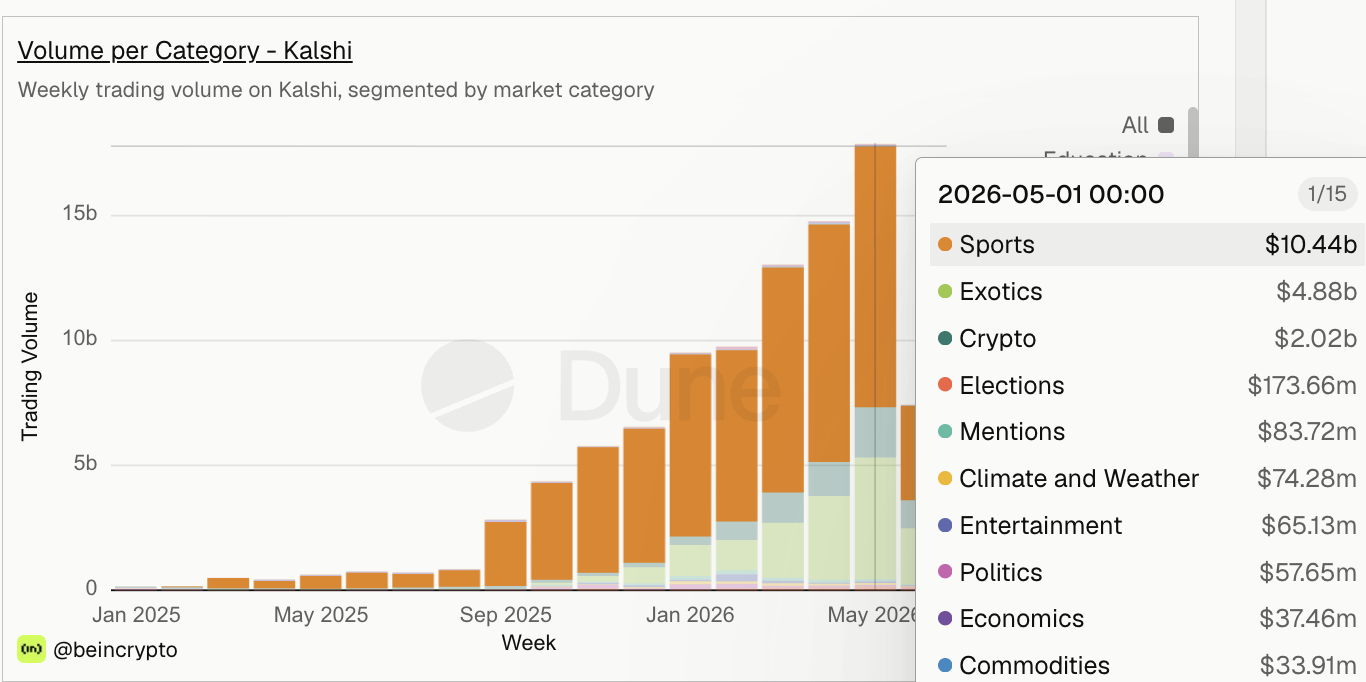
BeInCrypto’s own research shows where Kalshi’s share is coming from. During its biggest month of 2026, May, sports-related trading hit $10.44 billion.
Political events, the use case that first put Kalshi on the map, contributed just $173.66 million in the same month, a tiny fraction by comparison.
Crypto-related bets on Kalshi topped $2.02 billion over the period, with an additional sports-adjacent “exotics” bucket bringing in $4.88 billion. These numbers indicate that the 2026 World Cup calendar, more than politics or digital-asset prices, fuels the platform’s current momentum.
All weekly figures below have been aggregated into monthly values.
June already shows sports pulling ahead again. With most of the World Cup schedule yet to be played, volume could still climb further. It’s worth noting that election-related activity on Kalshi is approaching May levels already, meaning politics could reclaim attention from sports.

The largest single football market reveals just how concentrated that momentum is.
A $2 Billion Market Versus 48 Smaller Ones
Polymarket’s World Cup Winner pool has accumulated $2 billion in all-time trading volume, holds $436 million in active liquidity, and generated $137 million in trades on Thursday alone. Across its full FIFA World Cup section, the platform lists more than 330 live markets.

Kalshi’s equivalent offering has produced $182.3 million across 48 separate markets. On the highest-profile events, Polymarket leads by roughly 11 to 1, and Thursday’s single-day Polymarket volume nearly matched the entire lifetime volume of Kalshi’s largest World Cup event.

The two venues differ in structure, not in football judgment. Both platforms price World Cup odds identically, listing Spain as the favorite at exactly 17%, with Kalshi offering 5.56x payouts on both Spain and France.
Kalshi distributes its volume across dozens of individual match markets, while Polymarket channels it into a single tournament-wide pool. Kalshi still processes more total volume across its entire platform, consistent with Binance Research’s 58% estimate, so the real contest is breadth versus depth rather than a simple size comparison.
That concentration is visible across Polymarket’s full-year performance.
Sports Have Dominated Polymarket All Year, and Activity Is Cooling
Sports led every weekly category on Polymarket throughout 2026. In January, sports generated $6.20 billion, or 43% of the $14.34 billion total, ahead of politics at $4.49 billion and crypto at $3.65 billion.
All weekly figures below have been aggregated into monthly values.

The high point came in March, when sports contributed $8.77 billion out of a record $19.58 billion monthly total. By June, overall volume had dropped roughly 70% to $5.91 billion, yet sports’ share actually grew to 56.5%. Crypto held at $1.73 billion, while politics fell to $831.25 million.

In other words, football’s dominance is not a short-term tournament effect. It was established well before World Cup hype kicked in, and it has only deepened as overall platform activity has cooled during the group stage.
Volume captures only part of the picture. Fees reveal the rest.
Kalshi Captures the Fees, Opinion Illustrates the Trend
In May, Kalshi earned $137.86 million in trading fees, compared to Polymarket’s $28.07 million and Opinion’s $159,330. That nearly five-to-one revenue gap aligns with Binance Research’s finding that Kalshi processes the most overall volume.

The dashboard tracks Kalshi’s fees starting in April, and both recorded months sit well above anything Polymarket has generated. So while betting volume splits between the two platforms, fee revenue flows overwhelmingly to Kalshi.
The smaller platform Opinion shows where this trajectory leads. In January, crypto led the platform with $729.52 million out of a $1.46 billion week.
All weekly figures below have been aggregated into monthly values.

By the week of June 1, sports made up 99.4% of all activity, while crypto dropped below $500,000. FIFA World Cup predictions didn’t just grow on Opinion; they displaced the very categories that originally built the prediction-market industry.

The surprises keep adding up. Sports have now outpaced crypto on every tracked platform, including those built specifically for crypto users, and politics has shrank to a rounding error just a year after driving the entire industry.
The platforms are in full agreement on the football, both pricing Spain identically. Most notably, the record-setting May arrived even as overall activity was already declining.
What comes next will determine the FIFA World Cup predictions race. Daily group-stage fixtures favor Kalshi’s match-by-match structure, while knockout-round drama should benefit Polymarket’s deep tournament-wide pool, so the lead could shift week to week.
Traders should monitor whether match days revive total volume, whether the recovering elections category takes share back from sports, and whether open interest continues building toward the knockout rounds.
If the group stage fails to reverse the slowdown, the prediction-market boom will have peaked before the first whistle even blew.
The post Polymarket vs Kalshi: Where are Fans Placing Their FIFA World Cup Predictions? appeared first on BeInCrypto.
