




The Payouts King ransomware is utilizing the QEMU emulator as a reverse SSH backdoor to run hidden digital machines on compromised methods and bypass endpoint safety.
QEMU is an open-source CPU emulator and system virtualization instrument that enables customers to run working methods on a bunch laptop as digital machines (VMs).
Since safety options on the host can not scan contained in the VMs, attackers can use them to execute payloads, retailer malicious information, and create covert distant entry tunnels over SSH.

For these causes, QEMU has been abused in previous operations from a number of risk actors, together with the 3AM ransomware group, LoudMiner cryptomining, and ‘CRON#TRAP’ phishing.
Researchers at cybersecurity firm Sophos documented two campaigns the place attackers deployed QEMU as a part of their arsenal and to gather area credentials.
One marketing campaign that Sophos tracks as STAC4713 was first noticed in November 2025 and has been linked to the Payouts King ransomware operation.
The opposite, tracked as STAC3725, has been noticed in February this 12 months and exploits the CitrixBleed 2 (CVE‑2025‑5777) vulnerability in NetScaler ADC and Gateway cases.
Operating Alpine Linux VMs
Researchers observe that the risk actors behind the STAC4713 marketing campaign are related to the GOLD ENCOUNTER risk group, which is understood to focus on hypervisors and encryptors for VMware and ESXi environments.
Based on Sophos, the malicious actor creates a scheduled activity named ‘TPMProfiler’ to launch a hidden QEMU VM as SYSTEM.
They use digital disk information disguised as databases and DLL information, and arrange port forwarding to supply covert entry to the contaminated host through a reverse SSH tunnel.
The VM runs Alpine Linux model 3.22.0 that features attacker instruments corresponding to AdaptixC2, Chisel, BusyBox, and Rclone.
Sophos notes that preliminary entry was achieved through uncovered SonicWall VPNs, whereas exploitation of the SolarWinds Net Assist Desk vulnerability CVE-2025-26399 was noticed in more moderen assaults.
Within the post-infection section, the risk actors used VSS (vssuirun.exe) to create a shadow copy, then used the print command over SMB to repeat NTDS.dit, SAM, and SYSTEM hives to temp directories.
Extra just lately noticed incidents attributed to the risk actor relied on different preliminary entry vectors. The researchers say that in an assault in February, GOLD ENCOUNTER used an uncovered Cisco SSL VPN, and in March they posed as IT employees and tricked workers over Microsoft Groups into downloading and putting in QuickAssist.
“In both instances, the threat actors used the legitimate ADNotificationManager.exe binary to sideload a Havoc C2 payload (vcruntime140_1.dll) and then leveraged Rclone to exfiltrate data to a remote SFTP location” – Sophos
Based on a Zscaler report this week, Payouts King is probably going tied to former BlackBasta associates, based mostly on its use of comparable preliminary entry strategies like spam bombing, Microsoft Groups phishing, and Fast Help abuse.
The pressure employs heavy obfuscation and anti-analysis mechanisms, establishes persistence through scheduled duties, and terminates safety instruments utilizing low-level system calls.
Payouts King encryption scheme makes use of AES-256 (CTR) with RSA-4096 with intermittent encryption for bigger information. The dropped ransom notes level victims to leak websites on the darkish net.
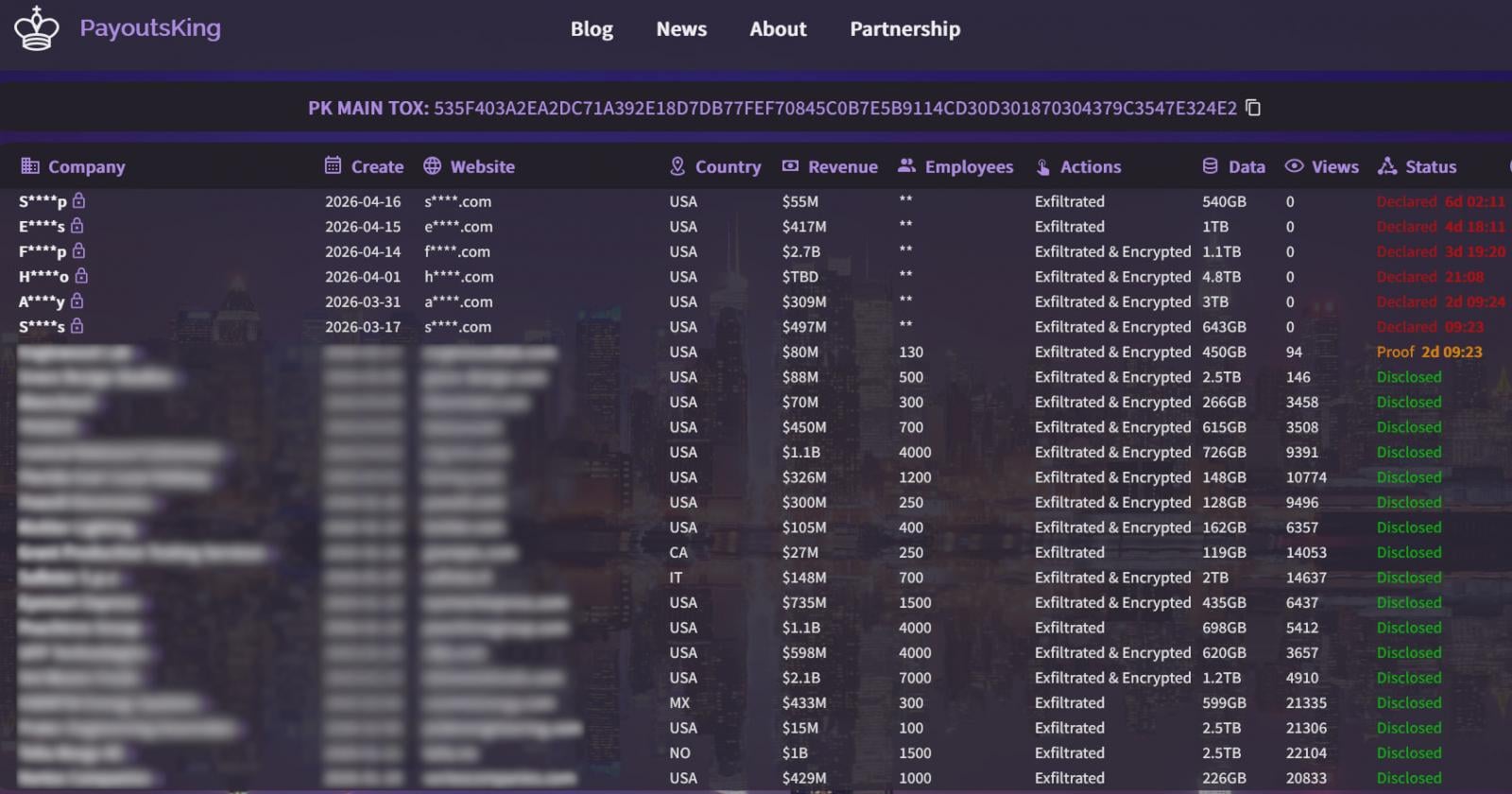
Supply: BleepingComputer
The second marketing campaign that Sophos noticed (STAC3725), has been lively since February and exploits the CitrixBleed 2 vulnerability to realize preliminary entry to focus on environments.
After compromising NetScaler units, the attackers deploy a ZIP archive containing a malicious executable that installs a service named ‘AppMgmt,’ creates a brand new native admin consumer (CtxAppVCOMService), and installs a ScreenConnect consumer for persistence.
The ScreenConnect consumer connects to a distant relay server and establishes a session with system privileges, then drops and extracts a QEMU bundle that runs a hidden Alpine Linux VM utilizing a customized.qcow2 disk picture.
As an alternative of utilizing a pre-built toolkit, the attackers manually set up and compile their instruments, together with Impacket, KrbRelayx, Coercer, BloodHound.py, NetExec, Kerbrute, and Metasploit, contained in the VM.
Noticed exercise consists of credential harvesting, Kerberos username enumeration, Lively Listing reconnaissance, and staging knowledge for exfiltration through FTP servers.
Sophos recommends that organizations search for unauthorized QEMU installations, suspicious scheduled duties operating with SYSTEM privileges, uncommon SSH port forwarding, and outbound SSH tunnels on non-standard ports.

AI chained 4 zero-days into one exploit that bypassed each renderer and OS sandboxes. A wave of recent exploits is coming.
On the Autonomous Validation Summit (Might 12 & 14), see how autonomous, context-rich validation finds what’s exploitable, proves controls maintain, and closes the remediation loop.
