



# Building a Community That Keeps Growing: Reflections on a Large-Scale Kubernetes Event in Lima
A community event in Lima proved once again that the appetite for cloud-native learning in Peru is not just real — it’s accelerating. On a Saturday in July, over 900 people packed into a university venue in the Barranco district for the third installment of a regional Kubernetes community gathering. The turnout, the quality of participation, and the spirit of collaboration made it one of the most significant technology events the city has hosted in recent years.
This is a reflection on what it takes to make an event like this happen, what the numbers tell us, and what comes next.
## The Morning That Set the Tone
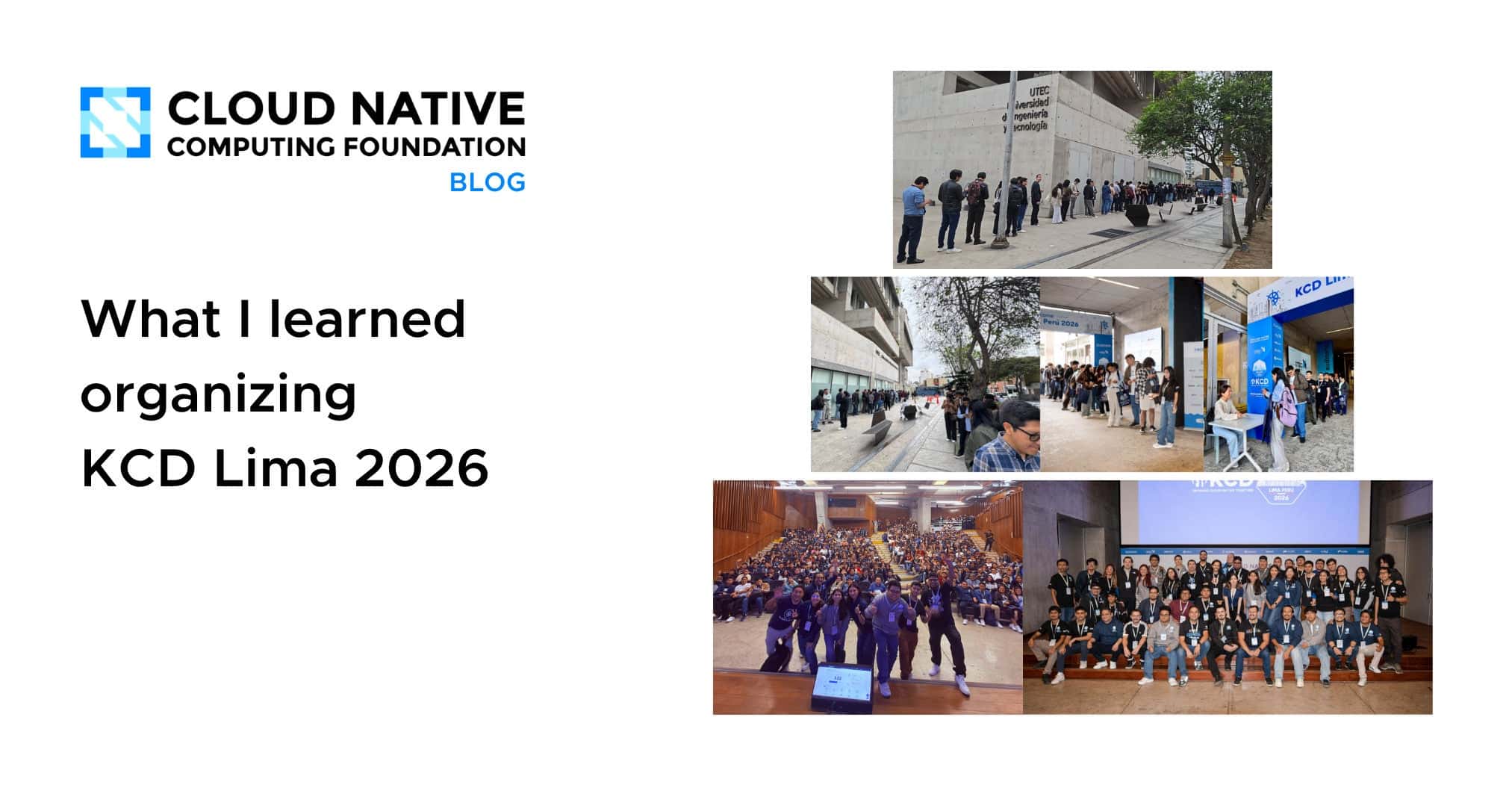
Arriving at the venue well before doors opened, the organizers were greeted by an unexpected sight: a line of roughly 100 attendees already waiting in the morning chill. People had come early, coffee in hand, eager to be among the first through the doors. Registration had to be moved up by thirty minutes just to manage the flow.
That image — a Saturday morning, a growing queue, and genuine excitement — says more about the health of a community than any survey ever could. It was a powerful reminder that when a community event resonates, people don’t just attend. They show up early.
## By the Numbers
The data from this edition tells a compelling story:
– **Over 2,200 registrations and more than 900 in-person attendees** — roughly 75% higher than the previous year and the largest turnout across all three editions.
– **60 speakers delivered 54 sessions** across five parallel rooms, selected from 89 proposals submitted by 44 companies spanning 14 countries.
– **Five international keynote speakers** joined the program, bringing perspectives from across the global cloud-native ecosystem.
– **Eleven sponsors** participated across five tiers, including major technology and financial institutions.
– **Post-event survey results averaged 4.7 out of 5**, with 98% of respondents rating the event four or five stars, and not a single attendee giving a score below three.
That last metric is the one that matters most. High attendance shows scale; high satisfaction shows that the event delivered on its promise.
## Three Editions, Three Evolutions
Each year of this event series has represented a different chapter.
The first edition was about proving it was possible. With no prior track record and limited visibility, the team pulled together over 500 attendees, 49 speakers, and 11 sponsors through sheer determination. It was driven by enthusiasm more than anything else.
The second edition focused on legitimacy. Now that the event existed, it had to prove it wasn’t a one-time success. The team formalized every process — sponsorship guides, contracts, run-of-show documentation, cash flow management. What was improvised in year one was written down so it wouldn’t depend on institutional memory. That year drew over 1,300 registrations and more than 500 attendees.
The third edition was about momentum. Attendance nearly doubled, returning sponsors brought new partners, and international speakers agreed to participate because the event had earned a reputation. The challenge shifted from convincing people to attend to meeting the expectations the community had built for itself.
What becomes clear through this progression is that a community event cannot simply be delegated. Logistics, website design, and venue coordination can be handed off. But the vision for what kind of gathering it should be — who it welcomes, what conversations it fosters — requires deliberate, yearly intention.
## The Work No One Sees
The visible parts of an event — the agenda, the speakers, the venue — get the attention. But a significant portion of the effort goes into things that never make it into a photograph.
This edition involved completing numerous compliance and onboarding forms for international sponsors, reviewing sponsorship agreement clauses covering liability, exclusivity, and refund terms, and managing a budget that straddled two currencies since revenue came in in one and expenses were paid in another. The team designed the full event layout across five rooms, ten exhibition booths, four coffee stations, and the logistical flow of stairs and elevators.
None of this is glamorous, but it is essential. There is a persistent myth that community events just happen organically. They don’t. Behind every successful gathering is a team doing work that no one applauds.
## Who Showsed Up and What It Means
Three data points from the attendee profile stood out to the organizers, each connecting directly to the broader technology landscape in Peru.
Forty-five percent of attendees came from end-user companies, and within that group, banking and finance was the dominant sector. Major financial institutions were well represented, confirming that digital transformation in Peruvian banking has moved far beyond strategy presentations and into real, operational platform teams staffed by DevOps engineers and site reliability professionals.
Fifteen percent identified as architects — the single most common role, ahead of both developers and DevOps engineers. This signals that cloud-native adoption in the region has reached a stage where architectural decisions carry as much weight as technical implementation. It is a conversation happening in boardrooms and engineering meetings alike.
Eight percent of attendees were students from local universities. Keeping the event free and reserving space for students removes the financial barrier to participation. Seeing students register and attend on a Saturday morning is one of the most encouraging outcomes of the entire event.
## Honest Reflections on What Needs Improvement
The feedback was overwhelmingly positive, but the post-event survey also surfaced four clear areas for growth.
First, the coffee break capacity was insufficient. Four stations were designed for 600 attendees, but nearly a thousand people showed up. Future planning needs to account for a buffer above expected capacity.
Second, session punctuality was a challenge. With five parallel rooms running simultaneously, even a five-minute delay in one room cascades across the entire schedule. More dedicated room moderators with authority over timing would help.
Third, session pre-registration was identified as a gap. Some talks drew packed rooms while others of comparable quality had sparse attendance. Knowing demand in advance would allow for smarter room allocation.
Fourth, and perhaps most importantly, the representation gap on stage is real. Out of sixty speakers, only five were women, even though female attendance was 17%. Publishing this number rather than hiding it is the first step toward addressing it in future calls for proposals.
## Gratitude and Looking Ahead
No large community event succeeds without a team. The core organizing group — nine individuals balancing full-time jobs with event production — deserves immense credit. Alongside them, volunteers handled registration, guided attendees across five rooms, kept sessions on schedule, and quietly solved the hundred small problems that nobody else noticed.
To the speakers who prepared and traveled, to the sponsors who invested in Lima before the numbers were impressive, to the venue that opened its doors, and to the more than 900 people who gave up a Saturday — the appreciation runs deep.
For the organizer, the recognition of being accepted into a global ambassador program for the cloud-native community was both an honor and a motivator. It reinforces the commitment to keeping Lima a growing hub for cloud-native collaboration in the region.
That image of the early morning line — hundreds of people waiting before 8 a.m. on a Saturday — is something worth remembering. It captures what a community event can be: a shared commitment to learning, to showing up, and to building something that outlasts any single edition.
## Frequently Asked Questions
**What kind of event is this?**
This is a community-focused gathering dedicated to Kubernetes and cloud-native technologies, organized by local volunteers and backed by a global foundation that supports open-source projects.
**Is attendance free?**
Yes, these events are free for the community. Sponsorship covers the costs, making it accessible to students, professionals, and enthusiasts alike.
**How are speakers selected?**
Speakers are chosen through a call for proposals process where community members submit session ideas. A selection committee reviews submissions and picks a balanced program.
**Who can attend?**
Anyone with an interest in cloud-native technologies, Kubernetes, DevOps, or related topics. The event attracts professionals, students, architects, and engineers from a wide range of industries.
**What makes a community event different from a conference?**
Community events are typically organized by volunteers rather than commercial entities, focus on knowledge sharing and connection rather than sales, and are often free or low-cost. They prioritize local participation and grassroots engagement.
**How can someone get involved in organizing?**
Community events always need volunteers and organizers. Reaching out to the local organizing team or connecting with established community members is the best first step.
## Conclusion
Large-scale community events are testaments to what happens when dedicated people invest their time and energy into something bigger than themselves. The growth trajectory from the first edition to the third shows that a community can build momentum organically when it stays true to its mission: welcoming everyone, fostering learning, and creating a space where professionals and students can connect over shared interests.
The challenges — capacity planning, scheduling, representation, unseen operational work — are real and persistent. But each edition provides the lessons needed to improve. The survey feedback, the attendee data, and the honest self-reflection are what turn a one-time gathering into an annual tradition that the community can rely on.
For anyone considering organizing a similar event, the message is clear: it requires significant effort, but the impact — measured in the eyes of a hundred people waiting in line at 7 a.m. on a Saturday — is worth every bit of it.
Thank you for reading
