



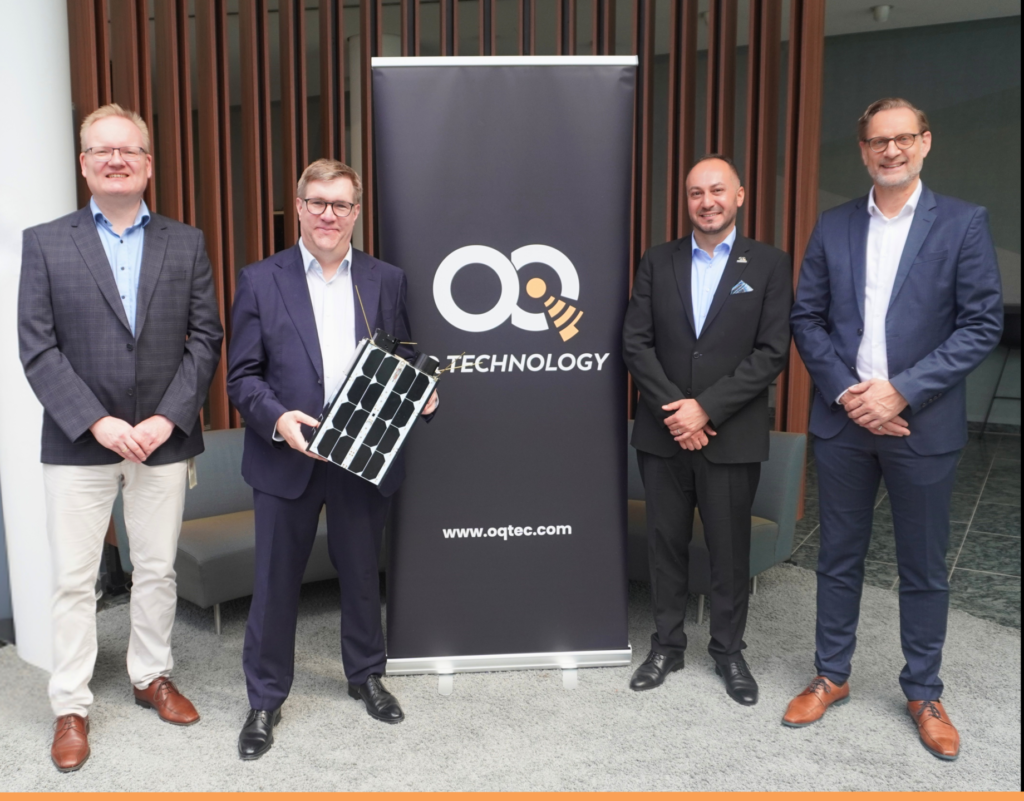
OQ Technology, a leading European direct-to-device (D2D) satellite operator, has partnered with Telefónica Germany to carry out the continent’s inaugural live trial of two-way satellite communications — transmitting directly to standard, off-the-shelf smartphones (including iPhone, Samsung, and Google models) over conventional mobile spectrum. Set to take place in Mecklenburg-Western Pomerania, Germany, the trial will assess how low Earth orbit (LEO) satellites can be woven into today’s mobile networks to deliver messaging and voice services straight from orbit.
This partnership marks a significant milestone for European non-terrestrial network (NTN) advancement and illustrates how blended terrestrial-satellite systems can bolster the durability, coverage, and strategic independence of Europe’s digital framework.
As part of the arrangement, OQ Technology will deploy its advanced satellites and proprietary multi-band D2D payload — developed entirely in-house — alongside spectrum contributed by Telefónica Germany. Together, they will verify direct-to-smartphone connectivity using everyday consumer devices and licensed operator frequencies. The payload, built on 3GPP standards, accommodates MSS S-band, C-band, and IMT bands, opening the door to versatile deployment options for upcoming NTN services.
With this initiative, OQ Technology becomes the first European firm preparing operational missions across all three D2D spectrum bands — MSS S-band, C-band, and IMT — further cementing Europe’s position at the forefront of sovereign satellite-mobile communications.
“Europe needs to build its own independent, interoperable space-based mobile infrastructure,” said Omar Qaise, founder and CEO of OQ Technology. “Our work with Telefónica Germany proves that European operators and satellite companies can come together to create next-generation connectivity built on open standards, licensed spectrum, and the smartphones people already own. Our D2D satellite network is engineered to work hand-in-hand with terrestrial mobile networks, filling coverage gaps where they matter most while respecting mobile operators’ control and spectrum rights.”
“This is a pivotal moment for Germany’s digital infrastructure,” said Jörg Kablitz, chief partner and wholesale officer at Telefónica Germany. “We’re testing mobile links established directly between satellites and everyday smartphones — using a European technology approach, with the goal of reinforcing Europe’s digital independence. The satellite-based service is designed to complement existing mobile networks, particularly in regions where building out ground-level infrastructure would be prohibitively expensive or simply not feasible.”
OQ Technology holds the distinction of being the first European company to operate a purpose-built LEO constellation dedicated to D2D and IoT NTN services. The firm develops standardized 3GPP-compliant satellite connectivity solutions that enable direct communication with unmodified smartphones and IoT devices, serving enterprise, government, and consumer markets alike.
The upcoming demonstration in Mecklenburg-Western Pomerania will concentrate on verifying how terrestrial mobile infrastructure interacts with OQ’s LEO satellite network — examining achievable data throughput, spectrum coexistence, and direct-to-device communication scenarios in areas where extending traditional coverage remains difficult.
The project underscores the growing significance of hybrid NTN architectures in the telecommunications networks of tomorrow. While terrestrial mobile infrastructure continues to serve as the primary connectivity backbone, satellite systems can deliver supplementary coverage in remote, underserved, or infrastructure-limited regions.
OQ Technology has already proven D2D connectivity using MSS S-band spectrum and is steadily broadening its multi-band satellite roadmap, with Europe’s first forthcoming missions spanning MSS S-band, C-band, and IMT spectrum for direct smartphone access. The company’s next-generation satellites and payloads are designed and manufactured entirely in-house, allowing for fast innovation cycles and adaptable support for operator-driven NTN deployment models that leverage both satellite and terrestrial mobile spectrum.
The Telefónica Germany partnership further confirms the adaptability of OQ Technology’s 3GPP-compliant satellites, demonstrating their ability to enable smooth integration between terrestrial and non-terrestrial mobile networks — all while remaining fully compatible with existing consumer smartphones, requiring no hardware changes whatsoever.
The initiative also extends the two companies’ ongoing work in IoT satellite connectivity, where OQ Technology’s NTN infrastructure already powers global monitoring and communication capabilities for enterprise use cases.
As NTN technologies gain traction within 3GPP standardization efforts and the evolution toward 6G, OQ Technology continues to position Europe as a leader in sovereign satellite-mobile convergence and standardized D2D communications.
Share your thoughts on this article via X: @IoTNow_ and check out our homepage IoT Now
