



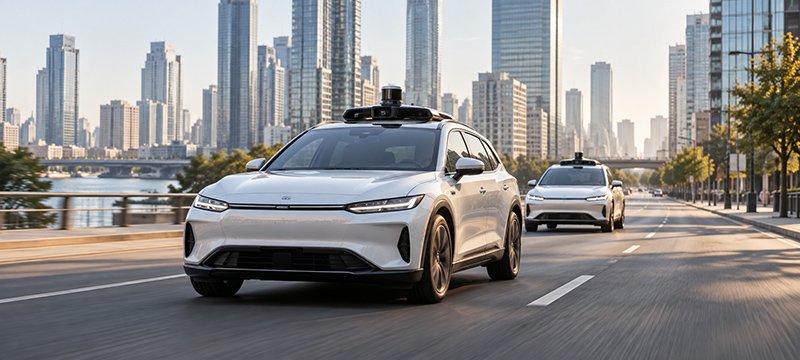
From Prototype to Platform: The Economic and Operational Surge of Autonomous Ride-Hailing Fleets
The landscape of urban transportation is on the cusp of a dramatic transformation. Industry projections indicate that the global autonomous ride-hailing fleet—comprising Level 4 driverless vehicles—will explode from a modest 6,500 units at the close of 2025 to over 1.53 million by 2036. Alongside this fleet expansion, passenger fare revenues are expected to skyrocket from $260 million to a staggering $158.7 billion, representing a compound annual growth rate of 79.2 percent.
However, scaling autonomous driving is no longer merely a question of whether a vehicle can navigate without a human at the wheel. The true challenge lies in whether the entire operational system surrounding that vehicle can be replicated economically across different cities. Deploying robotaxis brings together a complex web of sensors, onboard computing, vehicle-control systems, connectivity, mapping, fleet infrastructure, and remote operations. Making commercial expansion work means orchestrating all these elements simultaneously, a task far more intricate than simply adding more vehicles to the road.
Currently, driverless services are concentrated primarily in the United States, China, and the Middle East, though recent breakthroughs have recently brought these services to Europe, South Korea, and Singapore. As the industry looks to expand further, operators must grapple with the reality that different traffic environments, regulations, and road conditions create additional engineering and data requirements whenever a service enters a new region.
**The Integration Layer of the Ecosystem**
What sets the robotaxi market apart from conventional connected-vehicle businesses is the heavy concentration of technology integration within the automated driving provider. These companies do more than supply a single subsystem; they develop the entire Level 4 driving stack, determining how perception software, sensor hardware, compute systems, and vehicle controls work in concert. Because the driving system and the data used to train it are the primary proprietary assets, the vehicle itself becomes just one component of a much broader distributed computing system. As fleets grow, data generated in the field must continuously feed back into the system for validation and improvement, while fleet operations rely on centralized infrastructure and remote assistance.
**Mobility Platforms and Commercial Viability**
A second critical layer consists of mobility platforms that provide the passenger-facing interface. Ride-hailing applications handle booking, payments, pricing, and customer support, connecting autonomous vehicles with existing pools of consumer demand. The distinction is vital: technically capable vehicles do not automatically create commercially viable services. The economics of robotaxis depend on keeping vehicles sufficiently utilized while covering the costs of the vehicle, the technology, and daily operations. Established mobility platforms bring existing customer bases and travel-pattern data, helping operators align autonomous fleet capacity with actual demand.
**Generalization and Vehicle Design**
One of the most consequential shifts on the horizon involves the adoption of end-to-end artificial intelligence and large driving models. By reducing dependence on manually specified driving rules, these advanced technologies could improve a system’s ability to generalize across different driving environments, making geographic expansion less reliant on extensive city-specific engineering. Furthermore, the physical design of the vehicles themselves is set to influence the economic model. Factory-integrated and purpose-built autonomous vehicles, once production volumes become sufficiently large, could significantly reduce the complexity and cost associated with retrofitting conventional cars for driverless operation.
**Conclusion**
The forecast for over 1.5 million autonomous vehicles by 2036 represents far more than a simple increase in autonomous car numbers; it signifies the industry’s urgent need to evolve from highly integrated, location-specific pilots into repeatable, scalable operational platforms. Reaching that scale will require satisfying stringent safety requirements, navigating diverse local regulations, and balancing the economics of commercial mobility services—all while turning isolated deployments into a standardized global offering.
**Frequently Asked Questions (FAQ)**
*What is driving the massive revenue growth in the autonomous ride-hailing sector?*
Revenue growth is driven by the scaling of Level 4 autonomous fleets from limited pilot programs into larger, commercially operational networks that can serve millions of passenger trips globally, thereby increasing per-vehicle utilization and fare collection.
*Why is scaling robotaxis across different cities so challenging?*
Scaling requires more than just deploying cars; it demands replicating an entire ecosystem of sensors, connectivity, fleet infrastructure, and remote operations. Each new city introduces unique traffic conditions, regulations, and operating environments that require additional engineering and localized data collection.
*What role do ride-hailing apps play in the autonomous vehicle ecosystem?*
Mobility platforms provide the critical passenger-facing layer, managing booking, payments, and customer support. They connect autonomous vehicles with existing consumer demand pools, helping operators keep their fleets utilized and economically viable.
*How is technology changing the way robotaxis navigate new environments?*
The development of end-to-end AI and large driving models is reducing the industry’s reliance on manually coded driving rules. These advanced systems improve generalization, allowing autonomous vehicles to adapt to new cities with less need for city-specific engineering.
Thank you for reading
