



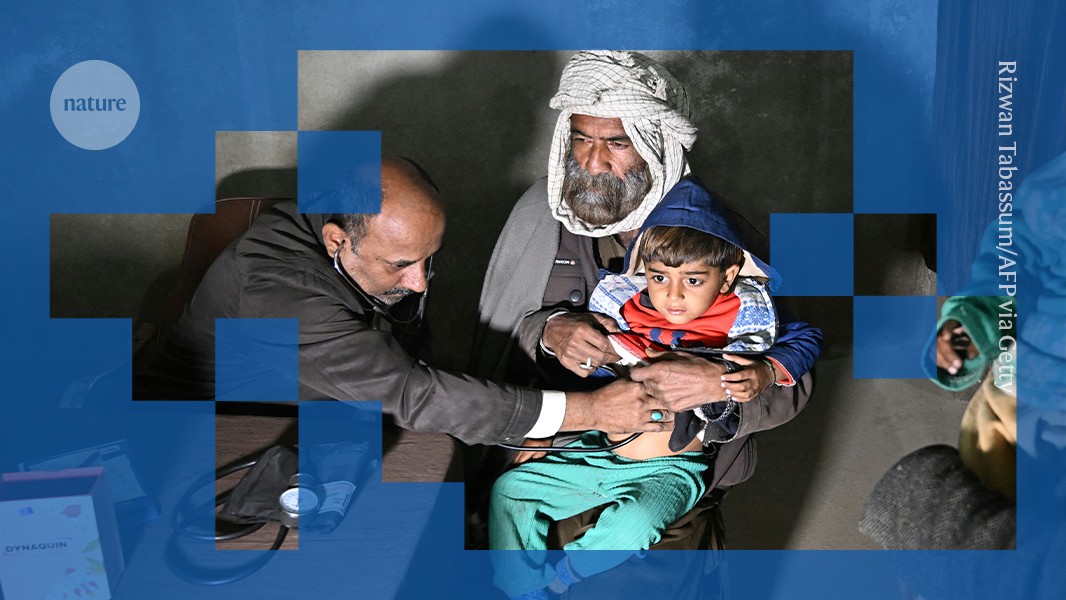
LLMs vastly improved physicians’ diagnostic accuracy.Credit score: Rizwan Tabassum/AFP by way of Getty
Giant language fashions (LLMs) can move postgraduate medical examinations and assist clinicians to make diagnoses, not less than in managed benchmarking assessments. However are they helpful in real-world settings, which have too few physicians to test the solutions, in addition to lengthy affected person lists and restricted assets?
Two research revealed in Nature Well being on 6 February counsel that they’re as much as the duty. The work reveals that cheap-to-use LLMs can increase diagnostic success charges, even outperforming educated clinicians, in health-care settings in Rwanda1 and Pakistan2.
In Rwanda, chatbot solutions outscored these of native clinicians throughout each metric assessed. And in Pakistan, physicians utilizing LLMs to assist their analysis achieved a imply diagnostic reasoning rating of 71%, versus 43% for these utilizing standard assets.
“The papers highlight how LLMs might be able to support clinicians in lower- and middle-income countries to improve the level of care,” says Caroline Inexperienced, director of analysis on the Institute for Ethics in AI on the College of Oxford, UK.
Actual-world complexity
Within the Rwanda examine, researchers examined whether or not LLMs may give correct scientific info to sufferers in low-resource well being programs throughout 4 districts. A typical drawback there’s that there are too few docs and nurses to see all sufferers, so most individuals are seen and triaged by neighborhood staff with little coaching, says examine co-author Bilal Mateen, the London-based chief AI officer at PATH, a world non-profit group that’s devoted to well being fairness.
Mateen’s workforce requested about 100 neighborhood well being staff to compile an inventory of greater than 5,600 scientific questions they have a tendency to obtain from sufferers.
The researchers in contrast the responses generated by 5 LLMs to roughly 500 of those questions towards solutions from educated native clinicians. Grading the responses on a 5-point scale revealed that each one the LLMs outperformed native clinicians throughout all 11 metrics, which included alignment with established medical consensus, understanding the query and the chance of the response resulting in hurt. The workforce additionally demonstrated that the LLMs may reply roughly 100 questions in Kinyarwanda, the nationwide language of Rwanda.
Medical AI can rework drugs — however provided that we rigorously monitor the information it touches
Mateen says that LLMs have one other benefit: that they’re out there for session by a neighborhood well being employee 24/7, which isn’t the case for physicians. LLMs have been additionally 500 instances cheaper per response — clinician-generated solutions value a mean of US$5.43 for docs and $3.80 for nurses, whereas LLM responses value $0.0035 in English and $0.0044 in Kinyarwanda.
This examine “suggests that commercial LLMs are able to give medically and culturally appropriate responses to common queries”, says Adam Rodman, a scientific and AI researcher at Beth Israel Deaconess Medical Heart in Boston, Massachusetts.
Nevertheless, Rodman stays sceptical about evaluating LLMs to human efficiency. This kind of analysis mechanism of written solutions is nice at measuring fashions, he says, however much less so human efficiency.
Diagnostic accuracy
In Pakistan, researchers led by Ihsan Qazi, a pc scientist on the Lahore College of Administration Sciences, discovered that LLMs can increase diagnostic accuracy in low-resource health-care settings2. There, says, Qazi, a paucity of medical specialists and large affected person masses trigger a excessive variety of diagnostic errors.
Qazi’s workforce performed a randomized managed trial wherein 58 licensed physicians obtained 20 hours of coaching in find out how to use LLMs to help with diagnosing sufferers’ signs and to be cautious of errors or hallucinations made by the packages.
Physicians who had entry to the GPT-4o LLM had considerably improved diagnostic accuracy rankings when reviewing scientific instances in contrast with these utilizing solely PubMed and Web searches. Physicians with entry to LLMs achieved a imply diagnostic reasoning rating of 71%, whereas these utilizing standard assets achieved 43%.

AI may assist docs and nurses see and triage extra sufferers in clinics with restricted assets.Credit score: Guerchom Ndebo/AFP by way of Getty
A secondary evaluation discovered that an LLM alone achieved higher scores than did physicians assisted by an LLM. Nevertheless, there have been exceptions. In 31% of instances, the physicians did higher than the median lone AI efficiency. “It turned out that these cases involved red flags, contextual factors, which the LLM seems to have missed,” says Qazi.
Qazi expects his outcomes to be relevant to different international locations, however says they should be replicated utilizing different chatbots. “This work opens up new avenues that can eventually lead to more safe and effective integration of AI and health care,” he says.
