



# How Bitcoin Payments Are Carving Out a New Kind of Commerce in American Main Street
**A quiet revolution is unfolding in towns and cities across America — not driven by speculators chasing quick gains, but by local business owners who decided to accept something other than dollars at the register.**
The story of Bitcoin merchant adoption has moved far beyond tech conferences and online forums. Today, it lives inside neighborhood shops, butcher counters, coffee houses, and breweries where real people make real decisions about how they receive payment for goods and services. What began as an experiment has, in many cases, become a permanent feature of how these businesses operate — and some are discovering that holding the digital currency opens doors that cashing out never could.
## The Moment Local Commerce Goes Bitcoin-First
Every merchant adoption story has a starting point. For many Indiana business owners, it began with a single customer — someone who walked through the door, placed an order, and paid in satoshis. At first, most owners simply ran those transactions through a conventional payment processor and converted everything to dollars immediately. It felt like the safest way to avoid volatility exposure.
But the pattern kept repeating. The same customers came back — week after week, month after month — and the transactions added up. A local Bitcoin community, sometimes formalized into a regional group, proved to merchants that there was a consistent, growing stream of demand for goods and services payable in Bitcoin. That consistency is what transformed curiosity into conviction.
## From Conversion to Holding: The Old Major Shift
One of the most compelling case studies in Midwest merchant adoption involves Old Major Market, a distributor of artisan meats based in Indianapolis. The company ships its products across 48 states and has built a loyal customer base that includes local Bitcoin enthusiasts.
For over a year, Old Major accepted Bitcoin payments but immediately liquidated every satoshi into cash. That changed in 2026 when owner Mark LaFay made a pivotal strategic decision: **keep 100% of the Bitcoin the company receives on its balance sheet.** The reasoning was straightforward — paying customers in Bitcoin was no longer a gimmick. It had become a meaningful revenue channel, and the market value of the digital assets being received was growing steadily. The risk of selling and regretting it outweighed the risk of holding.
“LaFay’s approach is a textbook example of how merchant adoption evolves,” says one local observer. “You start by accepting to build goodwill and attract a new customer segment. Once the numbers are clear, the logical next step is to hold.”
Today, Old Major markets itself as a destination for products like Maple Bourbon Bacon, drawing Bitcoin-paying customers who appreciate both the quality of the products and the alignment with open payment networks.
## The Business Math: Why 1% Can Change Everything
Skeptics often ask whether Bitcoin-accepting merchants are just chasing a tiny niche. The math suggests otherwise — and it’s surprisingly compelling.
Consider a local business generating **$1 million in annual revenue** with a standard **10% profit margin**. That translates to **$100,000 in net profit per year**. Now imagine that **just 1%** of customers — the Bitcoin-aware segment — begin paying in Bitcoin. That’s **$10,000 in annual transactions** the business receives in digital assets.
Here is where the calculus gets interesting. If the merchant sells the Bitcoin immediately, the outcome is neutral: profit stays at $100,000. But if the merchant chooses to hold the Bitcoin, and the asset appreciates over the course of a year, the financial impact compounds in the owner’s favor.
Assume Bitcoin doubles in value during that holding period. That $10,000 in Bitcoin payments effectively becomes $20,000 in real purchasing power — a **20% increase** in the owner’s net return. Even modest appreciation changes the equation dramatically.
This framework, sometimes called the **”1% Orange Pill Math,”** demonstrates that directional customer spending toward a receptive merchant is not symbolic. It is economically persuasive. It works whether the owner holds from day one or requires time to understand the incentives before making the leap.
**Key takeaway:** A small but committed community of customers, directing regular spending toward open-minded local businesses, can meaningfully shift a merchant’s financial picture — no matter the payment method they eventually choose to retain.
## Beyond the Butcher: A Network of Bitcoin-Aware Businesses
Old Major is an example, not an island. Across Indianapolis and surrounding areas, a growing network of businesses spans multiple industries:
### Coffee and Cafés
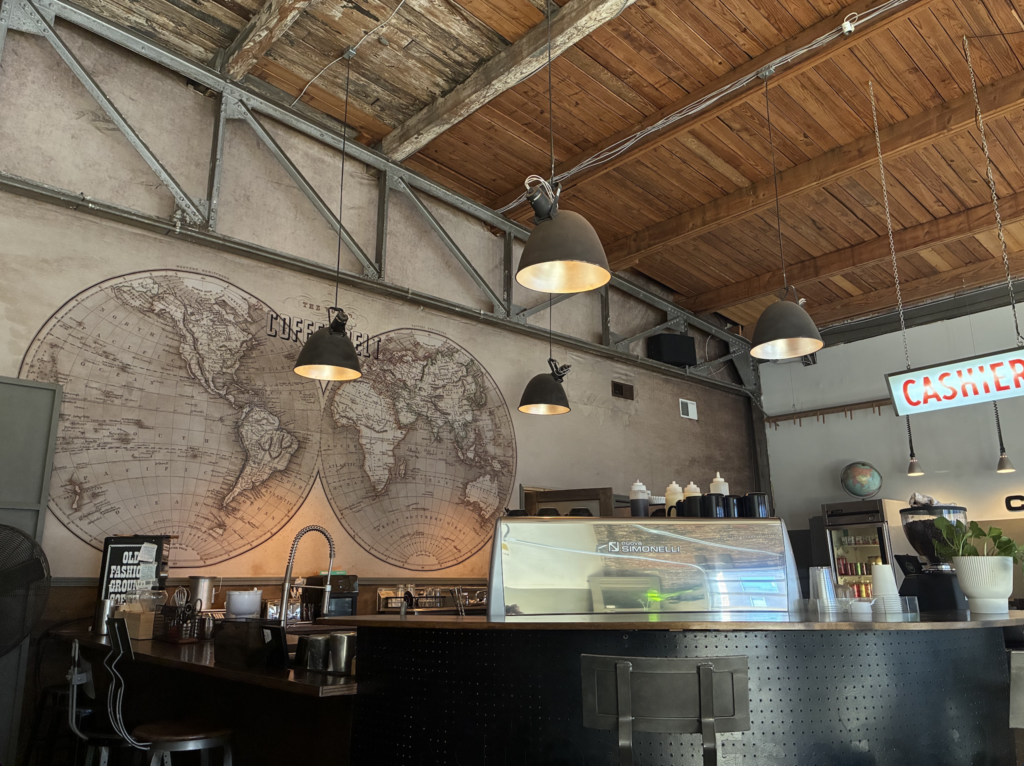
Third-wave coffee shops have historically served as natural gathering places for communities. Kaffeine Coffee Co., located on Fulton Street in downtown Indianapolis, is one such point of convergence — a place where craft coffee culture and Bitcoin-native payment rails overlap. The shop has become a recurring meeting spot where Bitcoiners gather, connect, and introduce newcomers to local adoption networks.
### Wineries and Taprooms
The Rejoicing Vine, a mission-driven winery in northwest Indianapolis specializing in sparkling wines, opened its doors to Bitcoin payments over a year ago through a standard point-of-sale processor. Owner Brent Kumfer saw the result immediately: **zero processing fees** compared to traditional card networks and a steady stream of events hosted by local Bitcoin meetup groups. The winery is not yet holding its Bitcoin, but it is actively considering the shift — a sign of how quickly the conversation evolves once business owners see the fee savings and community benefits.
### Retail and Everyday Commerce
The range of Bitcoin-accepting merchants extends far beyond specialty shops. Independent bookstores, thrift shops, tattoo studios, automotive repair shops, bakeries, grocery stores, farm stands, home service contractors, and even large multi-location restaurant chains have all begun accepting Bitcoin alongside traditional payment methods. This organic spread across categories shows that adoption is not confined to any single demographic or industry.
## How Community Drives Adoption
The most successful merchant adoption stories share a common thread: **community involvement.** Regional Bitcoin groups — sometimes operating under specific local names, other times simply organized around geography — play a critical role in connecting interested customers with willing merchants. These groups organize social events, Lightning Network meetups, and casual gatherings at participating businesses.
This creates a virtuous cycle: customers visit stores that accept Bitcoin → shop owners observe consistent Bitcoin-paying traffic → owners become more comfortable with the idea of holding → merchants become advocates who tell other business owners about their experience.
The coffee shop counter is often where the real education happens. A local Bitcoiner paying for a latte in satoshis becomes an ambassador for the network in that moment. No whitepaper needed. No pitch deck required. Just a simple transaction that answers the unspoken question: *Can ordinary people actually use Bitcoin to buy ordinary things?*
## Frequently Asked Questions (FAQ)
**Q: What makes Bitcoin different from using a credit card for merchants?**
A: Credit card transactions typically carry processing fees between 1.5% and 3.5% per sale, plus settlement delays of one to three days. Bitcoin transactions — especially those routed over the Lightning Network — can settle almost instantly and carry minimal or zero fees, helping merchants keep more of their revenue.
**Q: Is it risky for a business to hold Bitcoin instead of converting it immediately?**
A: Holding any asset introduces price risk. However, many business owners calculate that the macroeconomic value trend of Bitcoin, combined with the benefit of receiving revenue in an appreciating asset, outweighs short-term volatility. Owners who hold should understand their risk tolerance and have a strategy in place.
**Q: How do customers pay in Bitcoin at participating stores?**
A: Most merchants use a point-of-sale app or QR-code-based system that generates a payment request. Customers scan the code with their Bitcoin wallet, enter the amount, and confirm the transaction. Lightning Network payments tend to be near-instant, while on-chain transactions may take a few minutes depending on network conditions.
**Q: What is the Lightning Network and why does it matter for everyday payments?**
A: The Lightning Network is a second-layer technology built on top of Bitcoin that enables extremely fast and low-cost transactions. It makes Bitcoin viable for everyday purchases — coffee, groceries, dinners — by eliminating the delays and high fees associated with sending Bitcoin directly on the base blockchain.
**Q: Do customers have to be wealthy to pay in Bitcoin?**
A: Not at all. Bitcoin is divisible down to eight decimal places (the smallest unit is called a satoshi, or “sat”). Customers can buy a cup of coffee, a pack of sausages, or a loaf of bread using fractions of a dollar worth of Bitcoin. The barrier to entry is the same as any other payment method — a wallet app and some basic knowledge.
**Q: How can a merchant start accepting Bitcoin?**
A: Many merchants begin by signing up for a payment processor that supports Bitcoin (and often Lightning) and integrating it with their existing point-of-sale system. Others use standalone QR-code solutions for simpler setups. The process is comparable in complexity to accepting mobile wallet payments like Apple Pay or Google Pay.
**Q: What kind of business owner is most likely to start holding Bitcoin?**
A: Business owners who have a long-term view of their cash flows, an understanding of inflationary monetary policy, or simply customers who regularly request the option tend to be most receptive. Often, hearing about another local business successfully holding Bitcoin — and seeing the results — is what tips the decision.
## Conclusion
The story of Bitcoin adoption at the local level is not about price charts, trading strategies, or hype cycles. It is about the quiet accumulation of small, everyday transactions between willing buyers and open-minded sellers. Each SAT paid at a butcher counter, each Lightning invoice settled at a coffee shop, and each bottle of sparkling wine purchased with digital money represents a vote for an alternative financial infrastructure — one that touches real businesses and real communities.
Merchants like Old Major Market are proving that Bitcoin acceptance is not a one-time marketing stunt. When supported by a consistent community of customers and backed by straightforward math, it becomes a legitimate business strategy — one that can improve margins, attract loyal customers, and position a business at the forefront of the ongoing evolution of commerce.
The question is no longer whether Bitcoin can work as a payment method. Local businesses across the country have already answered that. The question now is how far this trend will travel next — and which Main Street will be next to discover it.
Thank you for reading
