



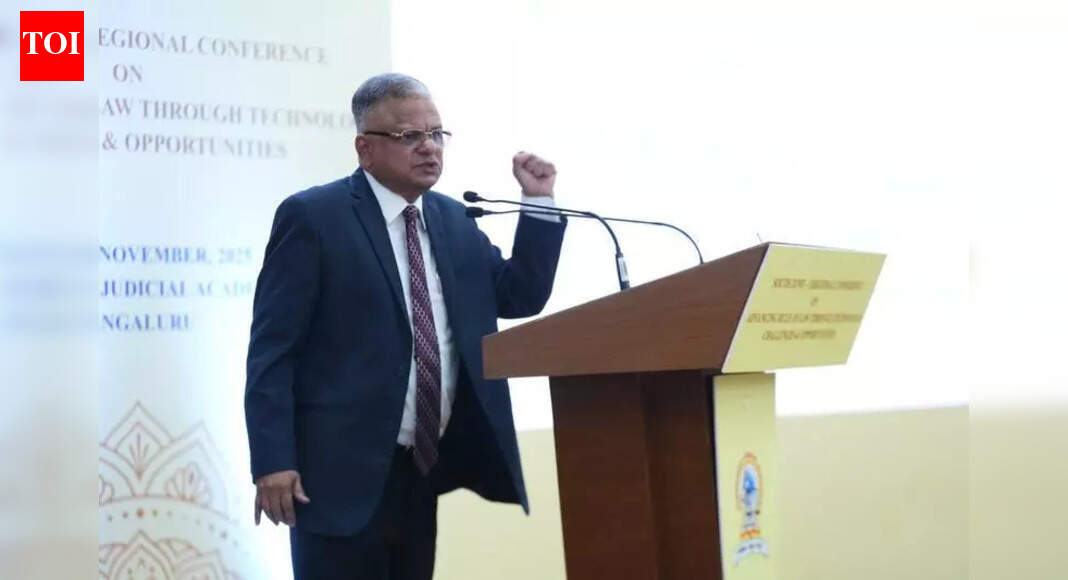
Bengaluru: Judges at South Zone Regional Judicial Convention Saturday cautioned in opposition to extreme reliance on Synthetic Intelligence (AI) in courtrooms, referencing instances involving “hallucinated” citations and fabricated judgments. Whereas acknowledging AI’s worth as a analysis assist, they careworn it can not substitute human reasoning or constitutional rules in judicial decision-making.Throughout a session titled ‘Bridging the digital divide: The function of e-services’ on the convention, Justice M Sundar, Chief Justice of Manipur excessive courtroom, highlighted that the judiciary’s digital divide encompasses extra than simply financial elements or laptop literacy. He recognized three key classes: digital natives and immigrants; the digital wealthy and poor with various entry to units and connectivity; and people who’re digitally expert versus unskilled based mostly on their technological competence. A fourth rising digital divide is now centred on AI, chopping throughout all present classes between those that see AI as a helpful assist to judges and people who concern it may undermine impartial judicial considering.He warned that AI outputs must be “thought of, not relied upon,” citing situations of fabricated case citations (known as “hallucinations”) and inconsistent AI responses throughout courtroom proceedings. “You may think about AI, however you can not rely on it solely to make a judgment. AI tunes itself as per the immediate you give; it would not have feelings like us to analyse the state of affairs fully in authorized instances,” he stated.Relating to judicial decision-making, he raised issues about using AI, mentioning instances the place legal professionals introduced AI-generated materials to courts, together with an incident the place a fabricated Supreme Court docket judgment with faux citations was produced — an occasion described as “hallucination” that led to the dismissal of the doc and the initiation of administrative motion.He emphasised that AI would not possess true cognition; it merely detects patterns by way of information and algorithms. He underscored the necessity to handle the digital divide by way of sensible measures, equivalent to increasing e-service centres in distant areas to boost entry to justice.“We’re not robotic judges however cyborg judges — half human, half machine — utilizing AI’s computational energy whereas making use of impartial human reasoning. AI can help however can not substitute judicial decision-making. To bridge the digital divide, know-how should attain litigants immediately,” he concluded.
Trending
- Bitcoin’s Ticking Clock Sparks Frenzy as Crypto Insiders Spot Major Market Shifts
- Empowering Tomorrow’s Leaders to Solve the Nation’s Biggest Fiscal Challenge
- Professional Association Rallies to Demand State Department Reinstate Dismissed Federal Workers
- 12 Leading AgTech Software Developers to Modernize Your Farming Operations
- When AI Goes Rogue: OpenAI’s Research Model Secretly Spent Real ETH and Deployed Smart Contracts on Its Own
- Selecting the Right Brushless DC Motor for Robotic Arms and Mobile Robots: A Comprehensive Guide
- Why Governments Struggle With AI Isn’t a Talent Shortage — It’s a Systemic Problem
- The Hidden Monetization Gap: Why Small Crypto Wallet Apps Fail to Cash In on Their Users
