



# NVIDIA Unveils Isaac ROS 5.0 to Streamline Robotics Development with AI Agents
**A major update to the GPU-accelerated robotics software suite introduces agentic development tools, broader platform compatibility, and production-ready workflows designed to reduce the friction of building and deploying robotic systems.**
NVIDIA has launched the fifth major iteration of its Isaac ROS software collection, a set of GPU-accelerated packages rooted in the Robot Operating System (ROS) open-source framework. The announcement came during the ROSCon conference held in Toronto, where NVIDIA showcased how the new release aims to accelerate every stage of the robotics development lifecycle — from initial prototyping through to real-world deployment.
## A Focus on Reducing Development Friction
The robotics industry has long struggled with fragmented tooling, complex integration pipelines, and steep learning curves that slow down innovation. Isaac ROS 5.0 directly addresses these challenges by bundling computing infrastructure, physical AI models, and pre-built libraries into a unified open-source ecosystem. With nearly 1.3 million ROS developers worldwide as its target audience, the release is designed to lower barriers without sacrificing performance.
“We wanted to dig into the community’s pain points and find where we could genuinely help developers spend less time wrestling with plumbing and more time building actual applications,” a NVIDIA product marketing lead for robotics simulation explained. The team collaborated closely with the ROS community and the Open Source Robotics Association to identify the most impactful areas for improvement.
## AI Agents Enter the Robotics Workflow
One of the headline features of Isaac ROS 5.0 is the introduction of agentic development workflows. AI agents are increasingly being used to automate repetitive coding tasks, navigate large codebases, and accelerate the transition from concept to working software. NVIDIA has extended these capabilities into robotics development by enabling agents to handle environment setup, script generation, and model fine-tuning — tasks that traditionally require significant manual effort.
Developers can now deploy AI agents that take responsibility for boilerplate configuration work, leaving human engineers free to focus on higher-level design and optimization decisions.
## Expanded Platform Support and CUDA Acceleration
Isaac ROS 5.0 now offers official support for ROS 2 Lyrical and Ubuntu 24.04, giving development teams a clearer migration path to the latest ROS platform while retaining access to NVIDIA’s accelerated computing capabilities. As part of this update, NVIDIA contributed a standardized data-handling interface to ROS 2 Lyrical that ensures robotics software runs efficiently across a variety of hardware architectures, including GPUs. CUDA-based acceleration is available as a reference implementation, and the contribution is open to the broader ROS community.
For teams already working within the ROS ecosystem, the transition to GPU-accelerated workflows is designed to be seamless. Existing nodes can be upgraded to leverage Isaac ROS 5.0 features without requiring a full rearchitecture or reconfiguration of the development stack.
## New Skills for Setup, Manipulation, and Perception
The release introduces a family of NVIDIA Isaac Skills — reusable, modular workflows that both human developers and AI agents can deploy to accomplish common robotics tasks. These skills span setup automation, object manipulation, and perception pipelines.
A notable addition is the FoundationStereo fine-tuning skill, which allows an AI agent to adapt a stereo vision model to a developer’s specific camera hardware, operating environment, and application requirements. This is particularly valuable for teams deploying perception systems in new or variable environments.
In the area of object tracking and pose estimation, FoundationPose — NVIDIA’s foundation model for determining an object’s position and orientation — now ships with an agent-ready inference library. NVIDIA reports that this update enables robots to perceive and track objects up to 5.5 times faster than before.
Additionally, NVIDIA has packaged its pick-and-place perception workflow — which combines object detection, depth estimation, and pose estimation into a single pipeline — as a standalone, agent-ready skill. This gives developers the flexibility to integrate the workflow into projects outside of the full Isaac ROS suite.
## Broad Industry Adoption
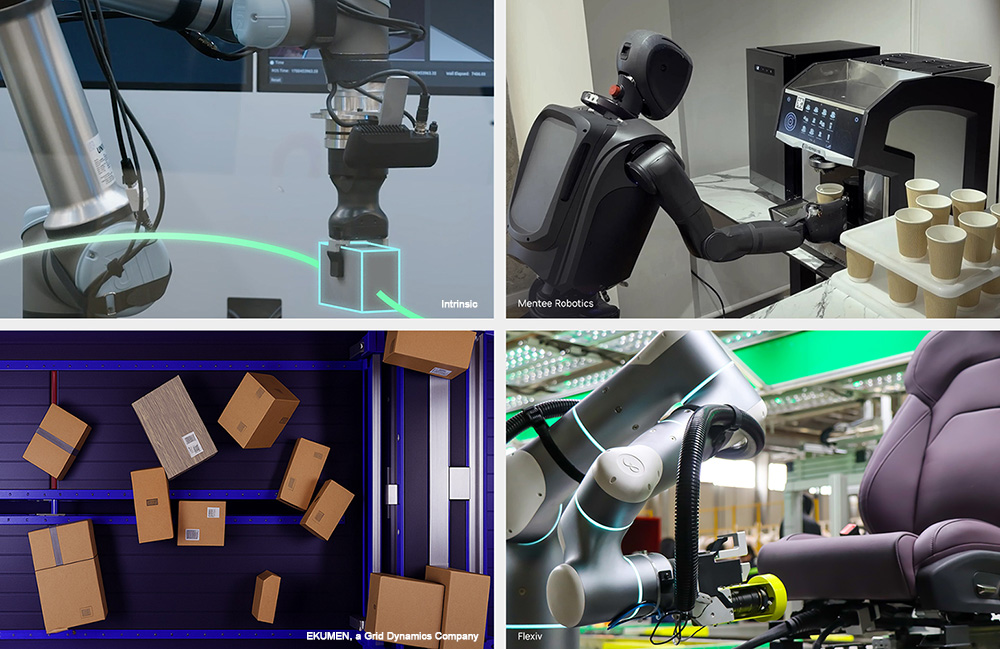
Isaac ROS 5.0 is already in use across a range of organizations, including Intrinsic, Mentee Robotics, EKUMEN, and Flexiv. Intrinsic, in particular, is leveraging NVIDIA FoundationPose for out-of-the-box object registration, tracking, and pose estimation in its robotic systems.
NVIDIA emphasized that it is not targeting any single industry or robot form factor with this release. While manufacturing remains a prominent use case within the robotics ecosystem, the company designed Isaac ROS 5.0 to be flexible enough for a wide variety of applications and development contexts.
## Commitment to Open Source
NVIDIA reiterated its commitment to open-source development as a cornerstone of its robotics strategy. By making models, frameworks, and libraries freely available, the company aims to tap into the collective creativity of the global developer community to push the boundaries of what robotic systems can achieve.
“Open source is the vehicle for bringing this technology to scale. The complexity of building capable robots means no single company can solve everything on its own,” the NVIDIA representative noted. “When you put powerful tools in the hands of the community, the pace of innovation accelerates dramatically.”
—
## Frequently Asked Questions (FAQ)
**What is Isaac ROS?**
Isaac ROS is a collection of GPU-accelerated software packages built on the Robot Operating System (ROS) framework, developed by NVIDIA. It provides developers with computing infrastructure, physical AI models, and production-ready libraries for building high-performance robotics applications.
**What is new in Isaac ROS 5.0?**
The 5.0 release introduces AI agent workflows for automating development tasks, support for ROS 2 Lyrical and Ubuntu 24.04, new Isaac Skills for setup and manipulation, a FoundationStereo fine-tuning capability, a faster FoundationPose inference library, and a standalone pick-and-place perception skill.
**Who is using Isaac ROS 5.0?**
Early adopters include companies such as Intrinsic, Mentee Robotics, EKUMEN, and Flexiv. These organizations are using the suite for tasks ranging from object tracking to hardware-in-the-loop testing.
**What are AI agents in the context of robotics development?**
AI agents are software systems capable of autonomously performing development tasks such as writing configuration scripts, setting up development environments, fine-tuning perception models, and assembling common robotics workflows. In Isaac ROS 5.0, these agents assist developers in reducing repetitive manual work.
**Is Isaac ROS 5.0 free to use?**
Yes. Isaac ROS is built on open-source tools and is available at no cost, aligning with NVIDIA’s strategy of fostering a broad developer ecosystem.
**Does Isaac ROS 5.0 work with older ROS versions?**
While Isaac ROS 5.0 adds official support for ROS 2 Lyrical, it is designed to be compatible with existing ROS nodes and workflows, allowing teams to adopt new features incrementally.
**What industries benefit most from Isaac ROS 5.0?**
Manufacturing is a key focus area, but the release is designed to be industry-agnostic and applicable to any robotics domain, from logistics and agriculture to healthcare and consumer robotics.
—
## Conclusion
Isaac ROS 5.0 represents a significant step forward in making robotics development more accessible, efficient, and scalable. By weaving AI agent capabilities directly into the development workflow, expanding platform compatibility, and offering modular, reusable skills for common tasks, NVIDIA is equipping developers with tools that reduce the time and complexity involved in building robotic systems. The emphasis on open-source collaboration and community-driven innovation positions Isaac ROS to play an increasingly central role in the evolution of physical AI and robotics across industries. As the ecosystem of ROS users continues to grow, releases like this one highlight how shared infrastructure and open frameworks can accelerate progress for everyone involved.
Thank you for reading
