



**Is Crypto Funding India’s Cockroach Janta Party Protests? We Traced the Money**
A public petition has alleged that foreign-funded groups helped drive India’s Cockroach Janta Party protests. A BeInCrypto audit found no public evidence of a broad crypto-funding wave during the movement’s July escalation.
### Key Findings at a Glance
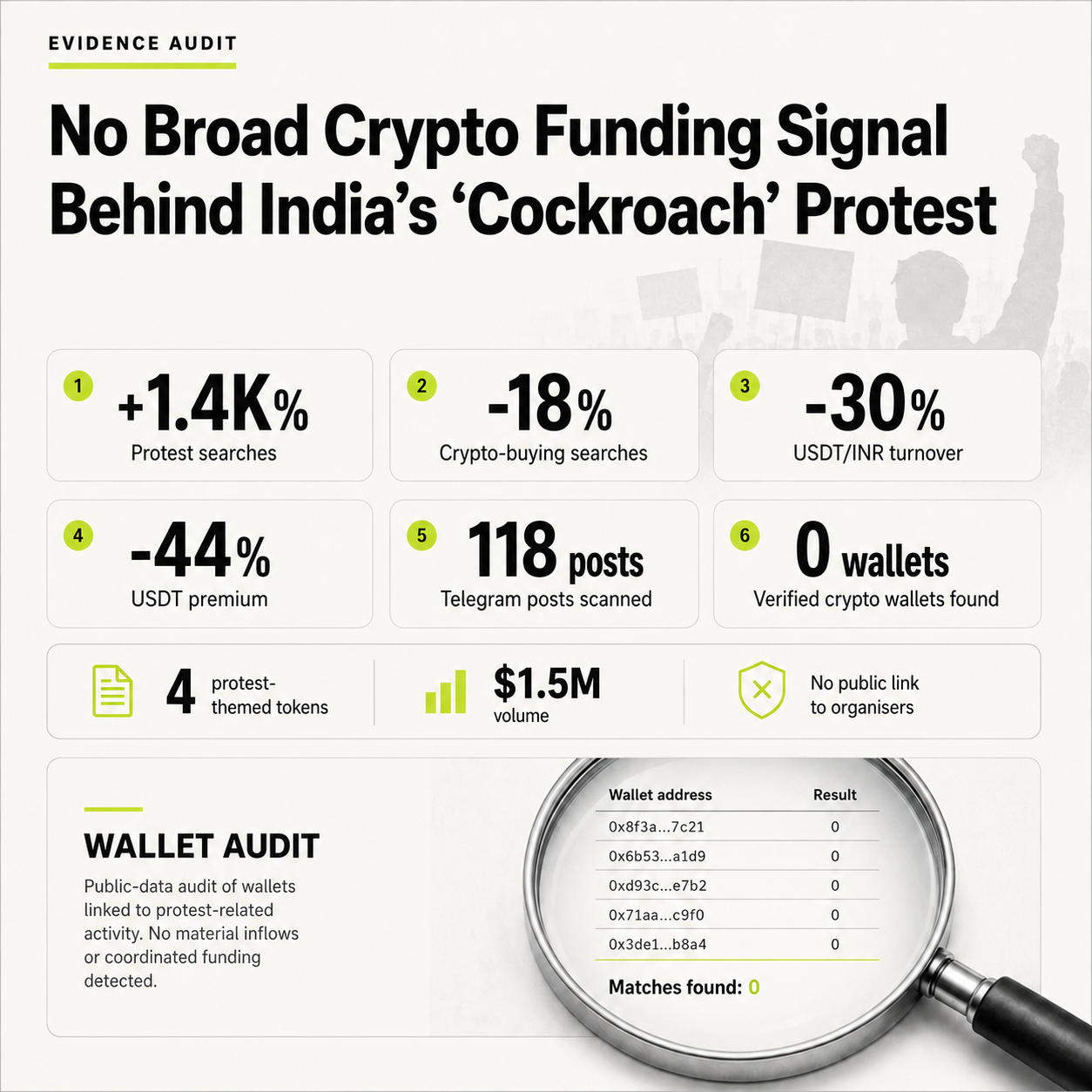
– **Crypto demand fell as protest attention surged**: Search interest for protests rose ~1,350%, while crypto-buying searches fell ~18%.
– **Exchange turnover dropped**: Estimated USDT/INR turnover fell ~30%; Bitcoin and Ethereum turnover dropped ~23%.
– **USDT premium narrowed by ~44%**, indicating reduced dollar-linked crypto demand.
– **Copycat tokens were the clearest crypto activity**: Four protest-themed Solana tokens generated ~$1.48M in decentralized exchange volume, but no public link to organizers was found.
– **No organiser wallet appeared in public trails**: Extensive on-chain and social audits found no verified crypto wallets tied to protest organizers.
—
### Claims of Foreign Extremist Groups Funding Indian Protests
A public interest petition filed before the Delhi High Court on July 22 requested a National Investigation Agency probe into alleged foreign funding behind the July 20 march on Parliament. The court agreed to hear the plea on July 24, though the allegations remain unproven and the court has not endorsed them.
Funding rumors spread online, including a forged letter presented as evidence of Bangladesh’s Jamaat-e-Islami’s involvement—later debunked by Alt News. The Cockroach Janta Party began as an online satire movement in May after India’s chief justice compared some unemployed young people and activists to “cockroaches.” It quickly evolved into a national protest channel focused on exam paper leaks, unemployment, and government accountability.
—
### How BeInCrypto Investigation Tested the Claim
BeInCrypto tested public data from May 15 to July 22, comparing a baseline period with the Sonam Wangchuk hunger strike and the five-day escalation that followed. The study examined Google Trends, exchange turnover, wallet labels, Telegram channels, and Solana token activity.
Every causal route was tested against expected signals, but no clear financial link to protest organizers emerged.
—
### Crypto Demand Fell as Protest Attention Surged
Google Trends revealed a sharp divergence: protest searches surged by about 1,350% across India (over 2,000% in Delhi), while searches related to buying crypto, USDT, and wallets fell by about 18% nationally and 19% in Delhi.
Haryana showed a slight exception with a ~48% rise in crypto-action search volume from a small baseline—an open lead, but not evidence of transactions or protest financing.
Exchange data also weakened. Combined estimated USDT/INR turnover on CoinDCX and WazirX fell about 30% below baseline. Combined Bitcoin and Ethereum turnover dropped about 23%. The USDT premium narrowed by about 44%, contradicting the expectation of a sudden rush for dollar-linked crypto.
—
### No Organiser Wallet Appeared in the Public Trail
The on-chain review covered USDT and USDC transfers touching 637 publicly labelled CoinDCX and WazirX addresses. Average daily stablecoin inflows to the labelled CoinDCX subset fell about 20%, and no matching transfer legs were found for WazirX labels.
These results have a large blind spot: public labels cover only a small share of exchange infrastructure. They cannot see private P2P trades, OTC desks, unlabelled wallets, or crypto held before the protest.
Labelled global exchange wallets also showed no surge. Stablecoin inflows into public Binance, Coinbase, Bybit, and KuCoin clusters fell between 20% and 52% from baseline.
A social audit of 118 publicly accessible Telegram posts from movement-linked channels found no crypto addresses or payment wallets. Organizers used a missed-call number for mobilization, and while one unrelated account posted a UPI payment handle “for Jantar Mantar,” neither established a financial link to the organizers.
—
### Copycat Tokens Were the Clearest Crypto Activity
Four protest-branded Solana tokens traded during the research period. The largest, named after the Cockroach Janta Party, recorded about $1.39 million in volume across 24,635 trades involving 4,126 traders. Its supply was highly concentrated: the largest holder controlled about 80%, and the top 10 controlled almost the entire supply. Three Wangchuk- or protest-themed tokens added roughly $91,700 in trading volume.
The pattern suggests traders are monetizing attention around the protests rather than fundraising. Organizers have not acknowledged the tokens, and no traced proceeds reached a verified protest wallet.
—
### What the Public Evidence Supports
The movement’s visible support system was more conventional. AP and India Today documented supporters ordering food and water through delivery apps, while organizers said many participants paid their own travel costs.
The public evidence supports a limited conclusion: there was no broad, visible protest-linked crypto funding wave between May 15 and July 22. The data also provides no public support for claims of foreign or China-linked crypto payments.
A private route could still exist outside the tested data. Proving it would require a verified recipient wallet, exchange customer records, bank records, or financial-intelligence reports—none of which have appeared publicly.
—
### FAQ
**Q: Did the BeInCrypto audit find evidence of crypto funding for the Cockroach Janta Party protests?**
A: No. The audit found no public evidence of a broad crypto-funding wave during the movement’s July escalation.
**Q: What happened to crypto-buying searches during the protest escalation?**
A: Crypto-buying searches fell by about 18% nationally and 19% in Delhi.
**Q: Were any protest-themed crypto tokens discovered?**
A: Yes, four protest-branded Solana tokens were found, with the largest generating about $1.48 million in decentralized exchange volume. However, no public connection to protest organizers was established.
**Q: Did protest organizers receive direct crypto donations?**
A: No. Social audits found no crypto addresses or payment wallets linked to the movement’s organizers.
**Q: What does the Delhi High Court case allege?**
A: A public interest petition requested an NIA probe into alleged foreign funding behind the July 20 march on Parliament. The court agreed to hear the plea, but the allegations remain unproven.
—
### Conclusion
The BeInCrypto investigation found no public evidence that foreign-funded groups or crypto channels played a role in driving India’s Cockroach Janta Party protests. While protest attention surged, crypto demand fell, exchange turnover dropped, and no organizer wallet surfaced in public trails. The clearest crypto activity came from copycat tokens that monetized attention rather than funded the movement. Based on available data, the allegations of foreign crypto funding remain unsubstantiated.
