



# Iridium Launches Hybrid IoT Module Combining Satellite, LTE-M, and GNSS in a Single Compact Unit
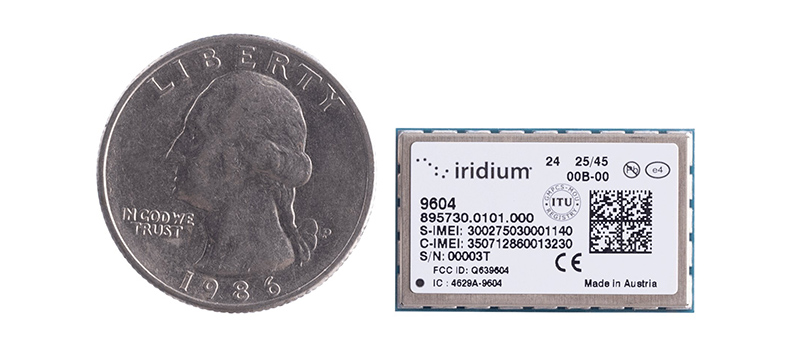
A new commercially available IoT module from Iridium is designed to simplify connectivity for devices that must operate across both terrestrial and remote environments. The Iridium 9604 module integrates Iridium Short Burst Data satellite connectivity, LTE-M cellular communications, and multi-constellation GNSS positioning into a single pre-integrated hardware platform, targeting OEMs and developers building connected devices for mixed network conditions.
## Solving the Coverage Transition Problem
For many IoT deployments, the core challenge is not maintaining connectivity when coverage exists, but managing what happens when coverage changes. Assets that move between cellular and non-cellular regions, or devices that cannot accommodate multiple separate radios and antennas without adding significant cost and engineering complexity, face persistent design hurdles. The Iridium 9604 module and its accompanying development kit are intended to address those challenges by replacing three discrete components — satellite communications, LTE-M, and GNSS — with a single module.
According to Iridium, this integrated approach can reduce board space requirements by 60 percent or more while simplifying RF routing, power architecture, and firmware development. The module is built on the u-blox SARA-R5 platform, measures 16 mm x 26 mm x 2.4 mm, and supports LTE-M Cat-M1, Iridium’s L-band satellite network, and GNSS services including GPS, GLONASS, Galileo, and BeiDou.
## Independent Control Enables Flexible Failover
The key architectural distinction of the 9604 is that it allows developers to manage the satellite, LTE-M, and GNSS subsystems independently. This separation enables the implementation of custom failover logic, location-aware connectivity decisions, and application-specific routing strategies. Rather than forcing a single connectivity behavior on every device design, the module gives OEMs the ability to define how and when each communication mode is used.
In practice, this means different applications — such as asset tracking devices, remote sensors, or maritime monitoring units — can all use the same module but make different choices about when to transmit over LTE-M, when to use satellite messaging, and how frequently to acquire a location fix. The flexibility reflects the reality that satellite capacity, cellular airtime, battery consumption, and reporting latency are not interchangeable design variables.
## A Shift Toward Multi-Mode Satellite IoT
The module also represents a broader evolution in satellite IoT hardware. While dedicated satellite-only devices remain relevant for remote and mission-critical applications, many industrial and logistics deployments now require continuity across mixed network environments rather than reliance on a single access technology. The 9604 sits within Iridium’s broader IoT portfolio alongside SBD modules, standards-based Iridium NTN Direct capabilities, and larger-payload connectivity through the Iridium Certus 9704 module, but is specifically targeted at compact, multi-mode IoT devices where small payloads, location awareness, and coverage resilience are central requirements.
The commercial availability of the module and development kit could shorten early engineering cycles by reducing the need to combine discrete cellular, GNSS, and satellite components at the board level. It may also simplify solution design in sectors such as transportation, utilities, infrastructure, maritime, and remote monitoring, where assets frequently cross between terrestrial and non-terrestrial coverage zones.
## Not a Complete Integration Solution
The announcement does not eliminate the need for integration work in hybrid IoT. Careful decisions remain necessary around antenna design, power budgets, firmware behavior, data prioritization, and commercial service models. However, by offering the 9604 and its development kit as commercially available products, Iridium is providing the IoT ecosystem a more packaged route into hybrid satellite-cellular design, particularly for devices where global coverage is required but board area and engineering resources are limited.
In a market where many satellite IoT announcements focus on future network capabilities or standards evolution, the 9604 stands apart as a module-level product aimed at near-term device development. Its significance lies in how it packages satellite, cellular, and GNSS functions for OEM implementation.
*Source: [Iridium Brings Hybrid Satellite, LTE-M and GNSS IoT Module to Commercial Availability – IoT Business News](https://iotbusinessnews.com/WordPress/wp-content/uploads/2026/02/Iridium-9604-IoT-module.jpg)*
