



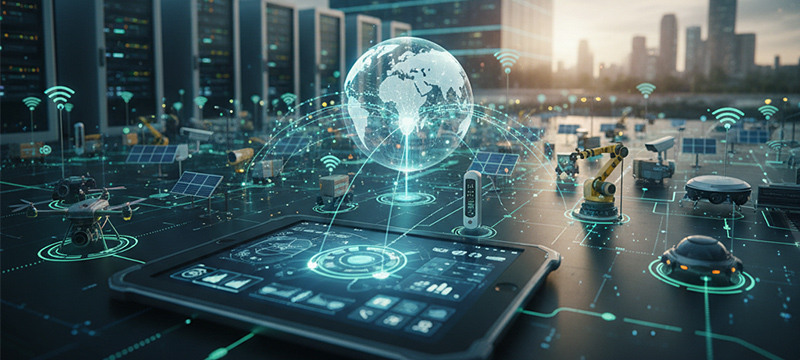
Managing linked gadgets at scale has develop into one of the crucial advanced challenges within the Web of Issues ecosystem. As deployments transfer from pilot tasks to 1000’s or thousands and thousands of endpoints, organizations should make sure that gadgets are securely provisioned, repeatedly monitored, and effectively maintained all through their operational life. That is the place IoT Machine Administration performs a central function.
Far past easy machine onboarding, IoT Machine Administration encompasses a full lifecycle method — from preliminary configuration and authentication to firmware updates, diagnostics, and decommissioning. For enterprises, the flexibility to manage distributed fleets of gadgets reliably is not only a technical requirement, however a vital consider making certain operational continuity, safety, and long-term return on funding.
Key Takeaways
- IoT Machine Administration permits safe provisioning, monitoring, and lifecycle management of linked gadgets at scale.
- It depends on a mix of cloud platforms, communication protocols, and embedded machine capabilities.
- Efficient machine administration is crucial for safety, reliability, and operational effectivity in IoT deployments.
- Challenges embody scalability, interoperability, energy constraints, and long-term upkeep.
- The ecosystem entails {hardware} distributors, connectivity suppliers, and cloud platform operators.
What’s IoT Machine Administration: Provisioning, Monitoring and Lifecycle Management?
IoT Machine Administration refers back to the set of processes and applied sciences used to provision, configure, monitor, preserve, and in the end retire linked gadgets all through their lifecycle. It supplies centralized management over distributed IoT belongings, making certain that gadgets function securely and effectively from deployment to decommissioning.
Throughout the broader IoT structure, IoT Machine Administration acts because the operational spine connecting bodily gadgets to cloud companies. It permits organizations to handle machine identification, implement safety insurance policies, acquire telemetry information, and deploy updates remotely. With out sturdy IoT Machine Administration, large-scale deployments develop into tough to keep up and weak to failures or safety breaches.
How IoT Machine Administration works
IoT Machine Administration methods sometimes depend on a layered structure that connects gadgets, networks, and cloud-based administration platforms. On the machine degree, embedded software program brokers allow communication with administration companies. These brokers deal with duties corresponding to authentication, telemetry reporting, and command execution.
Units talk with backend platforms utilizing light-weight protocols optimized for constrained environments. Information flows from gadgets to the cloud, the place it’s processed and visualized, whereas management instructions and updates are despatched again to gadgets.
Core useful elements embody:
- Provisioning: Safe onboarding of gadgets, together with identification project, credential injection, and preliminary configuration.
- Configuration administration: Distant adjustment of machine parameters and settings.
- Monitoring: Steady assortment of telemetry information corresponding to efficiency metrics, connectivity standing, and environmental information.
- Firmware and software program updates: Over-the-air (OTA) updates to repair bugs, patch vulnerabilities, or add options.
- Diagnostics and troubleshooting: Distant entry to logs and system states for difficulty decision.
- Decommissioning: Safe elimination of gadgets from the community and revocation of credentials.
Cloud platforms act because the management layer, offering dashboards, APIs, and automation instruments. Integration with enterprise methods permits machine information to feed into analytics, operations, and enterprise workflows.
Key applied sciences and requirements
IoT Machine Administration depends on a spread of applied sciences spanning connectivity, safety, and information change protocols. These applied sciences are designed to function effectively throughout numerous environments, from low-power sensors to industrial machines.
- Communication protocols: MQTT, CoAP, HTTP/HTTPS for device-to-cloud messaging.
- Machine administration requirements: LwM2M (Light-weight M2M), TR-069/TR-369 for distant administration.
- Safety frameworks: TLS/DTLS encryption, X.509 certificates, safe parts, and {hardware} root of belief.
- Connectivity applied sciences: Mobile IoT (LTE-M, NB-IoT), LPWAN (LoRaWAN), Wi-Fi, Ethernet, satellite tv for pc IoT.
- OTA replace mechanisms: Delta updates, safe boot, and rollback capabilities.
- Cloud integration: APIs and machine twins for synchronization between bodily gadgets and digital representations.
Interoperability stays a problem, as completely different distributors implement proprietary extensions or variations of those requirements. Efforts towards standardization intention to scale back fragmentation and simplify integration throughout heterogeneous environments.
Major IoT use instances
IoT Machine Administration is vital throughout a number of industries the place massive fleets of gadgets have to be deployed and maintained remotely.
Industrial IoT (IIoT): Manufacturing amenities use IoT Machine Administration to observe equipment, deploy predictive upkeep updates, and guarantee operational continuity throughout manufacturing traces.
Logistics and asset monitoring: Fleet operators handle monitoring gadgets put in on automobiles and shipments, making certain connectivity, location reporting, and battery optimization.
Good cities: Municipal deployments corresponding to good lighting, site visitors administration methods, and environmental sensors require centralized management and monitoring.
Power and utilities: Good meters and grid infrastructure depend on IoT Machine Administration for distant configuration, firmware updates, and consumption information assortment.
Healthcare: Related medical gadgets and distant monitoring methods require strict lifecycle management to fulfill regulatory and safety necessities.
Retail and good buildings: Units corresponding to digital signage, HVAC methods, and occupancy sensors are managed remotely to optimize operations and vitality utilization.
Advantages and limitations
IoT Machine Administration delivers vital operational and strategic advantages, but in addition introduces technical and organizational challenges.
Advantages:
- Centralized management over distributed machine fleets
- Improved safety by steady updates and credential administration
- Lowered operational prices through distant diagnostics and upkeep
- Enhanced scalability for big deployments
- Quicker innovation cycles by distant characteristic updates
Limitations:
- Scalability challenges as machine volumes enhance
- Interoperability points throughout heterogeneous {hardware} and platforms
- Connectivity constraints in distant or low-bandwidth environments
- Energy limitations for battery-operated gadgets
- Complexity of managing lengthy machine lifecycles, usually spanning 10–15 years
Safety stays a significant concern, notably as gadgets are sometimes deployed in untrusted environments. Weak provisioning or outdated firmware can expose total networks to danger.
Market panorama and ecosystem
The IoT Machine Administration ecosystem consists of a number of layers of stakeholders, every contributing to the general worth chain.
- Machine producers: Present {hardware} platforms with embedded administration capabilities.
- Connectivity suppliers: Supply mobile, LPWAN, or satellite tv for pc connectivity enabling machine communication.
- Platform distributors: Ship cloud-based IoT Machine Administration options with dashboards, APIs, and automation instruments.
- System integrators: Design and deploy end-to-end options tailor-made to particular industries.
- Safety suppliers: Ship identification administration, encryption, and risk detection options.
Competitors is formed by the necessity to stability scalability, safety, and ease of integration. Enterprises more and more favor platforms that assist open requirements and hybrid cloud architectures, permitting higher flexibility and avoiding vendor lock-in.
Future outlook
IoT Machine Administration is evolving alongside broader developments in edge computing, AI, and connectivity. As gadgets develop into extra clever, administration platforms are anticipated to include superior analytics and automation capabilities.
Edge-based administration is gaining traction, enabling native decision-making and lowering latency. That is notably related for industrial environments the place real-time responsiveness is vital.
The adoption of eSIM and iSIM applied sciences can be reshaping provisioning fashions, permitting gadgets to change connectivity profiles remotely with out bodily intervention. This enhances flexibility for international deployments.
Safety will stay a central focus, with growing emphasis on zero-trust architectures and hardware-based safety mechanisms. Regulatory frameworks are additionally anticipated to drive stricter necessities for machine lifecycle administration.
Lastly, AI-driven operations could allow predictive machine administration, the place methods anticipate failures and routinely set off corrective actions, lowering downtime and upkeep prices.
Incessantly Requested Questions
What’s IoT Machine Administration?
IoT Machine Administration is the method of provisioning, monitoring, sustaining, and controlling linked gadgets all through their lifecycle.
Why is IoT Machine Administration necessary?
It ensures that gadgets stay safe, useful, and updated, which is crucial for dependable large-scale IoT deployments.
What protocols are utilized in IoT Machine Administration?
Widespread protocols embody MQTT, CoAP, HTTP, and LwM2M, which allow environment friendly communication between gadgets and cloud platforms.
What’s machine provisioning in IoT?
Provisioning is the method of securely onboarding a tool, assigning it an identification, and configuring it for operation inside an IoT system.
What are OTA updates?
Over-the-air updates permit gadgets to obtain software program or firmware upgrades remotely with out bodily intervention.
What challenges does IoT Machine Administration face?
Key challenges embody scalability, interoperability, safety dangers, and managing gadgets with lengthy operational lifespans.
