



**The Intelligent Last Mile: How AI is Reshaping IoT Connectivity**
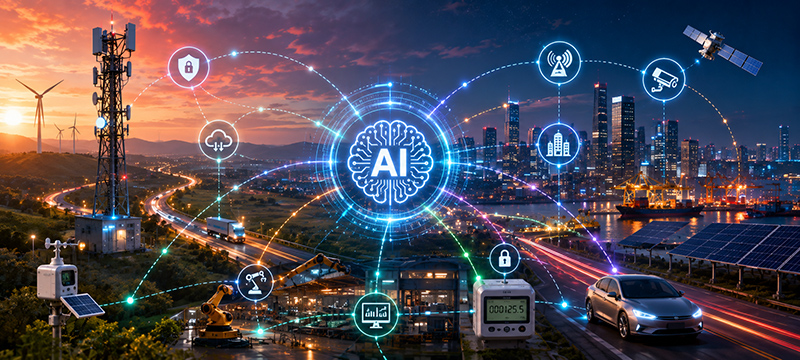
In today’s rapidly evolving technological landscape, the convergence of Artificial Intelligence (AI) and the Internet of Things (IoT) is unlocking unprecedented possibilities. Transforma Insights, a leading analyst firm, has been closely monitoring this synergy, coining the term “Physical AI.” This concept refers to the integration of digital intelligence with the physical world, where IoT devices act as the sensory nervous system. According to Matt Hatton, Founding Partner at Transforma Insights, the most significant value from AI is realized precisely at this intersection. Examples range from the transformative potential of autonomous vehicles to operational efficiencies gained through defect detection, workflow optimization, fleet management, and even workplace safety protocols like PPE detection.
This surge in intelligent applications creates a powerful feedback loop: as the value of IoT deployments becomes more apparent through AI, the demand for robust IoT connectivity grows exponentially. Simultaneously, the requirements of AI—such as edge processing, ultra-low latency, and complex data orchestration—place immense pressure on existing networks and infrastructure. To fully capitalize on the “Physical AI” opportunity, the traditional model of IoT connectivity must evolve.
A new report sponsored by Tata Communications, titled **“The Intelligent Last Mile: How networks must leverage AI to address the evolving needs of IoT,”** provides a comprehensive blueprint for this evolution. The report argues that the “last mile” of connectivity—the final leg linking devices to the cloud and intelligence—must become intelligent itself. It outlines a framework of nine essential characteristics that future-proof IoT networks must possess to support AI-driven applications.
### The Nine Pillars of an Intelligent Last Mile
The report defines the “Intelligent Last Mile” not just as a connection, but as a sophisticated, adaptive layer capable of supporting demanding AI workloads. Here are the nine critical characteristics it identifies:
1. **Secure-by-design:** Security can no longer be an afterthought. The report advocates for a “Secure-by-Design” approach that embeds security into the fabric of the IoT solution from the outset, holistically addressing threats across devices, networks, and data.
2. **Compliant:** As IoT moves into critical infrastructure and sensitive domains, regulatory scrutiny intensifies. The connectivity solution must natively support compliance with evolving regulations concerning security, data sovereignty, and AI ethics, turning compliance from a challenge into a core feature.
3. **Flexible:** The connectivity landscape is diverse, with technologies like NB-IoT, LTE-M, and 5G SA each serving different needs. An intelligent solution must offer flexibility, allowing users to select the right technology mix and incorporate remote SIM provisioning for global management.
4. **Interoperable and Cross-optimised:** Environments can be heterogeneous, spanning indoor, rural, and global deployments. The last mile must seamlessly manage a diverse fleet of devices and vendors. Furthermore, intelligence must extend to cross-optimizing the entire stack—from sensors and gateways to network, cloud, and application—to balance power, processing, and cost.
5. **Orchestrated:** AI applications often require rapid decision-making. The connectivity layer must orchestrate data flow between edge devices for local inference and central cloud platforms for large-scale training, ensuring information is transported efficiently and computation happens in the optimal location.
6. **Collaborative:** Success hinges on collaboration across the entire IoT stack. The intelligent last mile enables shared diagnostics, open APIs, and unified policy frameworks, ensuring devices, edge platforms, and cloud environments work in concert.
7. **User-friendly:** Managing complexity should not be complex. A unified, single-pane-of-glass (SPOG) platform is essential, providing a unified experience for device management, connectivity, policy, and AI data. Centralized billing, support, and automated provisioning reduce friction and administrative burden.
8. **Resilient, Scalable and Efficient:** The network must be robust, tolerating disruptions and variable signal quality. Crucially, as device fleets expand and AI models demand more data, the underlying Connectivity Management Platform (CMP) must scale effortlessly without introducing latency or congestion.
9. **Deterministic and Observable:** For real-time AI applications, predictability is paramount. The network must offer deterministic performance with tight control over latency, jitter, and throughput, enabled by features like traffic prioritization and deterministic scheduling.
### Conclusion
The fusion of AI and IoT is not merely a trend; it is a fundamental shift in how we interact with technology and the physical world. The “Intelligent Last Mile” is the critical enabler of this transformation. By evolving connectivity to be secure, compliant, flexible, and intelligent, businesses can unlock the full potential of their IoT investments. The report’s framework provides a vital guide for organizations and communication providers alike, ensuring that the networks of tomorrow are not just connected, but truly intelligent.
—
### FAQ Section
**Q1: What is “Physical AI”?**
Physical AI refers to the application of artificial intelligence to the physical world through the Internet of Things (IoT). It’s the convergence where digital intelligence is applied to physical assets, sensors, and devices to automate and optimize real-world processes, such as autonomous driving or predictive maintenance.
**Q2: Why is the “Last Mile” of connectivity becoming more important for AI?**
AI applications, especially those at the edge, demand specific connectivity features that legacy networks weren’t designed for. These include ultra-low latency for real-time decisions, high reliability, and the ability to process and transmit large volumes of data efficiently. The “last mile” is the final connection point, and if it’s not intelligent and adaptable, it becomes a bottleneck for AI’s potential.
**Q3: What is a Connectivity Management Platform (CMP)?**
A CMP is a core component of IoT connectivity solutions. It’s a software platform that allows businesses to manage, monitor, and configure the connectivity of all their IoT devices remotely. For an intelligent last mile, the CMP must be scalable and efficient to handle the dynamic needs of AI-driven fleets.
**Q4: What does “Secure-by-Design” mean in this context?**
“Secure-by-Design” means that security is not added as a patch after the fact but is integrated into every layer of the IoT solution from the initial planning stage. This includes securing the device, the communication channel, and the cloud backend to proactively mitigate threats.
**Q5: How does “Interoperability” benefit an AIoT deployment?**
Interoperability ensures that devices from different manufacturers can communicate and work together seamlessly. For AI, this is vital because data often comes from a wide variety of sensors. An intelligent last mile must be able to ingest and make sense of this heterogeneous data to provide a unified intelligence.
