



**The Rise of the Software Factory: How AI is Revolutionizing Development**
Follow ZDNET: [Add us as a preferred source](https://www.google.com/preferences/source?q=zdnet.com) on Google.
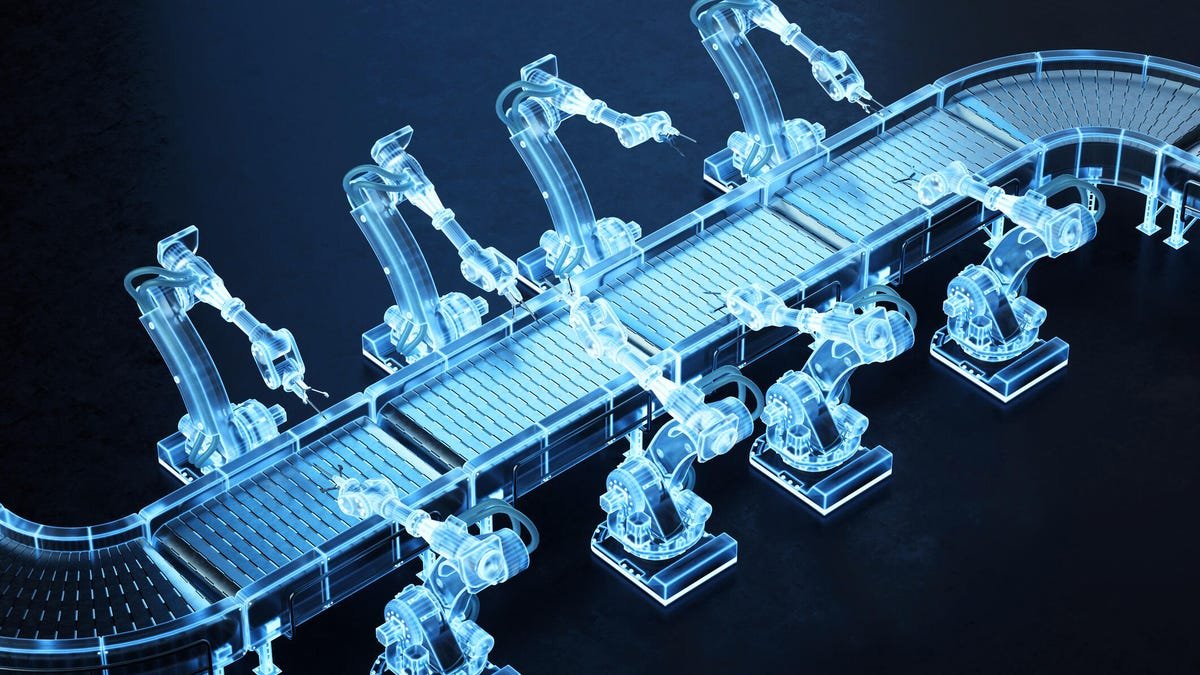
Image: Andriy Onufriyenko/ Moment via Getty Images
In the fast-evolving world of technology, the way we build and deploy software is undergoing a fundamental shift. Just as a car factory transforms individual components into a finished vehicle, a new paradigm is emerging in the software world: the “software factory.” This concept, once a buzzword from the late 2000s, is experiencing a powerful resurgence, driven by the capabilities of modern artificial intelligence. This article explores what a software factory is, how it works, and why it’s becoming a critical model for the future of software delivery.
### What is a Software Factory?
At its core, a software factory is a structured, automated system designed to mass-produce software. Instead of a team of developers hand-coding a unique solution from scratch for each request, a software factory uses standardized processes, components, and templates to create software quickly and reliably.
Imagine a customer support professional has a brilliant idea for a new app based on user feedback. Traditionally, this would involve a lengthy process of finding developers, writing code, and testing—a significant bottleneck. A software factory, however, acts like a manufacturing plant. You submit your “prototype” or initial idea, and the factory’s automated systems handle the repetitive construction, allowing human experts to focus on oversight, validation, and high-level strategy.
> “Let’s say somebody works in a customer support role, and they have an interesting idea based on all the feedback they hear from customers. Like a car factory, you have a prototype that’s experimental. But then you have a factory that produces the cars at scale. Likewise, that person with the software idea can submit it to the factory and the first iteration of that gets created.” — Moritz Plassnig, CEO of CloudBees
### The AI-Powered Revival
While the concept of a software factory isn’t new—Microsoft was discussing it as far back as 2008—the rise of foundation AI models has given it a powerful new engine. These AI models, with their ability to generate and understand code, have dramatically reduced the time and cost associated with the most challenging part of software development: writing the code itself.
This shift has moved the bottleneck. In the past, coding was the primary constraint. Today, with AI-assisted tools, the challenge lies in ensuring the generated code is correct, secure, and reliable. As Moritz Plassnig of CloudBees noted, “Coding created the bottlenecks for a lot of organizations… You had to hire more engineers, but it was very hard and costly to hire them.” AI is alleviating this pressure, allowing development teams to scale their output without a proportional increase in headcount.
Companies at the forefront of the “agentic economy”—including Anthropic, OpenAI, GitHub, Google, and Cursor—are leading this charge. They are building the foundational infrastructure for this new model, creating what one engineer described as a “machine” for software production that is converging on a common architecture.
### What Does a Modern Software Factory Look Like?
According to industry experts, a modern software factory powered by AI is built on several key components:
1. **The Queue:** This is where work begins. It’s not a prompt for an AI, but a formalized issue or request.
2. **The Control Plane:** A durable, centralized system that manages the workflow, rather than a single person’s laptop.
3. **The Sandbox:** A temporary, isolated environment where the AI builds and tests code for a single task, which is then destroyed to prevent clutter.
4. **The Pull Request:** The final output of the process, which is reviewed and retrieved by a human developer for final integration.
5. **The Event Stream:** A system that monitors every action, allowing for intervention and debugging without stopping the entire process.
6. **Durable Memory:** The ability for the system to retain information and context between runs, ensuring continuity and learning.
### The Caveat: Verification is the New Challenge
Despite the incredible speed, a software factory is not a magic solution. The ease of AI code generation has created a new challenge: **verification**. While an AI can write thousands of lines of code in minutes, ensuring that code is bug-free, secure, and efficient is a major engineering problem.
> “It’s incredibly cheap. Verification has become the blocker for a lot of these companies. Making sure that agents write code is very easy. But making sure that that code is correct is still a major engineering problem.” — Jaymin West, Forward-Deployed Engineer
Rushing to deploy code without rigorous validation can lead to software flaws, security vulnerabilities, and system instability. The software factory model, therefore, is not about eliminating human oversight, but about shifting it from the act of writing code to the critical role of validating and managing it.
***
### FAQ
**Q: What is the main benefit of a software factory?**
A: The primary benefit is the ability to mass-produce software quickly and cost-effectively. By automating the repetitive coding process, organizations can turn a good idea into a working prototype and then a scalable product in a fraction of the time it would normally take.
**Q: Does a software factory eliminate the need for human developers?**
A: No, it does not. While AI handles the initial coding, human engineers are more crucial than ever. Their roles shift to tasks like validating the AI’s output, managing the overall architecture, ensuring code quality, and making high-level strategic decisions about what to build.
**Q: What is “agentic coding”?**
A: Agentic coding refers to the use of AI agents that can work autonomously to understand requirements, write code, and even debug. These agents act more like assistants, handling the “how-to” of programming, which frees up human developers to focus on the “what” and the “why.”
**Q: Why is verification so important in a software factory?**
A: Because AI-generated code, while fast, can contain errors, security holes, or performance issues. Without rigorous automated and human-led testing and validation, a software factory could churn out buggy and unreliable software at an unprecedented scale. Verification is the quality control step that makes the entire process viable.
**Q: Which companies are leading the development of software factories?**
A: Leading the charge are major tech companies including Anthropic, Cognition, Cursor, Google, GitHub, OpenAI, and Ramp, all of which are investing heavily in AI tools and platforms that automate the software development lifecycle.
***
### Conclusion
The software factory represents a significant evolution in software development, moving from a craft-based model to an industrialized, AI-powered one. By leveraging the generative capabilities of foundation models, organizations can unlock unprecedented speed and efficiency in bringing software to market. However, this new model requires a corresponding shift in strategy. Success will not come from simply generating code, but from building robust systems for verification, quality control, and human-AI collaboration. The future of software isn’t just written by code; it’s meticulously engineered, tested, and managed by a new generation of intelligent factories.
