



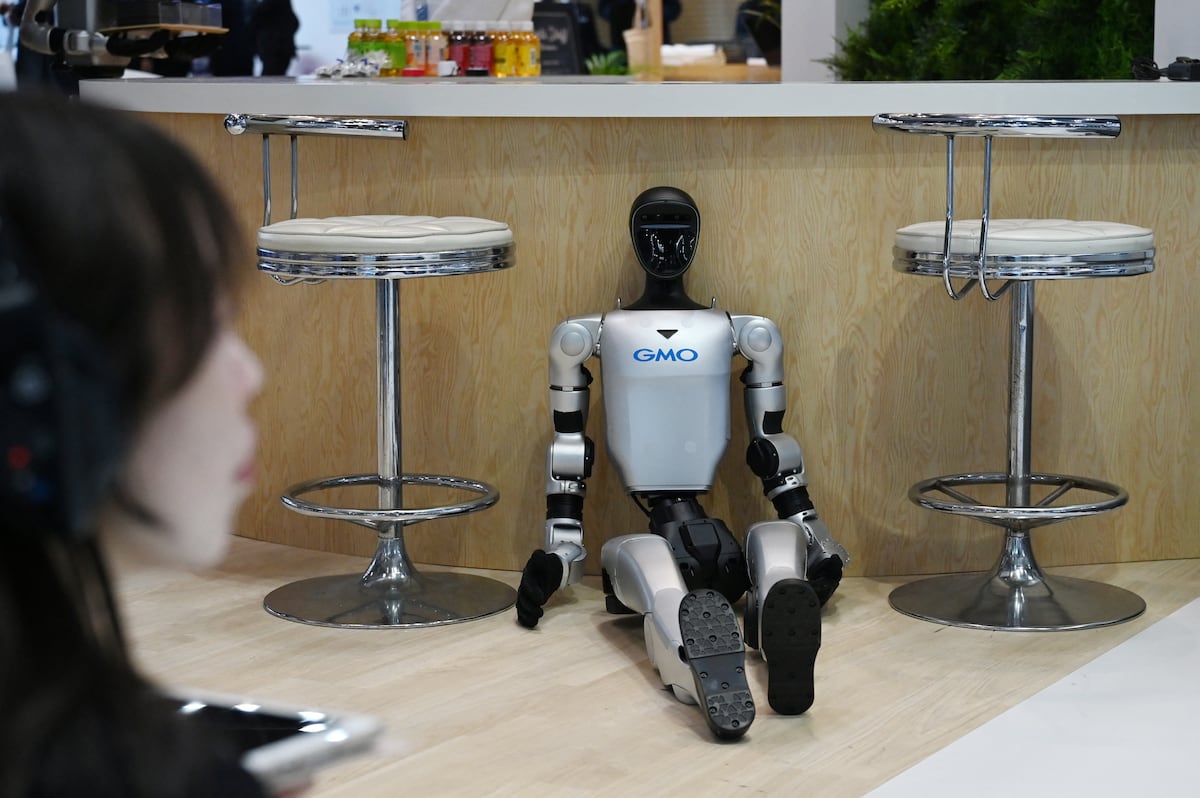
The flexibility of U.S. and Chinese language firms to combine sensors, unify requirements, and share information is driving their progress in bodily synthetic intelligence, an space wherein Japan’s structural weaknesses threaten to impress what its personal authorities calls a “digital defeat.” Manufacturing robots that co-exist in on a regular basis areas with human beings is a gorgeous resolution for a rustic that has been mired for many years in a rising demographic disaster and restrictive immigration insurance policies.
Japan additionally has a particular predisposition in direction of residing with units. Its in style tradition abounds with characters like Doraemon the cosmic cat, a robotic from the long run who does all the pieces potential to assist its proprietor within the anime collection that bears its identify. In 1999, Sony launched the Aibo canine, the longest-running robotic pet available on the market, which continues to be bought as we speak in several variations. In 2000, automotive producer Honda was one of many first to construct an autonomous strolling humanoid who glided by the identify of Asimo.
The nation is without doubt one of the world leaders within the manufacturing of commercial robots, and up till 2023, it represented 38% of worldwide manufacturing of those machines, in accordance with the Worldwide Federation of Robotics. In 2024, there have been 435,299 industrial robots working in Japanese factories producing electrical gear, vehicles, and metallic merchandise. Identified for his or her clean, secure, and precise actions, Japanese industrial robots use high-precision velocity reducers and high-performance servomotors that management their axes.
In idea, bodily AI is the right means for Japanese industrial robotics to take the large leap from structured, predictable environments to actual life. However coaching autonomous programs to behave in all kinds of conditions implies a collection of challenges in coordination and funding, along with cultural and regulatory boundaries. The Japanese authorities itself acknowledges that one of many major obstacles to the implementation of bodily AI in Japan is the nation’s company tradition, which is oriented in direction of information safety.
A current Digital Economic system Report from the Ministry of Economic system, Commerce and Business (METI) factors to Japanese firms’ structural reluctance to share information. The examine says the nation must resolve points associated to standardization, governance, operability, and company practices as a way to generate the big volumes of real-world information that bodily AI requires. It factors out that many Japanese producers lack modernized and digitized workflows, which blocks the gathering and standardization of information crucial for bodily AI.
Lack of competitiveness
The METI report explains that this lack of competitiveness is mirrored in the truth that Japan pays extra for digital providers from overseas than it earns. It stresses that this “hidden digital deficit” might attain practically $300 billion by 2035 if the present development of dropping floor to america in software program and platforms will not be reversed.
The report warns of an imminent “digital defeat” and calls on firms, buyers, and policymakers to share a standard prognosis and act collectively to resolve it. Firstlight Capital, an funding agency that promotes the creation of firms addressing Japan’s inhabitants decline, echoes the METI examine in a press release on its web site that calls on Japan to “study from previous defeats.”
Within the case of bodily AI, it warns {that a} related sample may very well be repeating: Japan invents the underlying know-how and, as a substitute of reworking its benefit into international merchandise, cedes its hegemony. Sooner or later, states Firstlight, Japan might even see robots caring for its aged utilizing native know-how, however with imported software program, explaining that U.S. and Chinese language firms have a bonus within the improvement and software of bodily AI thanks to personal and state-owned ecosystems that facilitate the era, standardization and large-scale circulation of information.
Join our weekly e-newsletter to get extra English-language information protection from EL PAÍS USA Version
