



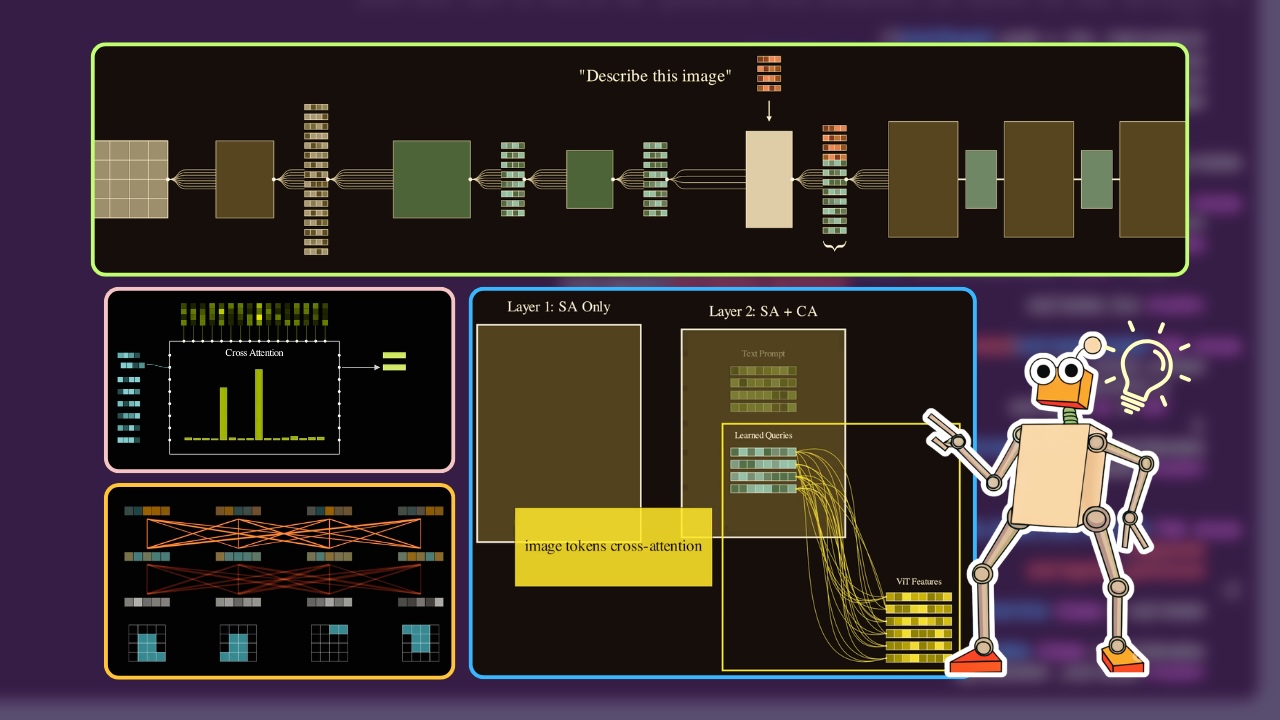
to remodel a small text-only language mannequin and reward it the facility of imaginative and prescient. This text is to summarize all my learnings, and take a deeper have a look at the community architectures behind trendy Imaginative and prescient Language Fashions.
The code is open-source, you may take a look at the GitHub hyperlink on the finish of the article. There may be additionally a 30-minute companion YouTube video that explains the entire article in a visually wealthy format.
Additionally, except in any other case talked about, all photos on this article are produced by the writer.
Wait, are you actually going to be “training from scratch”?
Sure… I imply no… it’s a bit nuanced.
Analysis labs in 2026 don’t practice multimodal fashions from “scratch” anymore. It is just too costly to show a mannequin imaginative and prescient and (textual) language on the similar time! It requires extra knowledge, compute, time, and cash. Additionally, it usually results in poorer outcomes.
As an alternative, labs take current pretrained text-only language fashions, and finetune it to provide “vision capabilities”. In concept (and observe), that is far more compute-efficient.
The usual structure
Though it’s much less data-intensive, finetuning text-only LMs to all of the sudden begin seeing photos would absolutely open its personal can of worms.
- how can we embed the picture, i.e. convert it into numerical representations {that a} neural community can perceive?
- how can we tune the picture embeddings to be suitable with textual content?
- how can we regulate the weights of the textual content mannequin in order that it retains it’s earlier world information, but additionally generate textual content from picture embeddings?

These modules are:
- The Picture Spine: A mannequin that converts uncooked photos into embeddings.
- The Adapter Layer: These are fashions that convert the picture embeddings right into a “text-compatible” embedding. That is the principle difficult half – what architectures to make use of, what loss capabilities, and so on.
- The Language Layer: The language mannequin we are going to practice to enter the tailored embeddings and generate textual content from it.
Let’s talk about them one after the other.
1. The Picture Spine
The objective of your picture spine is straightforward:
Enter: A uncooked 2D pixel map/picture.
Output: A sequence of vector embeddings representing the picture
On the whole, we simply use an off-the-shelf picture mannequin that has been pretrained with huge corpus of photos, usually on self-supervised duties.
You need to use a Convolutional Neural Community (like a ResNet) to make use of as a picture spine. However trendy state-of-the-art VLMs have virtually solely shifted to ViTs as a result of they scale higher with knowledge and are extra versatile for multimodal fusion.

Do I practice the picture spine or hold it frozen?
In most VLM analysis, there’s a clear development towards preserving backbones static (frozen) to save lots of prices. Additionally, vision-language coaching usually wants paired image-text datasets. Since these datasets are all the time a lot smaller than the VIT’s pretraining dataset, finetuning the spine usually results in overfitting and degraded efficiency.
By preserving these weights frozen, we’re mainly transferring the possession of vision-language studying to latter components of the community (i.e. the adapter layer and the textual content spine).
In my experiments, I used the ViT-Base mannequin. This mannequin takes the picture enter, splits it into patches of 16×16 photos and applies self-attention on them to generate an embedding sequence of 197 vectors. Every vector is 768 dimesnions lengthy (the embedding dimension of the VIT).
2. The Adapter Layer
That is the place we’re going to spend nearly all of our time. We have now transformed photos into embeddings already, however these embeddings are utterly text-unaware.
Imaginative and prescient Transformers are pre-trained purely on picture pixels. Not on their captions, or any native textual options. The position of the adapter is to floor the pixel-based-image-embeddings right into a (usually shorter sequence of) text-based-image-embeddings.
There are a lot of methods to do that, like utilizing CLIP fashions, however we’re going to have a look at one of many extra widespread approaches — the Question Former of the Q-Former.
Q-Former
Alright — so what’s a Q-Former? A Q-Former or the Question-Former was launched within the BLIP-2 paper.

How do I practice a Q-Former?
Commonplace Q-Formers could be educated utilizing any multimodal image-text pair dataset. For instance, you need to use the Conceptual Captions dataset, which is an enormous corpus of photos and their corresponding captions. In my venture, I took simply 50,000 pairs to coach the Q-Former.
You may practice a Q-Former from scratch, however the BLIP-2 suggestion is to make use of an pretrained BERT mannequin. In order that’s what we are going to do.
At a excessive degree, right here is our fundamental gameplan:
- Prepare a multi-modal joint embedding house. An area the place textual content and pictures “know” one another.
- Mainly, we are going to enter pairs of picture and captions — and embed each of them in the identical joint house.
- Pictures and incompatible captions shall be mapped in separate locations on this new embedding house, and suitable captions shall be mapped shut to one another.


Organising cross-attention layers
There’s an issue — BERT fashions are purely textual content fashions. They do not know what a picture is.
So, our goal is to first introduce new cross-attention layers to marry the imaginative and prescient embeddings popping out of the VIT and the textual content embeddings from BERT. Let’s break down step-by-step how we convert BERT right into a Q-Former:
- Pattern a picture and textual content pair from the dataset
- Move the picture by the frozen VIT mannequin to transform the picture into picture embeddings, formed [197, 768]
- Initialize “learnable query embeddings”. These are (say 32) vector embeddings that we’ll use to transform the picture embedding sequence right into a text-grounded token embedding sequence. Discover that 32 is way decrease than the unique VIT embedding sequence size (197).
- We enter the textual content caption embeddings and the question embeddings into the primary BERT layer. The layer applies self-attention on these inputs.
For now, let’s assume that the question tokens solely attend amongst themselves and the textual content tokens amongst themselves (i.e. the question tokens and the textual content tokens don’t see one another).
- Within the 2nd layer of the BERT, one thing INTERESTING occurs. The 2 units of embeddings undergo one other self-attention layer like earlier than. However this time, we additionally use a cross-attention layer to contextualize the question embeddings with the ViT picture embeddings we calculated earlier.
After all, regular BERT doesn’t have any cross-attention layers, so we introduce these multi-headed cross-attention layers ourselves.
- Similar to this, we alternate between a pure self-attention layer (the place queries and textual content independently self-attend amongst themselves) adopted by a cross-attention layer (the place the question embeddings attend to the frozen VIT embeddings).
- Within the closing layer, we select a joint embedding coaching loss, like ITC (Picture Textual content Contrastive Loss) or ITM (Picture Textual content Matching Loss) or ITG (Picture Textual content Era Loss and so on). Extra on this later.
What does cross-attention do?
It contextualizes the picture content material with the question embeddings. You may think about every question is making an attempt to match a selected embedding sample towards the 197 VIT embeddings.
For instance, if a question has a excessive match with a single picture vector, it would seize that characteristic very prominently. If the question matches with a mixture of vectors, will probably be a mean of these embeddings, and so forth.
Bear in mind we educated 32 of those question embeddings, so you might be permitting the Q-Former to be taught a number of totally different co-activations inside the picture embeddings. As a result of nature of coaching, these coactivations are inspired to maximise alignment between picture and textual content.
As we practice the Q-Former, each the preliminary question embeddings and the cross-attention weights shall be optimized so we are able to extract related options from the VIT picture tokens.
The question former embeddings usually are not making an attempt to seize each element of those 197 embeddings — as an alternative they’re making an attempt to learn to mix them right into a compact 32 token sequence.
Word that after the Q-Former is educated, we received’t truly use the textual content a part of the Q-Former for something. We’ll merely go the query-embeddings by the Q-former and alternatively run self-attention and cross-attention solely on them.
Loss capabilities for coaching Q-Formers
How the Q-Former mannequin is educated is definitely intently associated to how we attend between question and textual content tokens all through the layers.
- Picture-Textual content-Contrastive Loss (our setup)
For this activity, we use a unimodal self-attention masks. Question tokens attend amongst one another, textual content token amongst one another.The loss perform could be any customary CLIP-like contrastive loss perform. We’ll align the picture and textual content in the identical embedding house. Mainly, we take the output of the queries and the output of the textual content encoder and compute their similarity. If a picture and a caption belong collectively, we wish their vectors to be as shut as potential.
This forces the queries to extract a “global” visible illustration that matches the final theme of the textual content with out truly trying on the phrases but.
- Picture-Textual content Matching Loss (ITM)
This makes use of a bi-directional self-attention masks. Right here, each question token is allowed to see each textual content token, and each textual content token can see each question!For the loss fucntion, we use a binary classification activity the place the mannequin has to foretell: “Is this image and this text a match—Yes or No?”. Binary cross-entropy loss.
As a result of the modalities are absolutely blended, the mannequin can do fine-grained comparisons. The queries can have a look at particular objects within the picture (by way of the cross-attention) and confirm in the event that they correspond to particular phrases within the textual content. That is way more detailed than the contrastive loss and ensures the 32 tokens are capturing localized particulars.
- Picture-Textual content Era Loss (ITG)
Lastly, we’ve got the generative activity. For this, we use a multimodal causal masks. The queries can nonetheless see one another, however the textual content tokens at the moment are handled like a sequence. Every textual content token can see all 32 question tokens – which act as a visible prefix. However they will solely see the textual content tokens that got here earlier than it.For the loss perform, we simply practice the mannequin to foretell the subsequent token within the caption. By forcing the mannequin to actually “write” the outline based mostly on the queries, we be certain that these 32 tokens comprise each little bit of visible info vital for a language mannequin to grasp the scene.
For my venture, I simply used the only — ITC. For a small dataset like I used to be utilizing, this was the simplest method! BLIP-2 recommends to make use of a combination of all these coaching strategies. The github repo shared on the finish of the article supplies the recipe to make use of any of the above consideration schemes.

Within the subsequent part, we are going to do the ultimate step — coaching the VLM!
3. The Language Layer
Now comes the ultimate step. We’ll use the VIT and the Q-Former to make a language mannequin right into a imaginative and prescient mannequin. I picked one of many smallest instruction-tuned language fashions — the SmolLM2-135M. Fortunately, this half is just not as sophisticated because the Q-Former coaching.
We have now the picture embeddings (coming from the VIT and the Q-Former), and we’ve got the textual content tokens (coming from the SmolLM tokenizer). Let’s see some particulars.

- We pattern a picture and a caption from our dataset
- We randomly choose from an inventory of easy system prompts, much like: “You are a helpful assistant. Respond truthfully to the user.”
We additionally choose the person question from an inventory of prompts, for instance: “What do you see on this picture?“
We tokenize the output captions sampled from the dataset as properly.
These 3 issues kind the textual content tokens. We tokenize all of them utilizing the SmolLM2 tokenizer, however we’re not going to insert it into the LLM simply but — we should course of the picture first.
- We go the picture by the frozen VIT, then by the Q-Former (once more, notice that the textual content captions usually are not handed into the Q-Former, solely the picture pipeline is executed)
- We introduce a small MLP layer that converts the Q-Former output into new embeddings which are of the identical form because the LLM’s anticipated embedding dimension. As we practice, this MLP layer will map the Q-Former embedding into the LLM embedding house.
- Now that we’ve got the textual content tokens sequence and the brand new picture embeddings (VIT -> Q-Former -> MLP). We’ll go the textual content tokens by the LLM’s native embedding layer. We sandwich the textual content and picture embeddings within the following sequence:
- Why that particular sequence? Since autoregressive LLMs use causal masking, we are going to primarily be coaching fashions to generate the output (caption) sequence given the complete prefix (system immediate, person immediate, and the picture embeddings).
- We add LoRA adapters (Low-Rank Adaptation Matrices) as an alternative of coaching the complete LLM from scratch. By wrapping our LLM with LoRA, we freeze the unique tens of millions of parameters and solely practice tiny, low-rank matrices injected into the eye layers. This makes the mannequin trainable on client {hardware} whereas preserving all that pre-existing intelligence intact.
- And that’s it! We go these stitched embeddings and labels into the LLM. The mannequin attends to the textual content instruction and the visible tokens concurrently, and because of LoRA, it learns the best way to replace its inner wiring to grasp this new visible language. Solely the Q-Former layers, the MLP layer, and the LORA adapters are educated. All the things else is saved frozen.

After coaching this for only a few hours on a small subset of knowledge, the educated VLM can now see the pictures and generate textual content about it. Machine Studying is so lovely when it really works.
In abstract
You could find the complete github repository right here:
And watch the youtube video right here:
Let’s summarize all of the modules in Imaginative and prescient Language pipelines.
- A imaginative and prescient spine (just like the VIT) that takes picture enter and converts it into embeddings
- An adapter layer (just like the Q-Former) that grounds the picture with textual content
- An LLM that we practice to consolidate the textual content and picture embeddings to be taught the language of imaginative and prescient
My Patreon:
My YouTube channel:
Comply with me on Twitter:
I’m constructing Paper Breakdown, a spot to review analysis papers
Learn my articles:
