



**How I Used Claude to Land a $200k+ Machine Learning Engineer Role: A Resume Breakdown**
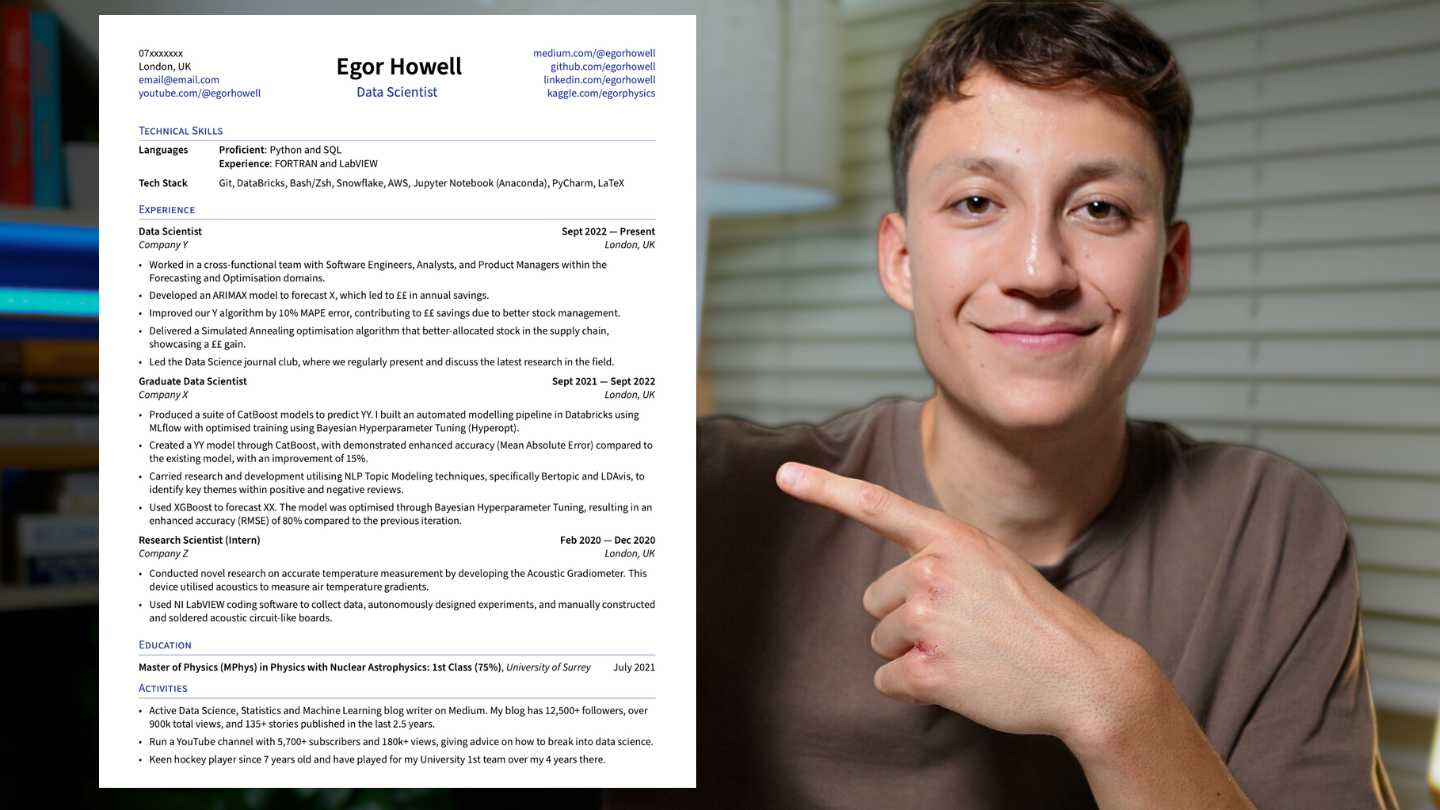
My resume was the single most important document in securing a $200,000+ Machine Learning Engineer offer. I spent over 10 hours crafting it, and that investment was exactly why it delivered results. While there is no single “definitive” guide to a perfect resume—resumes are more of an art than a science—I used a combination of a solid framework and strategic optimization to make mine stand out.
Here’s how you can do the same, using tools like Claude to refine your application into a top 1% resume.
### **Resume Mindset: The Foundation of Your Job Search**
Your resume is your professional story, and it must be treated with care. A great resume is not just a list of duties; it’s a tailored document that highlights your value to a specific employer. The easiest way to achieve this is by starting with a **”master” resume** that contains everything you’ve ever done. From there, you create a **tailored version** for each role by removing irrelevant information. Remember, it’s much easier to subtract than to add.
### **The Fundamental Structure: What Every Resume Needs**
Before you ask AI to help, you need a solid raw draft. I found that a clean, simple structure is most effective. Avoid fancy formatting, colors, or columns. Stick to black text, readable fonts, and bullet points.
A standard structure that works for most roles includes:
* **Header**
* **Summary Statement** (for experienced professionals)
* **Skills**
* **Experience**
* **Projects**
* **Education**
### **Section-by-Section Breakdown**
**1. Header**
Keep it simple:
* Your name
* Job title (e.g., “Machine Learning Engineer”)
* Contact details
* Location
* Links (LinkedIn, GitHub, Portfolio—limit to 4)
**2. Summary Statement**
This section is for experienced professionals (2+ years). It should summarize your expertise, key results, and specialisms. Avoid fluffy language like “passionate” or “hard-working.” Instead, focus on concrete achievements.
*Exception:* If you are changing career roles, use this section to provide context for your transition.
**3. Technical Skills**
For data science and ML roles, this section is critical and should appear near the top. Use a clear 3-row format:
* **Languages:** Split into “Proficient” and “Familiar.”
* **Technologies:** List tools like AWS, Docker, Git, GCP, Linux.
**4. Experience**
This is the most essential part. Use 3–5 bullet points per role.
* **Action Verbs:** Use “developed,” “led,” “optimized,” “generated.”
* **Relevance:** Only include experience relevant to the job.
* **Metrics:** Use numbers and financial impact in every bullet point.
* **Innovation:** Don’t be afraid to include technical keywords and details.
**5. Projects**
Treat projects like mini-experience sections.
* Use numbers and metrics.
* Ensure links work and your GitHub/portfolio is clean and well-documented.
* Highlight the most relevant projects for the role.
**6. Education**
Include:
* University and degree
* Grade (if good)
* Graduation date
—
### **Optimizing with Claude: The Three Key Strategies**
Once you have a solid draft, Claude becomes a powerful tool for elevating your resume from good to exceptional.
#### **1. Generating Financial Impact (The Hardest Part)**
Many candidates struggle to quantify their achievements. Claude is excellent at helping you find the “financial levers” behind your work.
**The Prompt to Use:**
> *“Walk me through this step by step: Ask me clarifying questions about what this task/project actually did—the scale, who used it, what process it touched. Identify the possible financial levers this work could plausibly connect to (e.g., cost savings, revenue growth, time saved). Tell me where I might realistically find that data.”*
**Example Transformation:**
* **Original Bullet:** “Built a suite of CatBoost models for risk pricing.”
* **Claude-Optimized Bullet:** “Built an automated CatBoost risk pricing pipeline in Databricks (MLflow, Bayesian hyperparameter tuning), reducing model retraining time from [X hours] to [Y hours] and contributing to a [X]% improvement in loss ratio.”
#### **2. Tailoring & Removing Irrelevant Information**
Instead of asking Claude to rewrite your resume for a specific role (which can lead to inaccuracies), ask it to **remove irrelevant information** from your master resume to fit a one-page limit. This is a ruthless and effective way to keep your resume focused.
#### **3. ATS & Job Description Alignment**
Claude can help you align your language with the Applicant Tracking Systems (ATS) that many companies use. It can compare your resume keywords with the job description and suggest subtle but powerful changes.
**Example:**
* **Your Wording:** “Recipe popularity forecast model.”
* **Job Description Wording:** “Demand forecasting.”
* **Claude’s Suggestion:** “Built a predictive analytics model for recipe demand forecasting.”
—
### **FAQ Section**
**Q: Do I need a master resume?**
**A:** Yes. A master resume acts as your comprehensive database of skills and achievements. It’s far easier to remove unnecessary information for a specific job than to try to add new, relevant details from scratch.
**Q: How long should my resume be?**
**A:** Aim for one page. Use Claude to help you remove irrelevant points and condense your most impactful achievements. Quality is always more important than quantity.
**Q: Can I use a resume template?**
**A:** Absolutely. A clean, proven template ensures the hiring manager focuses on your content, not your formatting. My recommended template can be found at: resume.egorhowell.com.
**Q: Is it okay to use a creative job title?**
**A:** Yes, but be strategic. If your title is unconventional, ensure the role and responsibilities are clear. If in doubt, include the standard industry title (e.g., “Data Scientist”) alongside your creative one.
**Q: How do I talk about financial impact if I don’t have direct access to company data?**
**A:** You don’t need access to the company’s SAP system. Think about scale, efficiency, and error reduction. Ask yourself: “What process did this improve?” and “What cost did this save or revenue did this generate?” Claude can help you brainstorm realistic estimates based on logical assumptions.
—
### **Conclusion**
A great resume is the product of strategy, not just effort. By starting with a solid, well-structured foundation and then using AI tools like Claude for targeted optimization, you can create a document that truly highlights your value. Remember, a resume is not an island; it’s part of a larger process that includes networking and interview preparation. If you want to accelerate that process, consider seeking guidance from career-coaching communities.
