




Companies are migrating workloads to the general public cloud and implementing non-public clouds in-house. As these types of cloud computing proceed to develop, giant and small companies are targeted on a hybrid cloud technique to bridge the 2 fashions and kind a hybrid cloud surroundings to assist ever-more complicated computing calls for, corresponding to AI and information sovereignty.
What’s hybrid cloud?
A hybrid cloud is a logical assemble that establishes an operational connection between a non-public cloud and public cloud. Usually, a person enterprise builds and operates a non-public cloud supposed solely for its personal profit. The cloud is likely to be applied throughout the native information heart or offered as a third-party service.
A public cloud is usually a main multi-tenant cloud supplier, corresponding to Amazon Internet Providers (AWS), Microsoft Azure or Google Cloud, in addition to numerous different SaaS suppliers. A hybrid cloud exists when an operational relationship is established between a private and non-private cloud to create a single, ubiquitous, interoperable logical cloud entity.
In additional sensible phrases, a hybrid cloud is an amalgamation of applied sciences that embrace an on-premises information heart, in-house or third-party non-public cloud and public cloud companies. These applied sciences are related via a WAN and built-in via orchestration strategies to maneuver information and workloads seamlessly between non-public infrastructure and public clouds as computing wants or price fashions change.
Ideally, a hybrid cloud gives companies with aggressive benefits, corresponding to better flexibility, in addition to options for workload deployment with out undesirable tradeoffs, corresponding to migrating conventional VM workloads to cloud cases or growing cloud-native purposes tied to a particular supplier’s companies.
Why hybrid clouds will be difficult to construct and keep
Enterprises haven’t any direct management over the general public cloud, so they have to architect a non-public cloud to be appropriate with the supposed public cloud — and even a number of clouds. Compatibility consists of appropriate compute, storage and networking {hardware}, together with appropriate virtualization and personal infrastructure software program, corresponding to OpenStack, to offer a desired array of personal cloud companies, community companies, enterprise workloads and so forth. This setup requires the substantial experience of enterprise cloud architects and engineers.
As a substitute, some non-public clouds depend on predesigned infrastructure platforms offered by the general public cloud supplier. Examples embrace Azure Stack, Azure Arc, AWS Outposts and Google Anthos. As soon as deployed in a non-public cloud setting, these platforms supply a local interconnection to the broader public cloud — Azure, AWS or Google — to offer a quicker and extra handy path to a hybrid cloud surroundings.
Essentially the most important consideration is implementing a non-public cloud software program stack appropriate with the goal public cloud’s APIs and companies. With out this compatibility, workloads and information cannot transfer seamlessly from non-public to public clouds and again.
What are the advantages of a hybrid cloud?
Regardless that there’s appreciable funding and energy concerned, these eight principal hybrid cloud advantages make hybrid cloud structure compelling for a lot of enterprises.
1. Value management
A enterprise should be prudent concerning the workloads and companies that run in its non-public infrastructure. A personal cloud is usually deployed with an on-premises information heart infrastructure that the enterprise controls and operates, requiring a major funding of capital, tools and expertise to deploy and keep. Though a non-public cloud can parse and provision native sources in a cloud-like method, its infrastructure continues to be comparatively restricted in comparison with the huge world infrastructure of a public cloud supplier.
An enterprise can mitigate prices with a connection between its non-public cloud and a public cloud. When native demand stresses capability, the enterprise attracts upon extra public cloud sources to assist easy these spikes in demand. Equally, the general public cloud fits short-term, experimental or general-purpose workloads the corporate does not wish to supply, arrange and handle in-house, corresponding to catastrophe restoration. It is best to make use of finite non-public cloud sources to host sovereign or important workloads and information — or just run workloads the place the prices are lowest.
Public cloud sources and companies can even cut back {hardware} prices inside an on-premises information heart. For instance, a enterprise that makes use of a server and storage inside a public cloud does not buy or keep that server regionally. The general public cloud supplier shoulders these prices.
The price advantages of hybrid cloud additionally present readability about the place the cash goes. A hybrid cloud could make it simple to divide IT consumption into capital and operational prices. Enterprises can use instruments and practices, corresponding to FinOps, to watch cloud utilization; receive detailed studies on utilization by division, supervisor, workload or different standards; and quantify the prices of cloud companies for nearer inspection and oversight.
2. Flexibility and scalability
Flexibility is a core premise of cloud computing. A personal cloud gives some provisioning and scaling agility, however the sources obtainable in a bodily information heart are nonetheless restricted by the person group’s price range and capabilities. In distinction, public cloud customers can instantly deploy compute and storage cases — in addition to associated companies — globally with out useful resource constraints. However count on at the very least some migration preparation work to maneuver an area workload from non-public infrastructure to the general public cloud or from a public cloud again to the non-public cloud.
Consistency is among the principal advantages of hybrid cloud. It is simpler to create, shift and scale workloads and sources if the non-public cloud presents occasion sorts and companies much like these obtainable within the chosen public cloud. This consistency allows enterprises to provision and use non-public cloud sources when it is acceptable and cost-effective, draw upon extra sources from the general public cloud when vital, after which launch these extra sources within the cloud when demand or wants shift.
3. Safety
Safety is a core focus for a lot of enterprise IT groups. Information and the workloads that entry it are very important enterprise belongings. Historically, this requires a powerful stage of management over the IT infrastructure and its operation.
A principal safety concern with public cloud is that the infrastructure is the unique property of the cloud supplier, and its infrastructure is usually multi-tenant, or shared amongst numerous customers. The cloud consumer cannot see or management the whole cloud infrastructure. Moreover, the cloud supplier takes on duties to safe customers’ environments within the cloud however isn’t accountable when a breach or different malicious exercise happens. Safety duties are shared between cloud customers and suppliers — a relationship usually known as the shared duty model.
In lots of instances, the easiest way to guard information is to hold it on-premises. Essentially the most delicate information and demanding workloads keep throughout the owned information heart on a non-public infrastructure the place the group’s IT employees maintains and safeguards the belongings. With a mixed private and non-private surroundings, enterprises acquire some frequent hybrid cloud oversight. Finest practices and instruments, corresponding to Development Micro Deep Safety, McAfee hybrid cloud safety merchandise and IBM hybrid cloud infrastructure, might help organizations monitor, uncover and report safety points throughout hybrid cloud environments.
4. Compliance
One benefit of public cloud is its world attain and ample nature. Ideally, networking, storage and computing applied sciences assist most workload operations from information facilities positioned virtually wherever, even on the community edge. It mustn’t matter the place a workload and information reside within the public cloud supplier’s fleet of information facilities. However geopolitical boundaries can come into play, with regulatory limitations on the place corporations retailer information — an idea referred to as information sovereignty — and function computing workloads. That complicates the transfer to purely public cloud for some multinational organizations.
Regulatory compliance presents different challenges, corresponding to defending and retaining information, which might range by trade. Regulatory compliance usually calls for direct management over the storage and processing of delicate or personally identifiable info. These regulatory calls for can usually be met with a hybrid cloud infrastructure.
With a hybrid cloud, a enterprise can function delicate workloads in its non-public cloud and transfer information to and from appropriate information facilities throughout the general public cloud because the regulatory panorama adjustments or as information and workloads evolve. In an enormous information processing undertaking, for instance, an organization can accumulate personally identifiable buyer information in a non-public cloud, sanitize it in-house and ship it to a public cloud utility for processing or evaluation.
5. Uniformity
Hybrid clouds, in idea, assist better standardization in IT administration practices. However in follow, organizations usually battle to create that uniformity. An IT employees does not wish to assemble and function a non-public infrastructure framework, then develop workflows and cobble collectively companies which can be hopefully constant sufficient with a public cloud supplier to make the hybrid setup work. That is a time-consuming, error-prone and costly endeavor.
Public cloud suppliers have turn into extra delicate to the significance and advantages of hybrid cloud in addition to the challenges of integrating non-public and public environments. High cloud suppliers supply numerous companies that concentrate on hybrid wants:
- AWS Outposts presents capabilities for a hybrid cloud setup based mostly on AWS companies.
- Microsoft Azure Stack allows a enterprise to deploy Azure capabilities in on-premises programs.
- Google Anthos does not immediately prolong Google Cloud Platform companies on-premises; it makes use of Kubernetes, containers and plugins to deploy companies and workloads in numerous areas.
- VMware Cloud on AWS is a partnership designed so customers can combine their on-premises VMware environments with Amazon’s cloud.
These choices present prepackaged {hardware} and software program stacks that may be simply deployed throughout the customers’ information heart to create a non-public cloud that is already interoperable with the suppliers’ broader public cloud platform. This protects companies appreciable time, experience and funding.
As public cloud suppliers embrace hybrid cloud administration, companies need not assemble a whole surroundings high to backside. As an alternative, they merely prolong the virtualized information heart into acquainted cloud companies. The drawback right here is vendor lock-in; enterprise customers would possibly expertise challenges using multi-cloud hybrid paradigms or face stark limitations when constructing or configuring their very own native cloud infrastructure.
6. Agility
Clouds are designed to make provisioning and scaling a lot quicker than conventional bodily or virtualized environments. This “on-demand-for-as-long-as-it’s-needed” agility performed an enormous position in public cloud adoption. Non-public clouds search to copy this type of agile conduct.
When private and non-private clouds are merged right into a hybrid cloud, that pace and agility tackle a completely new which means. Companies can arise new workloads and information units on demand and make strategic decisions about the place to deploy these sources throughout the hybrid cloud relying on components corresponding to price, scale and efficiency.
A enterprise deploying an utility within the non-public cloud, for instance, might scale up the applying by deploying a second iteration of the workload in a public cloud information heart positioned inside a special geopolitical space that may present higher efficiency for native customers whereas sustaining information sovereignty necessities for all events concerned. Such objectives are virtually unattainable with conventional information facilities and workloads.
7. Continuity and danger administration
Enterprise continuity — the power to proceed functioning throughout disruption — is usually a main ingredient of regulatory compliance. One other approach {that a} hybrid cloud enhances enterprise continuity is by supporting utility, information and catastrophe restoration duties to guard towards system failures, safety points and bodily disasters, corresponding to fires, earthquakes and acts of conflict.
A enterprise, as an example, might replicate a important workload’s information from an area utility to a public cloud, making certain that the information stays obtainable or will be restored within the occasion of information loss on the utility. In a extra refined instance, a enterprise would possibly scale or migrate a busy utility from its non-public cloud to the general public cloud to accommodate a spike in consumer visitors. Such ways are ideally suited to hybrid cloud environments and may avert workload efficiency issues and disruptions, additional enhancing UX.
Danger administration is one other very important consideration. All enterprise purposes and information sources carry some danger when it comes to entry, safety, efficiency, and reliability. Hybrid clouds give companies the management and agility wanted to seamlessly find purposes and information in accordance with altering enterprise and expertise wants.
A hybrid cloud lets an enterprise resolve the place to find its purposes and information, and methods to greatest provision the required sources and companies to realize essentially the most fascinating final result for the enterprise and its utility customers. For instance, non-public and public clouds can implement sturdy safety companies, corresponding to authentication and authorization, to make sure solely acceptable staff or companions can entry information.
8. Promotes innovation
Latest years have seen a powerful emphasis on cloud computing as a driver of enterprise innovation. The underlying thought behind “innovation” is using expertise to create new alternatives. On this case, hybrid cloud computing can allow an enterprise to make use of it in ways in which improve enterprise effectivity, handle prices, implement regulatory frameworks, and even drive new income.
One instance of this innovation is in machine studying (ML) and AI initiatives. AI platforms are showing throughout industries, and it is commonplace for a contemporary enterprise to deploy a number of AI platforms — usually whereas refining and growing others. However AI platforms are significantly difficult of their infrastructure necessities. ML and AI demand appreciable computing energy, particularly when coaching huge information units.
In the present day, an enterprise can deploy an AI platform in a public cloud, utilizing the cloud’s monumental infrastructure for coaching and testing. It could then migrate that skilled platform again to the non-public cloud for manufacturing deployment, the place it could actually management and handle the platform regionally. On this context, cloud computing is a elementary enabler of AI innovation.
What are the disadvantages of a hybrid cloud?
Though the potential hybrid cloud advantages will be compelling, quite a few hybrid cloud disadvantages must be thought of — primarily associated to complexity points.
1. Architectural complexity
Designing and implementing a hybrid cloud is an in depth endeavor and sometimes requires the service of a talented cloud architect. Whereas the underlying servers, storage and networking {hardware} will be comparatively simple, the non-public infrastructure software program stack will be difficult to grasp. Cloud architects should construct sources and companies inside that personal tech stack and perceive the supposed public cloud so sources and companies align and interoperate. That raises the bar for change administration in addition to software program stack patches and upgrades.
In the end, the important thing to a profitable hybrid cloud is interoperability. A personal cloud usually should function in the identical methods as its related public cloud to make sure seamless operation. If a enterprise, for instance, chooses to construct a non-public cloud to interoperate with a public cloud, corresponding to AWS, the non-public cloud should possess some stage of compatibility with AWS and its companies. Consequently, non-public clouds is likely to be pressured to make software program and architectural decisions that could possibly be troublesome or suboptimal for the enterprise. Packaged non-public clouds, corresponding to AWS Outposts, ease these technical challenges however lock the enterprise additional into the supplier’s structure.
2. Safety complexity
Hybrid clouds will be strikingly troublesome to configure and safe. IT employees should implement and handle authentication and safety for personal — or native — workloads and information in addition to complete authentication and entry management for public — or world — cloud sources and companies. Safety settings for the 2 realms should stay constant and complementary, and a change in a single cloud would possibly must be mirrored within the different. Oversights, inconsistencies or errors can expose very important information and demanding workloads to unauthorized entry and loss.
Clear safety insurance policies and practices will assist by defining safety settings and requirements. Automation will be a necessary instrument in deploying and implementing safety insurance policies to keep away from oversights and human error. Nonetheless, safety impacts regulatory compliance and requires complete information of personal and public cloud architectures to implement, monitor and check totally.
3. Troubleshooting complexity
Issues in a hybrid cloud surroundings will be troublesome to isolate and mitigate. Directors depend on detailed logs and instruments to determine issues, and the troubleshooting course of can range between non-public programs and public clouds relying on the place the difficulty happens. Environment friendly troubleshooting can require the companies of extremely skilled directors and cloud engineers. For instance, a non-public cloud presents full visibility into the non-public infrastructure and software program stack, whereas a public cloud solely presents the visibility and management supported by native suppliers’ and third-party instruments. Restricted visibility would possibly require some public cloud troubleshooting to contain assist employees from the general public cloud supplier.
Instruments matter. Efficient troubleshooting throughout a hybrid cloud calls for well-integrated instruments that ideally assist a single-pane-of-glass method to allow observability and reporting with actionable alerting, regardless of the place the difficulty happens.
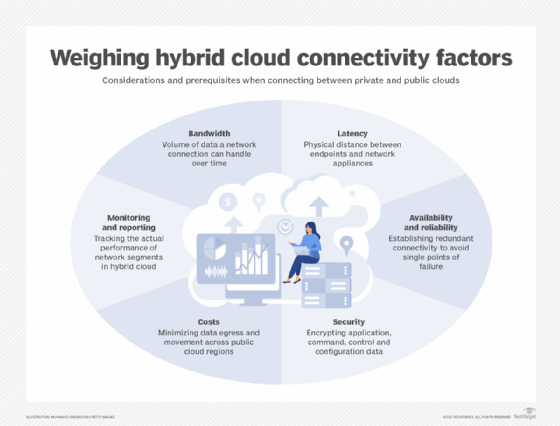
4. Complicated price constructions
Cloud price constructions will be notoriously troublesome to grasp. Public cloud prices are stunningly granular, making it troublesome to align prices with storage, purposes or customers. Non-public cloud prices are a lot nearer to conventional infrastructure, however there are nonetheless price complexities within the integration between private and non-private clouds, corresponding to the prices of public cloud information exfiltration or using API calls. All of those prices can range with utilization.
Cloud price administration is usually a group sport utilizing extremely skilled cross-disciplinary groups engaged in FinOps practices — plus a set of cloud cost-monitoring instruments to foretell prices after which break cloud billing into significant enterprise operations.
Hybrid cloud greatest practices
Enterprises can undertake a number of ways to assist mitigate the disadvantages of a hybrid cloud and improve the success of any hybrid cloud undertaking.
Align objectives and begin small
Enterprise initiatives fail most frequently when they’re approached with a scarcity of time, expertise and course. Organizations new to hybrid cloud applied sciences ought to first perceive why a hybrid cloud is required and objectively think about how such an endeavor aligns with enterprise objectives. Overlooking this easy benchmark can doom a pricey hybrid cloud undertaking from the beginning.
Subsequent, hybrid clouds will be complicated and would require human experience to implement, refine, scale and handle. There’s an enormous distinction between an IT admin who can deploy a workload in a public cloud versus an skilled engineer who can design and implement a completely realized hybrid cloud. Survey the obtainable expertise pool and rent the individuals who could make that undertaking successful.
Lastly, begin small. The concept is to restrict preliminary investments and display the enterprise worth of a hybrid cloud relative to easier, extra direct alternatives (the “low-hanging fruit”). This proves the expertise, builds expertise and experience, allows refinement and optimization, and will increase the probability of success for extra complicated or demanding hybrid cloud mechanics.
Perceive safety
The group chargeable for implementing and managing a hybrid cloud surroundings ought to grasp cloud configuration and safety. Spend money on coaching and experience to safe each the non-public infrastructure and the supposed public cloud. These configurations should work collectively seamlessly, however the information base to perform that may’t be gleaned in a single day.
Some organizations spend appreciable effort and time experimenting, growing, and refining proof-of-principle deployments earlier than they architect a deployment for manufacturing. Firms also needs to fastidiously doc and handle safety to take care of enterprise and regulatory compliance.
Transfer workloads with care
A hybrid cloud’s flexibility does not eradicate the want for strategic selections about workload deployment. Not all workloads are acceptable for every cloud sort. Enterprise and regulatory issues would possibly require that some important workloads stay in an area information heart, whereas different workloads could also be appropriate or preferrred for public cloud deployment.
Organizations should perceive the place that line is for their very own enterprise and trade and make deployment selections accordingly. Cloud information exfiltration can even pose unexpectedly excessive prices, so as soon as information is in a public cloud, shifting it to a non-public cloud could be a budget-busting affair.
Equally, not all workloads are fitted to all cloud environments, and the prices of shifting information units from the general public cloud can shortly turn into prohibitive. Legacy workloads would possibly nonetheless require extra conventional native information heart infrastructure and administration. IT employees should enable for personal cloud and conventional information heart infrastructure to function concurrently.
Use automation and orchestration
Clouds aren’t supposed to be manually managed entities. Non-public infrastructure, public clouds and the hybrid clouds created from them rely upon substantial automation to implement companies and sources as uniform, constant processes. Automation, when paired with orchestration, performs duties with little — if any — human intervention.
For instance, clouds are incessantly based mostly on container applied sciences and platforms, corresponding to Docker and Kubernetes. AI is more and more chargeable for these automation and orchestration duties, and it ought to be approached with cautious consideration to operational effectivity and value management.
Implement monitoring and observability
The adage “You can’t manage what you can’t see” is especially true for hybrid clouds. Organizations rely upon a wide range of instruments throughout the non-public cloud and instruments supporting the specified public cloud supplier to realize observability throughout the whole hybrid cloud surroundings.
Complete monitoring is essential to make sure workload availability, well being and reliability in addition to to gauge efficiency, regardless of the place these belongings are deployed. Monitoring and observability present a sound justification for scaling — adjusting the pricey sources allotted to the workload — and supply goal measures for troubleshooting when issues come up.
Use encryption
Information is a company’s Most worthy asset. Encrypting that information at relaxation and in flight might help mitigate loss or theft when intruders handle to slide previous a safety vulnerability. Complete encryption ought to be commonplace follow inside non-public cloud and public cloud storage.
Editor’s observe: This text was initially revealed in 2023 and was up to date in 2026 to incorporate extra info on hybrid cloud.
Stephen J. Bigelow, senior expertise editor at TechTarget, has greater than 30 years of technical writing expertise within the PC and expertise trade.
