



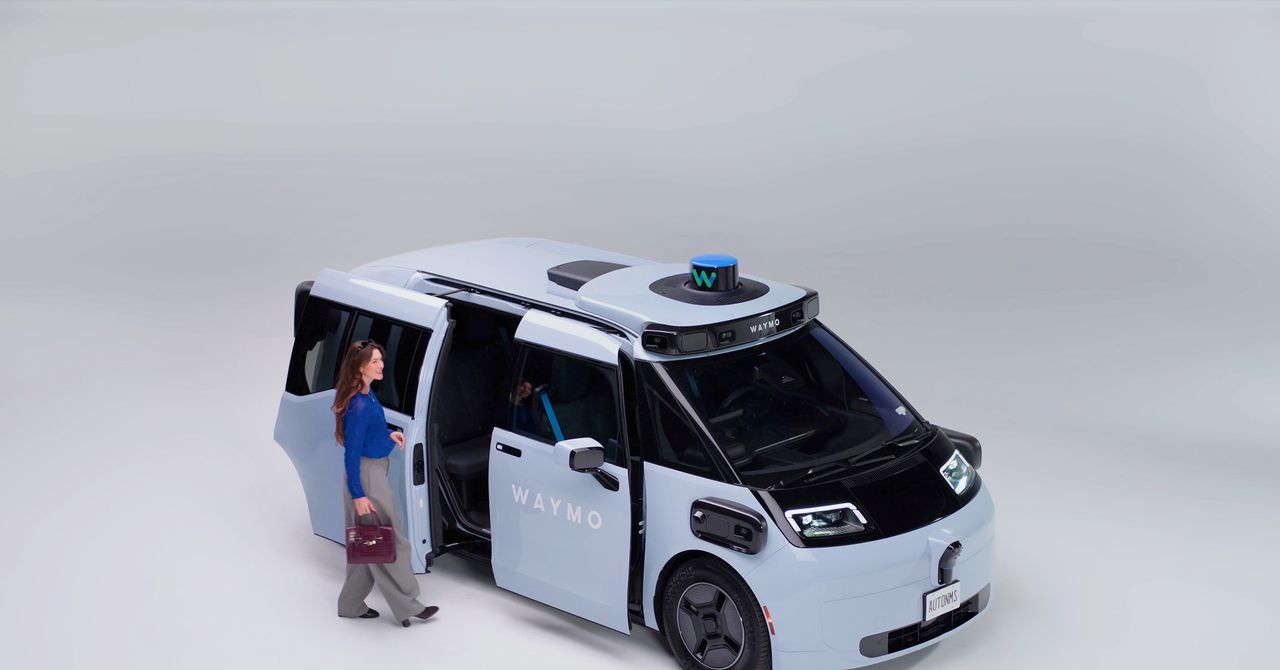
A new self-driving car is hitting the streets of Los Angeles, San Francisco, and Phoenix—or at least, it will be soon. In the coming weeks, Waymo, Alphabet’s autonomous vehicle subsidiary, will begin offering free public rides in its latest vehicle, the Ojai (pronounced “oh-hai”). These pale blue, sensor-covered minivans still come equipped with steering wheels, even though they’re built to operate without human drivers. For the time being, all rides called through the Waymo app will be complimentary.
The road to this launch has been lengthy. Waymo originally unveiled the vehicle in 2021 and has been testing it on public roads since 2024. The timing is also unusual for the company: as Waymo pushes to grow rapidly across the U.S. and globally, it recently halted service in six American cities because of problems with how its vehicles handle flooded conditions. Additionally, the company has paused its highway driving pilot due to safety concerns around construction zones.
We break down what makes the Ojai noteworthy and examine the sophisticated technology driving it.
Why introduce this vehicle?
For almost ten years, Waymo has refined its autonomous driving tech inside vehicles originally meant for human operators. It began with the Chrysler Pacifica hybrid and later transitioned to the all-electric Jaguar I-Pace in 2018. The Ojai represents a first: a vehicle purpose-built from the ground up for self-driving.
The Ojai’s rollout also debuts Waymo’s most advanced hardware and software suite. According to the company, this latest iteration “leverages breakthroughs in AI” and, similar to earlier generations, fuses data from three sensor types: cameras, lidar, and radar.
Waymo sees this upgraded system as the engine powering its ambitious expansion. The service currently runs in 11 U.S. markets and is slated to arrive in at least 20 additional locations worldwide, among them London and Tokyo. Satish Jeyachandran, Waymo’s vice president of engineering, said earlier this year that the platform is “designed for long-term growth across multiple vehicle platforms.” He noted that the new architecture should enable the company to enter new territory—including regions with harsh winters, which have long posed a serious obstacle for autonomous systems.
A note on the name: Ojai takes its name from the bohemian yet upscale village in Ventura County, California, celebrated for its arts scene.
What’s new with this model?
The Ojai has a distinctly different appearance compared to earlier Waymos. The interior is roomier, offering more leg space than the Jaguar it replaces, and now includes charging ports and cup holders. Waymo says the van is more accommodating to passengers with mobility challenges, thanks to flat floors, a low entry step, and grab handles. (The vehicles do not accommodate wheelchairs, however.) The company also claims the cabin is simpler to clean, and the vehicle’s overall design aims to boost operational efficiency: faster charging and a modular construction that streamlines repairs.
The Ojai is clearly not a conventional automobile. Packed across its exterior are the sensors that enable self-driving: 13 cameras, six radar units, and four lidar modules.
Courtesy of Waymo
Who built the Ojai?
Things get interesting here. The Ojai is a customized version of a “mobility platform” developed by Geely, a major Chinese electric vehicle manufacturer. More precisely, the vehicle body comes from Zeekr, a Geely sub-brand that has been selling cars internationally since 2023 and is now present across Europe, Asia, the Middle East, and Latin America. The U.S. remains a notable exception among Zeekr’s markets—yet that is precisely where these Ojai vehicles will be operating.
Waymo explains that the base vehicles are produced in China and then transported to Waymo’s facility in Arizona, where the autonomous driving hardware and software are integrated on American soil. Company spokesperson Sandy Karp states that the production goal is to eventually assemble tens of thousands of driverless-ready vehicles per year.
Hold on—aren’t Chinese cars banned in the US?
That remains largely accurate. Last January, the Biden administration enacted final rules prohibiting Chinese- and Russian-linked vehicle technology from American roads starting in 2027. U.S. officials argued that such foreign-connected tech poses a national security concern—and it didn’t hurt that domestic automakers were feeling the pressure of competitively priced, high-quality vehicles coming out of China. Steep tariffs also effectively keep Chinese-made cars out of the U.S. consumer market.
According to Waymo, however, these restrictions don’t apply to their operation. The company points out that Zeekr only supplies the “base vehicle” without any telematics or connected software, which are all installed in the U.S.
Nevertheless, the partnership with Geely and Zeekr has drawn criticism from political figures. During a February congressional hearing, a Republican senator slammed Waymo for “getting in bed with China.”
Regardless of one’s views on the collaboration, the Ojai’s debut will likely introduce many American riders to Chinese-manufactured vehicles for the first time.
Did you say the rides are free?
Yes, at least for now. Waymo spokesperson Sandy Karp explains that this complimentary phase allows the company to “gather rider feedback and continue refining the experience.“
There’s also a second reason, specific to California: while Waymo holds a permit to run the driverless Ojai vehicles in the state, it has not yet received authorization to carry passengers who pay for rides inside them. That approval is under review by the California Public Utilities Commission (CPUC), which requested that Waymo address several questions before granting permission—including how the company deals with unaccompanied minors riding unsupervised, as well as its protocols for major disruptions and natural disasters, such as the late 2025 San Francisco power outage that left Waymos stranded throughout the city. CPUC spokesperson Terrie Prosper says the commission will rule on the Ojai, along with Waymo’s proposed expansion into the East Bay and portions of Southern California, by June 27.
“We are awaiting the CPUC’s permission to charge fares for those rides,” Karp confirms.
What’s next for the vehicles themselves?
Waymo is also preparing to introduce Hyundai Ioniq 5 models into its robotaxi lineup. These are the result of a Waymo-Hyundai partnership formed in 2024. Meanwhile, the Jaguar I-Pace will continue to serve in the fleet for the foreseeable future.
