



Stay updated with ZDNET: Set us as your preferred source on Google.
ZDNET’s main highlights
- The new Google Home Speaker launches June 25, priced at $99.
- It goes head-to-head with Amazon’s $99 Echo Dot Max.
- Google may have the edge in intelligence, while Amazon could deliver superior sound.
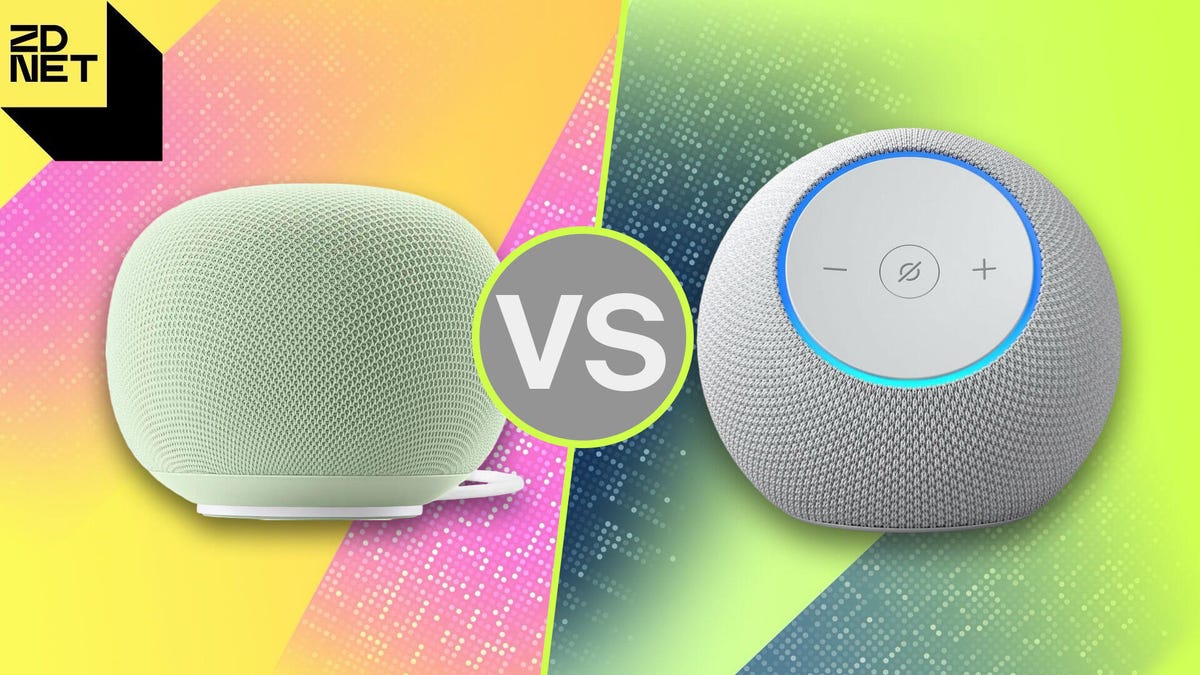
Google has unveiled the latest Google Home Speaker, set to hit stores on June 25. Priced at $100, this smart speaker packs Gemini for Home — a generative AI assistant — along with 360-degree audio and smart home hub functionality.
It’s positioned as a direct competitor to the recently released Amazon Echo Dot Max, another $100 smart speaker (currently discounted to $65) featuring Alexa+ built in. Alexa+ is Amazon’s version of a generative AI-powered virtual assistant, capable of managing complex tasks, answering questions, and creating content — much like Gemini.
Also: How I’m using this affordable smart plug to automate household tasks
With both speakers offering comparable pricing and features, choosing between them is a natural dilemma. Since the Google Home Speaker won’t be available until next week, we’ll break down each device’s specs to help you make an informed decision.
Advanced AI assistants
Given that both the Google Home Speaker and the Echo Dot Max come equipped with generative AI assistants — a significant leap from the traditional command-and-response style of classic Alexa and “Hey Google” — it’s worth examining how each assistant functions and responds to your requests.
I’ve had hands-on experience with both Gemini for Home and Alexa+, and both are highly capable smart home assistants. While I haven’t yet tested the Google Home Speaker itself, Gemini for Home within the Google Home app has felt slightly more conversational than Alexa+ in my experience. It provided more thorough, detailed answers to general questions and made fewer errors.
Also: These handy Amazon gadgets are discounted up to 68% – here’s why I recommend them
Google invests significantly more in consumer-facing AI and generative AI tools than Amazon. It’s no surprise, given Google’s strong commitment to advancing AI technologies, that Gemini can tackle complex requests, understand mid-sentence corrections (something Alexa+ can’t do), and work through multi-step questions by rapidly processing multiple pieces of information in sequence.
Audio performance showdown
One of the most notable differences we anticipate between the Echo Dot Max and the Google Home Speaker is that Amazon typically prioritizes audio quality more than Google does with its smart speakers. Both speakers deliver an improved audio experience over their predecessors, but the Echo Dot Max boasts upgraded sound with a dual-speaker setup and deeper bass compared to the older Echo Dot.
Also: Skip the soundbar: How I enhanced my TV audio using spare Bluetooth speakers
By contrast, Google doesn’t place much emphasis on audio specs, simply noting that the Google Home Speaker delivers balanced 360-degree sound for podcasts and music. While I plan to test these speakers side by side once I get the chance, I’m confident that the Echo Dot Max — engineered to produce powerful, room-filling audio — may come out on top in this category.
Smart home compatibility
When it comes to smart home integration, it might seem straightforward to recommend the Google Home Speaker if you’re mostly in the Google ecosystem and the Echo Dot Max if you rely on Amazon Alexa smart home products — but that would be an oversimplification.
The Amazon Echo Dot Max doubles as a Matter hub, just like the Google Home Speaker. While you can natively connect brand-compatible smart home devices to either speaker, you can also link other previously incompatible brands through Matter.
Also: This 55-inch Fire TV on Amazon is just $280 – and I genuinely recommend it
Staying true to Google’s approach, the Google Home Speaker also functions as a Thread border router, allowing you to use it with Matter over Thread — not just Matter over Wi-Fi like the Echo Dot Max. This can enhance local connectivity and add another node to your smart home’s Thread network.
Powered by the new Gemini for Home, the Google Home Speaker makes it easy to get updates about your Nest cameras, such as asking Gemini for a home summary or searching through your Nest camera history. Alexa offers similar functionality with Ring cameras, though both Google and Amazon require a subscription to their respective home security services.
Home entertainment integrations
Traditionally, compact speakers like these have often been paired with home entertainment setups. In terms of audio and connectivity, the Google Home Speaker works alongside a Google TV Streamer to serve as a TV speaker. However, between the Echo Dot Max and the Google Home Speaker, Amazon’s option provides more comprehensive home theater integrations.
Amazon supports a range of Echo speaker configurations, including stereo pairs, 2.1 audio setups, full wireless home theater systems, and Dolby Atmos-compatible audio. Google allows you to pair up to two Google Home Speakers with a Google TV Streamer to build a compact home theater with stereo sound.
Also: 7 budget-friendly ways I dramatically improved my TV sound (no soundbar needed)
Amazon offers a broader selection of Echo speaker tiers, including a dedicated wireless subwoofer (Echo Sub) for premium audio when paired with the Echo Studio, as well as a Fire TV soundbar.
Specifications
| Spec | Google Home Speaker | Amazon Echo Dot Max |
|---|---|---|
| Price | $100 | $65 (limited-time deal) |
| Assistant | Gemini | Alexa+ |
| Audio | 360-degree sound, unspecified construction | 0.8-inch tweeter, 2.5-inch woofer |
| Microphones | 3-microphone array | 4-microphone array |
| Smart home connectivity | Matter, Thread border router | Matter |
| Native ecosystems | Nest, Google TV, Google services | Ring, Fire TV, Prime, Amazon services |
My pick
Until I’ve had the chance to test the Google Home Speaker, I can’t fairly declare a winner between it and the Amazon Echo Dot Max. Based on the specs and what we currently know, the Google Home Speaker looks like a solid choice for users who mainly want a smart speaker for conversation and issuing commands. The Echo Dot Max, on the other hand, seems better suited for those who primarily want to enjoy listening to it.
