



Here is the rewritten HTML with text rephrased for better readability:
As we unveiled in What’s Next with AWS 2026, we’re now making OpenAI GPT-5.5, GPT-5.4 models, and Codex available on Amazon Bedrock for general use, providing you with cutting-edge models and a coding software agent.
OpenAI reports that GPT-5.5 and GPT-5.4 models perform exceptionally well at coding, reasoning, agent-based workflows, and intricate professional tasks. GPT-5.5 is your go-to for the most demanding customer workloads, while GPT-5.4 offers the best value for performance. You can reach them through the Responses API on Amazon Bedrock’s new inference engine built for outstanding performance, reliability, and security.
Codex serves as OpenAI’s AI development assistant for software. OpenAI states weekly usage by more than 4 million developers who write, refactor, debug, test, and verify code across large codebases with Codex. Backed by GPT-5.5’s inference capabilities, Codex brings a whole new level of intelligence engineered for complex, extensive developer workflows. You can work with it through the Codex App, command line, and integrated development environments like VS Code, JetBrains, and Xcode, with all model inference routed through the Responses API on Amazon Bedrock.
For those needing data residency, all processing stays within your chosen Bedrock region. You’ll pay by the token without any seat licenses or developer commitments.
Putting GPT-5.5 and GPT-5.4 Models to Work on Bedrock
Access the model using OpenAI’s Responses API to reach bedrock-mantle endpoints though the OpenAI SDK, or use command-line tools like curl.
Let’s dive into the OpenAI SDK for Python first. Install the SDK.
pip install -U openaiConfigure your authentication environment variables.
export OPENAI_BASE_URL="
export OPENAI_API_KEY=""
export BEDROCK_OPENAI_MODEL_ID="openai.gpt-5.5"
Here’s a Python example for calling the GPT-5.5 model on Bedrock:
import os
from openai import OpenAI

client = OpenAI(
    base_url=os.environ["OPENAI_BASE_KEY"],
    api_key=os.environ["OPENAI_API_KEY"],
)

response = client.responses.create(
    model=os.environ["BEDROCK_OPENAI_MODEL_ID"],
    input=[
        {
            "role": "developer",
            "content": "You are a software engineer with excellent AWS cloud knowledge. Be concise and practical.",
        },
        {
            "role": "user",
            "content": "Design a distributed architecture on AWS in Python that should support 100k requests per second across multiple geographic regions.",
        },
    ],
    reasoning={"effort": "medium"},
    text={"verbosity": "low"},
)

print(response.output_text)
You can directly reach the model endpoint with curl.
curl "$OPENAI_BASE_URL/responses"
  -H "Content-Type: application/json"
  -H "Authorization: Bearer $OPENAI_API_KEY"
  -d '{
    "model": "openai.gpt-5.5",
    "input": [
      {
        "role": "developer",
        "content": "You are a software engineer with excellent AWS cloud knowledge."
      },
      {
        "role": "user",
        "content": "Design a distributed architecture on AWS in Python that should support 100k requests per second across multiple geographic regions."
      }
    ],
    "reasoning": {"effort": "medium"},
    "text": {"verbosity": "low"}
  }'
Use the Responses API to take advantage of multi-turn state managed by the model, hosted tools, function tools, or tool orchestration features, and execute background or extended processes. To learn more, visit the OpenAI Cookbook Responses examples.
Working with OpenAI Codex and GPT-5.5 on Amazon Bedrock
Download the Codex CLI, App, or VS Code extension and get started with Bedrock for model inference. Codex works with two Bedrock authentication methods: Amazon Bedrock API key or AWS SDK credential chain. If AWS_BEARER_TOKEN_BEDROCK is set, Codex will use it first; otherwise it falls back to AWS SDK credential chain.
Set AWS_BEARER_TOKEN_BEDROCK in your environment for Codex to read:
export AWS_BEARER_TOKEN_BEDROCK=Next, select your preferred region and set the model ID to openai.gpt-5.5 in ~/.codex/config.toml, required for Bedrock API-key authentication. You can also choose openai.gpt-5.4, openai.gpt-oss-120b, or openai.gpt-oss-20b. For desktop applications or VS Code extensions, place any needed environment variables in ~/.codex/.env.
model = "openai.gpt-5.5"
model_provider = "amazon-bedrock"
[model_providers.amazon-bedrock.aws]
region = "us-east-2"
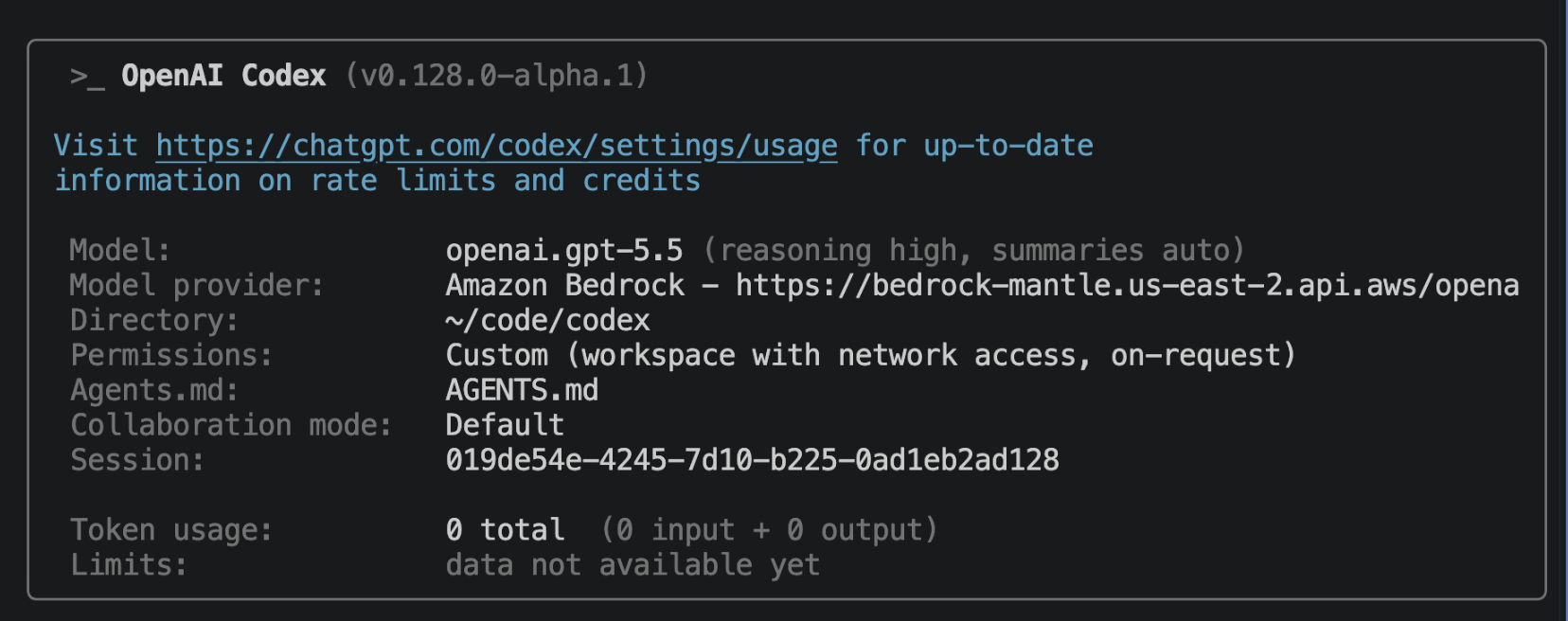
Restart either your desktop app or VS Code extension after making changes to ~/.codex/config.toml or ~/.codex/.env. With Codex CLI, a /status tab should appear like this:
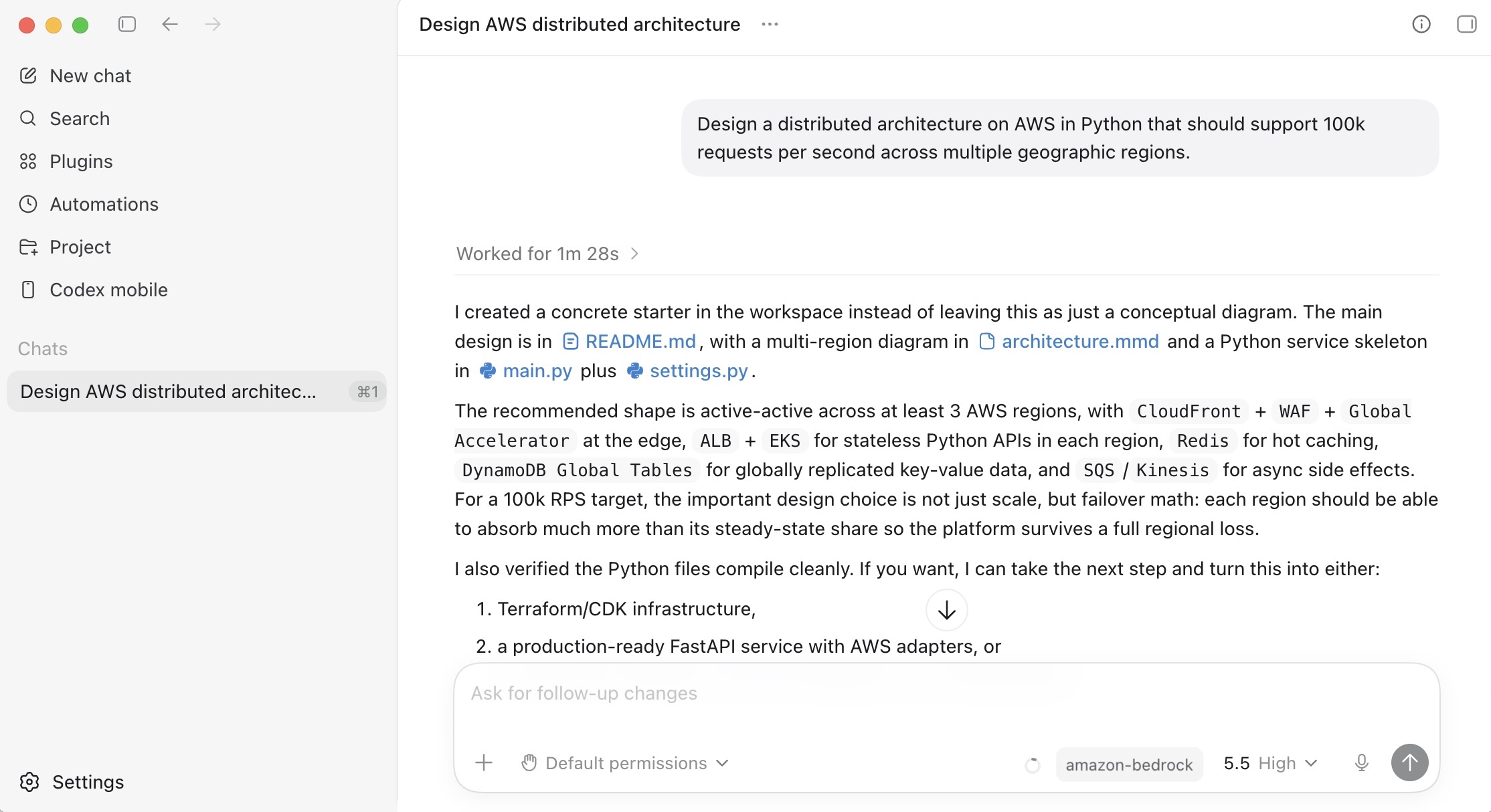
In the Codex App, you can work with GPT-5.5 model served via Amazon Bedrock inference.
Important Details to Note
Let me share some important technical insights you’ll find valuable.
- Model latency: OpenAI positions GPT-5.5 as fast and GPT-5.4 as medium-speed models, but actual customer-perceived latency varies depending on reasoning effort level, output length, tool calls, background mode, region, quotas, throttling, prompt size, and cache hits. For GPT-5.5, begin with the
mediumsetting. For GPT-5.4, explicitly configure effort rather than depending on itsnonedefault. - Scaling and availability: Bedrock’s updated inference engine can quickly provision and deliver capacity across various models. When receiving requests, we concentrate on maintaining consistent workloads, and scale both usage and capacity to match sudden increases in demand. During peak usage periods, requests get queued rather than rejected.
Available Now
OpenAI GPT models and Codex on Amazon Bedrock are live: GPT-5.5 model in the US East (Ohio) Region, GPT-5.4 model in the US East (Ohio) and US West (Oregon) Regions. Check the full list of Regions for future updates. To learn more, visit the OpenAI on Amazon Bedrock page and the Amazon Bedrock pricing page.
Try GPT-5.5, GPT-5.4 models, and Codex on Amazon Bedrock now and share feedback through AWS re:Post for Amazon Bedrock and your normal AWS Support contacts.
— Channy
