



This article was co-authored by Rahul Vir and Reya Vir.
Moving From Experimentation to Token Efficiency
We’ve progressed beyond the AI prototyping era. Expanding on the ideas from Escaping the Prototype Mirage [1], product and engineering teams in every sector are now deploying agentic applications that automate workflows previously handled by hand. Getting these autonomous agent prototypes up and running has become remarkably straightforward. It boils down to applying core principles like recursive Agentic Loops (Observe-Think-Act) for task execution, configuring headless gateways to link agents through messaging platforms, and leveraging persistent state that survives across restarts (as detailed in [1]). But transitioning them from prototypes to dependable products is an entirely different challenge. The real question now isn’t whether agents can function—it’s whether they can function profitably.
At the same time, internal benchmarks within enterprises are shifting. The “token maxing” mindset—spending tokens freely to achieve the best possible outcomes—was fine during prototyping. But as agentic products mature, the focus is turning toward the “value-to-token-spent” ratio. After all, most products must be profitable and optimize margins as they evolve from relying on inexpensive traditional computing (TradCompute) to leveraging AI intelligence instead.
However, models require room to reason, and recent research has demonstrated that open-ended agentic workflows consistently beat fixed pathways—they discover new routes, build MCP tools, and construct infrastructure that solves problems more efficiently. This raises the fundamental challenge of balancing the model’s need for autonomy against the hard reality of inference costs.
Why Overly Constrained Agents Struggle to Converge
Agent harnesses keep your task context and goals in markdown (*.md) files, which don’t map to rigid workflows so much as spell out the objective you want to achieve.
The Paradox of Objective Failure: Research on agents tackling complex problems has revealed that imposing narrow, tightly-constrained instructions—where every agent action is expected to bring it step-by-step closer to the goal—often leads to getting trapped in local optima and ultimately failing the objective. One illustrative example from Professor Jeff Clune’s work on open-ended agent learning shows this clearly: when an agent navigating a maze receives rewards only for moving directly toward the exit, it ends up repeatedly hitting walls and gets stuck in a local optimum, never making it to the end [2].
The Strength of Open-Ended Harnesses: Modern agent harnesses such as Google Antigravity and Anthropic’s Claude Code have proven remarkably effective precisely because they give agents the latitude to build, orchestrate, and carry out complex tasks—including creating their own tools—without heavy-handed human oversight. Their success comes from being allowed to take indirect, exploratory routes.
Consider a real-world edge case in a standard medical intake workflow: if we tightly force a healthcare agent to stick exclusively to a preset scheduling sequence, it will break in practice. If a patient brings up chest pain in the middle of that routine intake, the agent’s Agentic Loop must have the independence to immediately detect the urgency, drop the scheduling flow, and trigger a safety escalation. It should employ what we previously called a `No-Reply Token` to suppress booking responses and channel the context straight to a human nurse [1]. Rigidly constrained prototypes fail this scenario spectacularly because they lack the ability to respond to critical, unexpected context.
Unlimited Goal Searching Is Costly
While granting agents autonomy is necessary for initially discovering a solution, running a fully open-ended search for every incoming user request leads to enormous and unsustainable token consumption. At this point, the agent has already identified a valid approach—but continuing to re-explore or “hallucinate” the workflow structure wastes resources. While this process can self-correct over time, running repeated exploratory cycles for similar requests devastates enterprise token economics.
For instance, routing medical intake workflows—including the edge cases requiring escalation—can be learned over time. A clinic’s or solution provider’s workflows will settle into predictable paths for most situations, preserving autonomy only for rare outliers and highly complex exceptions.
Architectural Approaches Using Early Commitment and Deterministic Replay
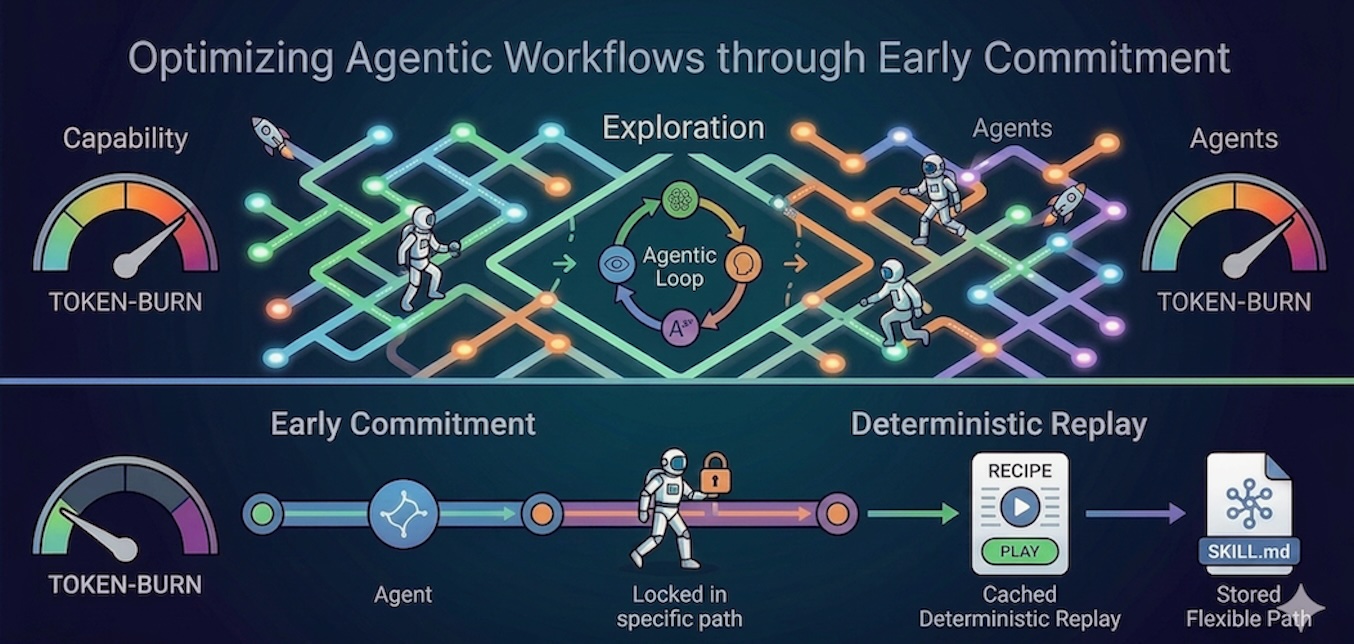
Early Commitment has proven effective in structured problem solving, and the same principle applies well to agentic workflows [3]. It works by classifying the problem upfront—for example, designing the system prompt to require the model to produce a specific classification label. Making an agent categorize the problem type and set boundaries before it generates execution logic prevents it from hallucinating or wandering down dead ends. This eliminates noise, keeping the agent focused on execution rather than endless exploration.
As an example, in a telehealth triage workflow, we can apply Early Commitment by requiring the agent to definitively classify the encounter as a “routine prescription refill” before proceeding. Once locked into that classification, the agent restricts its tool calls exclusively to the pharmacy database, completely avoiding the costly, open-ended diagnostic reasoning it might otherwise pursue by attempting to diagnose the patient.
A recent study by Wang, X., et al. presents the LOOP Skill Engine Framework, which elevates early commitment to the infrastructure layer through a one-shot recording and deterministic replay model [4]. The agent is allowed to freely explore once using full reasoning, after which the system compiles that successful trace into a concise, branch-free recipe. For all subsequent runs of that task, the LLM can be bypassed entirely, guaranteeing deterministic execution and cutting token usage by over 93.3% for routine tasks and up to 99.98% for high-volume executions. This approach translates naturally to agentic workflows.
Think about generating daily clinic compliance reports or standard post-discharge summaries—these are highly stable and repetitive tasks. By transitioning from exploratory reasoning to a deterministic framework early, an agent only needs to reason through the complex Electronic Health Record data extraction once. For the next hundred patients discharged with the same procedure, the system faithfully runs that branch-free recipe, plugging in the new patient’s vitals and dates without ever calling the LLM. This ensures zero hallucinated data on repetitive healthcare tasks while dramatically improving token economics.
ML practitioners must choose between a fully deterministic replay (as in LOOP) that maximizes token savings, and a hybrid approach (capturing the explored path in a SKILL.md file). The hybrid approach sacrifices some of those savings to retain the ability to reason through a well-guided yet flexible path that can adapt to evolving underlying systems. Whether this skill file is maintained manually or through an autonomous self-improvement process, keeping that reasoning capability ensures long-term adaptability and resilience. For example, if the database schema changes, the agent can update its SQL queries and continue pulling the right information.
Conclusion: The Explore-Commit-Measure ML Pipeline
ML engineers and Product Managers need to rethink how they harness the full intelligence of autonomous agents—embracing open-ended agent harnesses for initial problem discovery and for tackling complex, one-off edge cases. This produces optimal outcomes without the burden of an expensive reinforcement learning cycle (which is often blocked by gaps in expertise, platform limitations, training costs, or model restrictions).
Once a near-optimal path has been identified, the token economics of structured and repetitive tasks call for enforcing early commitment in prompt design, combined with deterministic replay architectures that cache the proven execution path.
As agentic products grow, operational metrics must evolve away from simple task completion rates and move toward token efficiency and value generated per token spent.
References
- Vir, R., & Vir, R. (2026, March 4). Escaping the prototype mirage: Why enterprise AI stalls. Towards Data Science.
- Clune, J. (2025, February 12). Guest Lecture 6 CS329A by Prof. Jeff Clune: Open-ended Agent Learning in the Era of Foundation Models [Video]. YouTube.
- Vir, R. (2026, January 1). Why early commitment helps AI solve structured problems. Towards AI.
- Wang, X., Yu, K., Liang, X., Wang, L., & Han, C. (2026). Good to go: The LOOP skill engine that hits 99% success and slashes token usage by 99% via one-shot recording and deterministic replay. arXiv.
