



# How a New Foundation Model Is Transforming Precision Weed Management on Farms
A Seattle-based agricultural robotics company is redefining how farms identify and manage weeds by shifting from a patchwork of crop-specific AI models to a unified, large-scale plant intelligence system. The company’s latest innovation — a “large plant model” — leverages deep learning trained on tens of millions of labeled plant images to power its flagship laser weeding platform across diverse crops, geographies, and growing seasons.
## From Crop-Specific Models to a Universal Plant Intelligence System
Historically, vision-based weed detection systems required extensive retraining each time a farmer introduced a new crop, encountered an unfamiliar weed species, or operated in a new region. This process was costly, time-consuming, and often put farms into a cycle of downtime while models were updated.
The company’s new foundation model fundamentally changes this equation. Pre-trained on a vast corpus of plant imagery collected from fields around the world, the model understands plant morphology — root structures, leaf patterns, growth stages — at a granular level. When deployed in the field, the system can be customized in minutes rather than weeks.
## How Farmers Personalize the System in Minutes
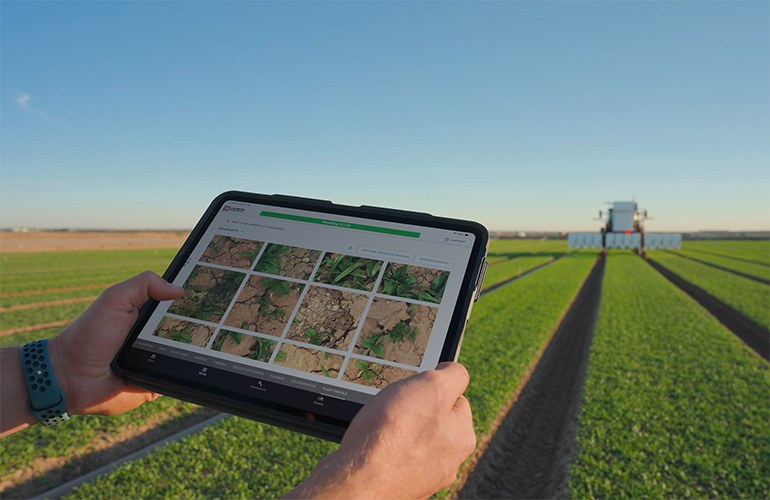
The customization workflow is remarkably simple. Farmers use a tablet-based interface to browse thumbnails captured from their own fields. They then tap a small number of images to label them as “crop” or “weed.” The foundation model ingests these examples and adjusts its behavior almost instantaneously — no software updates, no model retraining, and no cloud dependency required during operation.
This approach means a single LaserWeeder unit can treat one field for carrots in the morning and another for lettuce or herbs in the afternoon, with only a few minutes of reconfiguration between deployments. Even plants that are considered desirable in one region can be selectively removed if the farmer determines they are weeds in the current context.
## The Role of Human-in-the-Loop Data Annotation
Building a model capable of this level of flexibility required an enormous dataset. The company initially attempted to label images in-house, but the effort quickly proved unsustainable. As the team grew, they partnered with a global data annotation specialist to scale the labeling pipeline. Together, they built a custom annotation tool tailored to the specific nuances of plant identification — distinguishing between seedling-stage crops and look-alike weeds, for example. This collaboration resulted in the ingestion of millions of annotated plant images, forming the backbone of the foundation model.
The partnership highlights a broader trend in physical AI: the recognition that high-quality training data, annotated by experts who understand both agriculture and machine learning, is the critical bottleneck for deploying robust vision systems in real-world environments.
## Expanding Beyond Weeding: Full Tractor Autonomy
The company has also taken steps toward end-to-end farm automation with the introduction of an autonomy retrofit kit. Designed to work with popular tractor platforms, the kit integrates cameras, sensors, and onboard computing hardware to enable perception, obstacle avoidance, path planning, and mission execution — all without modifying the tractor permanently.
When paired with the company’s smart implements, the autonomous setup can carry out weeding missions entirely without a driver onboard. The system is also adaptable to other farming workflows, including tillage, spraying, and harvesting, opening the door to a more comprehensive autonomous farming solution.
The kit dynamically adjusts the tractor’s speed based on real-time weed pressure detected by its sensors, optimizing both efficiency and precision across varied terrain and crop conditions.
## Frequently Asked Questions
**Q: What is a “large plant model,” and how is it different from traditional farm AI?**
A: A large plant model is a single, pre-trained deep learning system that understands plant structures across species, regions, and growth stages. Unlike traditional models that are built for one specific crop and require retraining for each new scenario, a foundation model uses a universal understanding of plants and adapts to new fields with only a handful of labeled examples.
**Q: How long does it take to configure the system for a new crop?**
A: Configuration can typically be completed in minutes. Farmers review field thumbnails on a tablet, tag a small number of images as crops or weeds, and the model adjusts its behavior immediately.
**Q: Does the system require an internet connection in the field?**
A: The core inference and adaptation capabilities run on-board the equipment. Since the model does not need to be retrained in the field, no model downloads or cloud communication is required during active operation.
**Q: What types of equipment does the autonomy kit work with?**
A: The current version of the autonomy kit is compatible with John Deere 6R, 8R, 8RX, and 8RT series tractors from 2019 onward. It is designed as a retrofit solution with no permanent modifications to the tractor.
**Q: Can the laser weeder distinguish between a weed and a desired plant growing in an adjacent field?**
A: Yes. Because the farmer defines what counts as a crop and what counts as a weed through the customization process, the system can be configured to target specific plants within a field, even if those same plants are considered valuable elsewhere on the farm or in a different region.
**Q: What role did the data annotation partner play in developing the foundation model?**
A: The annotation partner helped the company scale from thousands of self-labeled images to millions of professionally annotated plant images. They also co-developed a custom labeling tool optimized for the specific requirements of plant identification, which proved essential for building a model capable of reliable multi-crop performance.
**Q: What other farming tasks can the autonomous tractor perform besides weeding?**
A: The autonomy kit supports a range of workflows including tillage, spraying, and harvesting, making it a versatile platform that can be adapted to different agricultural operations throughout the growing season.
## Conclusion
The convergence of large foundation models, accessible field-level customization, and full tractor autonomy is reshaping what precision agriculture looks like in practice. By collapsing the gap between a universal plant intelligence system and the specific needs of individual farms, this new generation of agricultural robotics promises to make laser weeding — and autonomous farming more broadly — faster to deploy, easier to use, and more effective across an expanding range of crops and environments. As data annotation pipelines mature and on-board computing power continues to improve, the roadmap points toward increasingly autonomous, self-adjusting farm equipment that reduces chemical usage, labor costs, and environmental impact simultaneously.
Thank you for reading
