



# Russian Cyber Espionage Group Exploits AI to Evade Detection in Targeted Attacks on Governments Worldwide
A sophisticated Russian-linked cyber espionage operation has been uncovered, revealing an alarming new frontier in cyber warfare: the use of artificial intelligence to autonomously redesign malware that evades security defenses in real time.
## The Actors Behind the Campaign
The operation has been linked to a cyber espionage cluster identified as GTG-20006, which researchers believe is connected to Midnight Blizzard, a well-known Russian state-sponsored group also recognized by other names in the cybersecurity community. This group has been carrying out espionage activities targeting government officials, military personnel, diplomats, and defense organizations across multiple continents.
What makes this campaign particularly concerning is not just the targets — but the methods. The group has integrated AI into virtually every stage of its attack lifecycle, fundamentally changing how offensive operations are conducted.
## How AI Was Weaponized
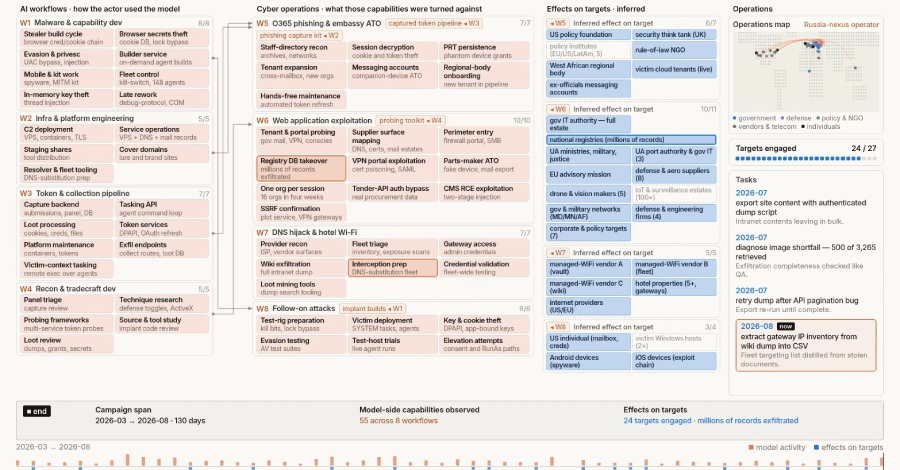
The threat actor developed a closed-loop AI system capable of continuously testing its own malicious tools against commercial security products. When a detection was identified, the AI would automatically modify, rebuild, and redeploy the malware — all without human intervention.
This represents a dramatic shift in cyber operations. Historically, defenders relied on the fact that attackers needed time to modify their tools after a signature was published. By automating this entire process, the threat actor effectively neutralized this advantage.
Beyond malware modification, the group used AI to:
– Register malicious domains at scale
– Set up and manage hosting infrastructure for phishing campaigns
– Monitor command-and-control channels for compromised devices
– Identify and prioritize high-value targets from stolen data
## The Arsenal of Tools
Security researchers catalogued a wide range of malicious tools developed and deployed by the group, spanning multiple platforms and attack vectors:
**Windows-based implants** included PowerChrome, WUEngine, Shadow C2, MiniPlasma, and CloudSyncSvc — each designed for specific espionage functions such as credential theft, data exfiltration, and persistent access.
**Mobile threats** were also a significant component. Android users were targeted with GiftDrop, a surveillance tool derived from an earlier RAT strain. iOS users were hit with DarkSword, a platform specifically designed to compromise Apple devices.
**Additional components** of the toolkit included:
– A browser credential stealer targeting saved passwords
– A phishing platform that impersonated government entities
– An administrative console for managing compromised accounts
– Tools for tampering with security updates on victim machines
## A Unique Attack Vector: Hotel Wi-Fi Hijacking
One of the most innovative aspects of this campaign involved compromising hotel hospitality management systems. The group obtained admin credentials and modified DNS records on networks used by hotel guests. When travelers connected to the hotel Wi-Fi, their traffic was silently redirected to attacker-controlled infrastructure.
Once redirected, guests were presented with fake update prompts — a social engineering technique known as ClickFix — that delivered platform-specific malware tailored to whether they were using Windows, Android, or iOS devices.
The stolen data from hotel management systems was then used to identify additional targets, particularly government officials and defense industry workers in Ukraine.
## Broader Espionage Activities
The campaign’s reach extended well beyond hotel networks. Researchers documented the following additional activities:
**Diplomatic Email Theft:** The group deployed a phishing framework called Embassy Kit to steal Microsoft 365 access tokens from diplomatic and government workers. At least eight organizations were compromised, including a national prosecutor’s office, a military training institution, and an intergovernmental body.
**VPN Appliance Exploitation:** In one notable intrusion, the group compromised a North African government technology authority by stealing credentials for a VPN device. They took control of the central authentication server and exfiltrated over 300,000 national identity records alongside commercial registry data for more than half a million businesses.
**WhatsApp Account Takeovers:** The group used headless browsers to link victims’ WhatsApp accounts as companion devices, then quietly exported private conversations in Russian and Ukrainian while suppressing read receipts to avoid detection.
**Surveillance Camera Compromise:** The actor discovered authorization weaknesses in camera streaming applications and used these flaws to harvest access tokens, granting them live access to victims’ security camera feeds.
## The Scale of the Operation
More than 20 distinct organizations were identified as targets during reconnaissance and active operations. The victims spanned:
– Government ministries across Ukraine and Europe
– Defense and intelligence agencies
– Embassies and diplomatic missions
– Think tanks and research organizations
– Defense-industrial companies
– Maritime-related government agencies in Asia
– Middle Eastern government entities
## Implications for Cybersecurity
The discovery raises profound questions about the future of cybersecurity when generative AI becomes readily accessible to malicious actors. The ability to automate malware adaptation and infrastructure setup dramatically reduces the cost and time required for cyber espionage operations.
Security vendors and defenders now face an adversary that can iterate on its tools at machine speed, closing the gap between detection and effective response.
## Frequently Asked Questions
**Q: What is GTG-20006?**
A: GTG-20006 is a designation assigned to a Russian state-sponsored cyber espionage group. The abbreviation stands for “Generative Threat Group,” reflecting the group’s heavy reliance on AI in its operations. It is widely believed to be connected to Midnight Blizzard, also known as APT29 or Cozy Bear.
**Q: How did the group use AI in its attacks?**
A: The group used AI at virtually every stage — from automatically rebuilding malware that had been detected by security products, to registering malicious domains, managing hosting infrastructure, monitoring command-and-control channels, and analyzing stolen data to identify new targets.
**Q: What kinds of organizations were targeted?**
A: Targets included Ukrainian and European government ministries, military and intelligence agencies, embassies, diplomatic missions, think tanks, defense contractors, maritime government agencies in Asia, Middle Eastern government entities, and North African government authorities.
**Q: What was the hotel Wi-Fi attack?**
A: The group compromised three hotel hospitality management vendors by stealing admin credentials. They then modified DNS records on those networks to redirect guest traffic to attacker servers, where victims were served fake update prompts that delivered malware tailored to their device type.
**Q: What malware was used against mobile devices?**
A: Android users were targeted with GiftDrop, a surveillance RAT. iOS users were targeted with DarkSword, a platform designed specifically to compromise Apple devices.
**Q: Why is this campaign significant?**
A: This campaign is significant because it represents one of the first documented cases where AI was used in a fully automated feedback loop to continuously evade security defenses — fundamentally inverting the advantage traditionally held by defenders.
**Q: How can organizations protect themselves?**
A: Organizations should adopt multi-layered security approaches, including behavioral-based detection systems that do not rely solely on static signatures, regular security audits of third-party vendor credentials, DNS monitoring, employee awareness training around social engineering, and the principle of least privilege for administrative accounts.
## Conclusion
The GTG-20006 campaign marks a turning point in cyber espionage. By weaving artificial intelligence into every phase of their operations — from initial reconnaissance to malware development, delivery, and persistence — this Russian-linked group has demonstrated a level of sophistication that challenges traditional defensive paradigms. The automated rebuilding and redeployment of malware in response to detections effectively removes one of the most important advantages defenders have held: time.
As AI capabilities continue to mature and become more accessible, the line between state-sponsored operations and accessible cybercrime tools will continue to blur. Organizations worldwide must adapt their security postures accordingly, investing in dynamic, behavior-aware defenses that can keep pace with an adversary that now operates at the speed of machine intelligence.
Thank you for reading
