



By Marc Kavinsky, Lead Editor at IoT Business News.
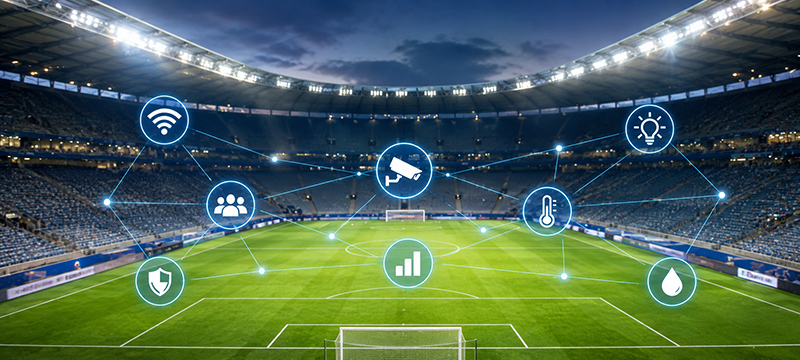
Deutsche Telekom IoT is using the upcoming 2026 FIFA World Cup as a real-world blueprint for how connected stadiums could function — covering everything from parking and logistics to building systems, mobility, safety, and fan services. What stands out here isn’t a specific product reveal, but rather a clear picture of how global IoT connectivity, 5G, and real-time data must collaborate across the demanding environment of a major international event.
When people talk about stadium digitalization, they usually focus on the fan-facing side: quicker entry, improved apps, seamless payments, and more relevant information. But the real challenge lies beneath those visible improvements. A major tournament demands that transportation, venue operations, building infrastructure, security, concession logistics, and mobile networks all perform simultaneously — under intense, short bursts of peak demand and across multiple countries and regulatory frameworks.
That’s the backdrop for Deutsche Telekom IoT’s latest smart-stadium vision tied to the 2026 FIFA World Cup, set to take place across the United States, Canada, and Mexico. With 48 teams playing 104 matches, the tournament serves as an ideal stress test for IoT architectures, combining packed stadiums with cross-border travel, temporary surges in activity, and the need for consistent digital services not just inside venues but in the surrounding areas as well.
From a connected venue to a connected event district
What sets Telekom’s approach apart is that it doesn’t treat the smart stadium as a simple building automation project. Instead, the company outlines an operational model that begins before the first whistle, continues throughout the match, and extends into post-event cleanup and safety procedures. Within this model, IoT sensors can track pitch moisture and sunlight levels, autonomous mowers and line-marking robots can rely on positioning data, and connected logistics systems can manage the flow of pallets, catering supplies, merchandise, and technical equipment throughout the venue.
Beyond the stadium walls, the same connectivity layer extends to parking, lighting, and mobility. Telekom highlights AI-driven parking sensors, electric vehicle charging integration, connected LED lighting that adapts to ambient conditions and crowd size, and shuttle services equipped with LiDAR, cameras, and precise positioning technology. During the event, building management systems pull together sensor data for lighting, ventilation, energy consumption, maintenance, and cleaning. After the final whistle, video analytics and other sensor inputs can help manage crowd dispersal, while connected emergency equipment and smart waste bins report their status or fill levels in real time.
What distinguishes this from a typical smart-building or fan-app announcement is the sheer scope of the operational footprint. Telekom is essentially framing the stadium as a temporary smart city district — where parking lots, access roads, service zones, energy systems, public transit connections, and visitor navigation tools all become integrated parts of the event’s infrastructure.
Connectivity is the core architectural challenge
The key technical takeaway isn’t simply that more sensors are being deployed. It’s that the 2026 tournament spans three countries, which makes device connectivity, roaming, provisioning, and platform integration far more complex than for a single domestic venue. Telekom points to global IoT connectivity, international partner and roaming networks, 5G, private 5G campus networks, and high-precision positioning using mobile and satellite data as essential pieces of the overall puzzle.
A practical consequence of this mix is that no single network technology is likely to serve every stadium use case. Low-power sensors for parking or fill-level monitoring have very different needs compared to real-time fan services, autonomous service vehicles, or the high-density mobile usage generated by tens of thousands of spectators. For IoT teams, the real challenge is orchestration — matching the right connectivity option to each application while maintaining consistent device management, data security, and operational visibility across the entire estate.
Telekom also notes that aggregated and anonymized visitor movement data could be used for crowd flow analysis, where permitted by regulation and applicable data protection laws. That caveat is important. Crowd analytics in a stadium setting can be highly valuable for safety and routing, but it also demands strong governance around data minimization, anonymization, and local compliance — especially in a tournament that crosses national borders.
Why IoT stakeholders should pay attention
For device manufacturers, the takeaway is that stadium-related products increasingly need to slot into broader operational ecosystems rather than function as standalone devices. Parking sensors, cleaning robots, lighting controllers, EV charging systems, and safety equipment must all be connectable, manageable, and supportable in environments where demand can spike and drop rapidly.
For connectivity providers and system integrators, the opportunity lies in weaving together public cellular IoT, 5G capacity, private networks, positioning services, and cloud platforms — without creating separate operational silos for each use case. Enterprises and venue operators, meanwhile, should see this scenario as a reminder that smart-stadium ROI extends well beyond fan-facing services. Energy management, logistics efficiency, maintenance coordination, parking utilization, safety preparedness, and post-event cleanup can all factor into the business case.
Telekom’s World Cup scenario shouldn’t be interpreted as a confirmed deployment plan for every venue. Its real value is in illustrating just how many operational domains now depend on reliable connected infrastructure. For large-scale events, the smart stadium is becoming less about any single impressive application and more about whether the invisible systems surrounding the venue can work in concert when tens of thousands of people arrive, move around, consume services, and depart within a tightly compressed window of time.
