



## **Single-cell Continual Integration with CL: Methods, Challenges, and Solutions**
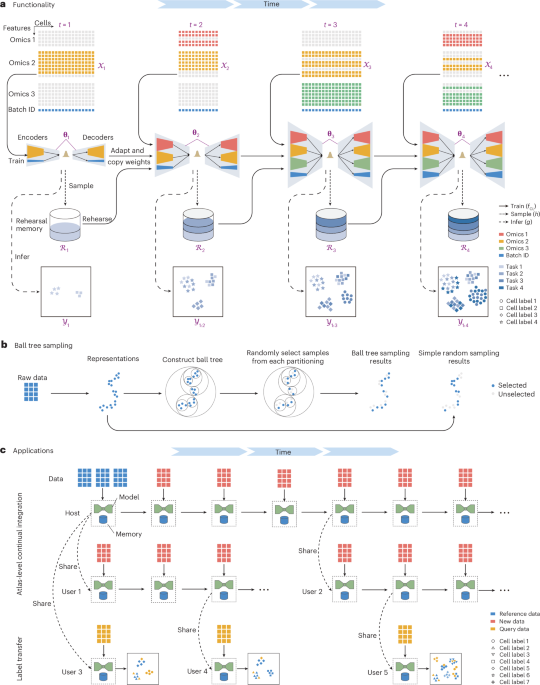
The integration of single-cell data in a continual manner—where new batches of data arrive over time—poses significant challenges for maintaining biological accuracy, batch correction, and computational efficiency. Traditional offline integration methods retrain models on all data whenever new information arrives, which becomes increasingly inefficient and resource-intensive. To address these limitations, recent advances in continual learning (CL) frameworks, particularly those leveraging contrastive learning (CL), have introduced robust strategies for dynamic and memory-efficient single-cell atlas construction. This article outlines the core scenarios, strategies, and technical components involved in single-cell continual integration, with a focus on contrastive learning-based approaches and their advantages over conventional methods.
—
### **The Scenario of Single-cell Continual Integration**
Single-cell continual integration aims to continuously incorporate new data into an evolving cellular atlas. As new cell batches arrive, the goal is to update all integration results without reprocessing the entire dataset from scratch. Mathematically, let
( mathcal{X}_t = {x_{t,n}}_{n=1}^{N_t} )
represent the batch of cells arriving at time
( t ),
where
( x_{t,n} )
is the observation for cell
( n ).
The corresponding integration results
( mathcal{Y}_t ), which may include low-dimensional embeddings or batch-corrected data, must be updated efficiently as
( mathcal{X}_t )
arrives, maintaining consistency across all accumulated data
( mathcal{Y}_{1:t} ).
—
### **Offline Strategy**
The most straightforward approach to continual integration is the offline strategy, where all historical and new data are used to retrain model parameters each time a new batch arrives:
[
mathbf{theta}_t = f_{text{off}}(mathcal{X}_{1:t})
]
[
mathcal{Y}_{1:t} = g(mathcal{X}_{1:t}; mathbf{theta}_t)
]
While this method is effective in principle, it becomes computationally prohibitive as data accumulate. Each new batch triggers a full retraining cycle, making scalability a major concern.
—
### **Online Strategies**
To mitigate computational overhead, online strategies have been developed. These approaches avoid retraining on all historical data by updating models incrementally.
#### **Online Strategy 1: Generalization**
One approach relies on a pretrained model that generalizes across batches. The model is trained offline on large external datasets and then applied directly to new data:
[
mathbf{theta}_0 = f_{text{off}}(mathcal{X}_0)
]
[
mathcal{Y}_t = g(mathcal{X}_t; mathbf{theta}_0)
]
Although efficient, this strategy suffers from poor adaptability, as external datasets may not capture biological or technical variations present in new data.
#### **Online Strategy 2: Fine-tuning**
Fine-tuning updates model parameters incrementally using new data:
[
mathbf{theta}_t = f_{text{FT}}(mathcal{X}_t; mathbf{theta}_{t-1})
]
[
mathcal{Y}_{1:t} = g(mathcal{X}_{1:t}; mathbf{theta}_t)
]
While this reduces retraining overhead, it suffers from **catastrophic forgetting**, where the model gradually loses knowledge of earlier batches as it adapts to new ones.
#### **Online Strategy 3 (Proposed): Contrastive Learning (CL)**
To balance adaptability and retention, a CL-based approach introduces a **rehearsal memory** that stores key samples from previous batches:
[
mathbf{theta}_t = f_{text{CL}}(mathcal{X}_t, mathcal{R}_{t-1}; mathbf{theta}_{t-1})
]
[
mathcal{R}_t = h(mathcal{X}_t, mathcal{R}_{t-1}; mathbf{theta}_t)
]
[
mathcal{Y}_{1:t} = g(mathcal{X}_{1:t}; mathbf{theta}_t)
]
By replaying representative samples from past data during training, CL prevents forgetting while incorporating new information. The initial memory
( mathcal{R}_0 )
and parameters
( mathbf{theta}_0 )
can be randomly initialized or pretrained.
—
### **Dynamic Architecture Adaptation**
In continual integration, new data may introduce additional modalities or features (e.g., new sequencing technologies). To accommodate this, model architecture can be dynamically expanded. Given new modality parameters
( tilde{mathbf{theta}}_t ), the combined parameter set is:
[
hat{mathbf{theta}}_t = [mathbf{theta}_{t-1}, tilde{mathbf{theta}}_t]
]
Training on both new and rehearsal data ensures seamless integration of new modalities without disrupting existing representations.
—
### **Distribution-preserving Reservoir Sampling (DPRS)**
As the rehearsal memory grows, efficiency and unbiased knowledge retention become concerns. **Distribution-preserving reservoir sampling (DPRS)** addresses this by limiting memory size while preserving data distribution:
– **Batched reservoir sampling** ensures that new and old data are retained proportionally to their original batch sizes.
– **Stratified sampling** maintains inter-batch distribution consistency.
– **Ball tree sampling (BTS)** preserves intrabatch data distribution, particularly important for high-dimensional, nonuniform single-cell data.
Together, these techniques ensure that memory remains both manageable and representative.
—
### **Handling Mosaic Data**
Real-world single-cell datasets often contain **mosaic data**, where batches include varying combinations of modalities (e.g., RNA + ATAC, or RNA + ADT). The **MIRACLE** framework extends contrastive learning to mosaic settings by wrapping a base model—such as **MIDAS**, a multimodal VAE—around CL. This enables dynamic integration of new modalities while preventing forgetting through rehearsal memory and architectural expansion.
—
### **Implementation and Evaluation**
The approach is evaluated on a wide range of public single-cell datasets, including large-scale RNA, ATAC, and ADT datasets. Integration performance is assessed using **scIB** and **scMIB** metrics, which measure batch correction, biological conservation, and modality alignment. Catastrophic forgetting is quantified using **ACC** (average accuracy) and **BWT** (backward transfer), adapted from continual learning benchmarks.
—
## **Frequently Asked Questions (FAQ)**
**Q1: What is single-cell continual integration?**
Single-cell continual integration is the process of incrementally incorporating new single-cell datasets into a unified cellular atlas while maintaining biological consistency and avoiding catastrophic forgetting.
**Q2: Why is contrastive learning (CL) used in continual integration?**
CL introduces a rehearsal memory that retains key samples from previous data, enabling models to adapt to new batches while preserving knowledge of earlier ones.
**Q3: How does dynamic architecture adaptation work?**
When new modalities or features are introduced, the model architecture is expanded by randomly initializing parameters for the new components and training them alongside existing parameters.
**Q4: What is distribution-preserving reservoir sampling (DPRS)?**
DPRS is a memory management strategy that limits rehearsal memory size while preserving both inter-batch and intra-batch data distributions through stratified and ball-tree-based sampling.
**Q5: How is mosaic data handled in this framework?**
Mosaic datasets are handled using MIRACLE, a CL-based framework built on MIDAS, which supports incremental integration of multiple modalities without forgetting.
**Q6: What metrics are used to evaluate integration performance?**
Performance is evaluated using scIB and scMIB metrics, which assess batch correction, biological conservation, and modality alignment. Catastrophic forgetting is measured using ACC and BWT.
—
## **Conclusion**
Single-cell continual integration represents a critical step toward building dynamic, evolving atlases of cellular states. Traditional offline and fine-tuning-based online methods face challenges in scalability, adaptability, and catastrophic forgetting. In contrast, contrastive learning–based approaches—combined with dynamic architecture adaptation and distribution-preserving sampling—offer a robust solution. These methods enable efficient, unbiased, and biologically faithful integration of new data over time, making them well suited for real-world single-cell applications. As datasets continue to grow in size and complexity, CL-based continual integration frameworks will play an essential role in advancing single-cell biology.
