



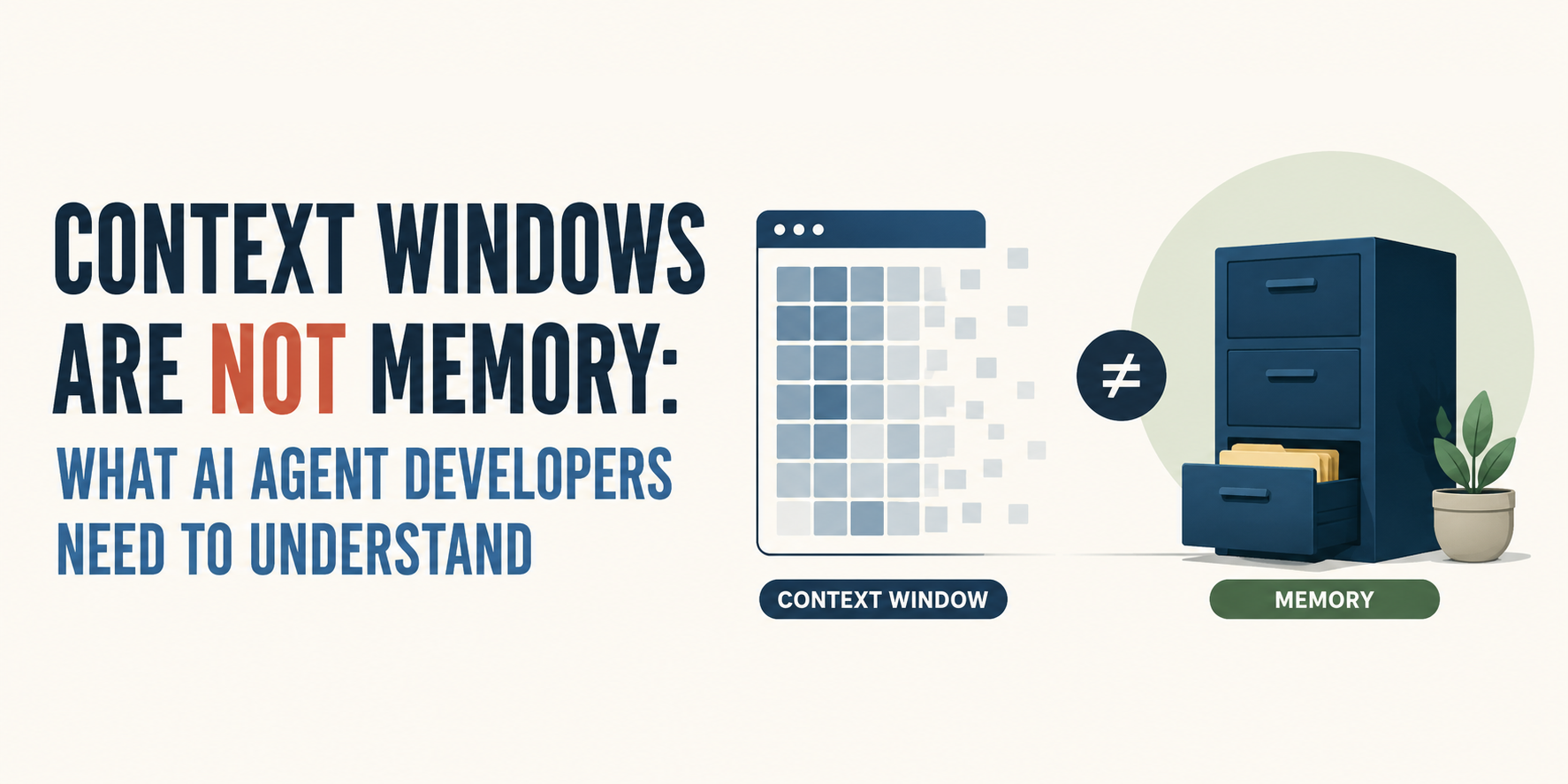
In this article, you’ll discover why a massive context window isn’t equivalent to agent memory, and how strategies like retrieval, compression, and summarization work together within an agent’s cognitive architecture.
Here’s what we’ll explore:
- Why a context window acts like a stateless scratchpad rather than a persistent memory store.
- How retrieval-augmented generation, compression, and summarization each serve a unique function in curating what gets placed onto that scratchpad.
- How agents can achieve true memory persistence by operating as a database administrator instead of serving as the database.
Introduction
Context windows are a fundamental feature of modern AI models — especially language models — that determine how much input and prior conversation these models can attend to and draw upon simultaneously when generating a response, typically quantified as a number of tokens.
When an AI lab releases a model with a 2-million token context window, some developers naturally assume: “Let’s dump the entire codebase into the prompt! Problem solved!” There’s a catch, though. Treating a large context window as “memory” is architecturally like buying a 25-foot-wide office desk simply because you don’t want to get a filing cabinet. Sure, you can spread all your papers out in front of you, but the moment the work session ends, the cleaners come and clear everything away.
To help clarify this distinction and untangle related ideas, this article provides a conceptual tour of the several layers that make up an AI agent’s cognitive stack. We’ll lean on a handful of office-themed metaphors along the way to make these notions easier to grasp.
Context Window
A context window in an AI model — especially one powering an agent built on top of a language model — behaves much like a desk surface or a stateless scratchpad. The crucial point is that models are fundamentally stateless. Every API call to a model begins from “step zero,” without exception.
When you hand an agent a conversation history spanning 200K+ tokens (a large context window), it isn’t recalling something that happened at an earlier moment in time. Rather, it is speed-reading its entire universe from scratch in a matter of milliseconds. Over time, leaning on this approach in agent-based systems can lead to several serious — even fatal — pitfalls:
- AI models act like a neglectful student who carefully reads only the opening and closing sections of a massive prompt while completely skimming over ideas and facts hidden in the middle.
- There’s a compounding effect: as the conversation lengthens, the agent is forced to re-transmit and re-read the entire history at every step, including the earliest, frequently irrelevant exchanges.
- From a latency standpoint, there’s a “brain freeze” phenomenon — confronted with an enormous wall of text, the model takes noticeably longer to produce even its first token of output.
To put this into perspective, consider what a single API call actually looks like behind the scenes. Because the model retains zero memory between calls, every prior exchange must be re-submitted in full just to pose one new question:
model.generate( messages=[ {: “user”, “content”: “Step 1: Let’s call this variable `session_id`.”}, {: “assistant”, “content”: “Got it, I’ll use `session_id` going forward.”}, # … every intervening turn must be resent, every single time … {: “user”, “content”: “Step 47: What variable name did we agree on back in step 1?”} ] ) |
By step 47 alone, the entire desk — all 46 preceding exchanges — has to be placed back onto the table, just to answer a question about step 1. That’s the compounding effect described earlier, made tangible.
Retrieval
Retrieval-augmented generation (RAG) systems function like a large bookshelf across the office that fetches static, pre-existing data relevant to the current step in a just-in-time manner. RAG systems pull the top-K most relevant document chunks into the scratchpad (the context window) as the user poses a given question — specifically, those chunks deemed most semantically aligned with the user’s query or prompt.
When agents enter the picture, however, things get more complicated, because vector similarity (the type of similarity)
In specific instances, the similarity scores and data formats utilized in Retrieval-Augmented Generation (RAG) frameworks may not perfectly align with the actual semantic truth of a situation. Consider a scenario where a user instructs an AI scheduling assistant to postpone a week-ahead meeting to the upcoming Friday. Later, the user sends a follow-up stating, “Please cancel the Thursday slot; Alice is unwell.” When querying a document store, a vector database might return both instructions, even though they directly oppose one another. Consequently, the AI agent and its underlying Language Model must function as cautious auditors, capable of discerily evaluating which directive precisely represents the current state of events.
A simplistic RAG workflow would just gather this retrieved information and feed it directly to the language model, leaving the AI to guess which rule is still in effect. A more robust solution involves resolving such logical conflicts before generating a final output—for instance, by prioritizing the instruction that was given most recently:
retrieved_chunks = [ {“text”: “Shift meeting to Friday”, “timestamp”: “2025-01-10T09:00:00”}, {“text”: “Cancel Thursday due to Alice’s illness”, “timestamp”: “2025-01-12T14:30:00”} ]
# Resolve conflicting information before it enters the prompt template latest_relevant = max(retrieved_chunks, key=lambda chunk: chunk[“timestamp”]) |
That single line of conflict-resolution logic distinguishes an AI agent that blindly repeats an outdated instruction from one that accurately recognizes the meeting has been called off.
Compression
This concept is straightforward if you have experience with file archiving tools like ZIP. Within the realm of AI agents and language models, compression refers to algorithmic token reduction: preserving the core informational content while shrinking its physical size within a prompt during a specific processing step. Various techniques can achieve this, such as removing common stop-words, routing raw text through a specialized compression model like LLMLingua, or implementing Prompt Caching. Fundamentally, this is a bandwidth optimization strategy—for example, condensing a 15,000-token JSON payload down to 3,000 tokens, thereby freeing up the necessary workspace for the model to perform its primary reasoning tasks.
In a practical implementation, this could be as simple as routing a bulky data payload through a compression utility before it ever touches the main prompt:
raw_payload = json.dumps(large_api_response) # approximately 15,000 tokens
compressed_payload = compress_with_llmlingua( raw_payload, target_token_count=5000 )
prompt = f“Analyze this dataset: {compressed_payload}nnFormulate a response to the user’s query.” |
The core factual data remains completely intact throughout the process; only
their impact on the workspace is minimized.
Summarization
In contrast to compression, summarization permanently removes the original data and substitutes it with a condensed version. It must be recognized for what it is: a one-way, fundamentally irreversible process. A highly recommended—almost essential—practice when performing context summarization is to employ forked storage: storing full transcripts in low-cost storage such as S3 buckets or simple SQL tables, and then feeding only the synthesized summary into the active prompt.
That forked-storage approach can be distilled into a simple two-step write operation—one directed to cold storage and one to the active prompt:
def summarize_turn(raw_transcript, session_id, turn_id): # 1. Save the full, unedited transcript to cold storage s3_client.put_object( Bucket=“agent-transcripts”, Key=f“{session_id}/turn_{turn_id}.json”, Body=raw_transcript )
# 2. Produce a concise summary for the active prompt summary = summarizer_model.generate(raw_transcript)
# 3. Only the summary re-enters the context window return summary |
If a subsequent step requires the original detail, it can always be fetched from S3. Unlike compression, summarization never needs to be reconstructed from within the active prompt itself.
Memory Persistence as a State Machine
Memory persistence in agents is frequently taken for granted, especially by less experienced developers. But to endow an agent with genuine memory, it should not serve as the database itself—it should act as the database administrator. Suppose a user says, “My dog’s name is Goofy, but we might rename him Pluto.” The agent should then be able to explicitly invoke a tool-call such as this:
{ “tool”: “update_entity_graph”, “params”: { “subject”: “User_Dog”, “attribute”: “Name”, “value”: “Goofy”, “notes”: “Considering Pluto” } } |
It makes no difference whether it is backed by a conventional SQL table, a knowledge graph, or Redis: in any case, the agent should be instructed to query the state machine at the beginning of every
Wrapping Up
By now, you should have a much better grasp of the moving parts involved in handling context for agents powered by language models. The core takeaway is straightforward: stop trying to purchase an enormous, 10-million-token workbench. Instead, get yourself a standard desk, hand your agent a reliable pencil, and train it to open the filing cabinet and make the most of everything inside so it can do its job well.
