



**Corgi: A Deep Learning Model for Predicting Chromatin Organization and Gene Regulation**
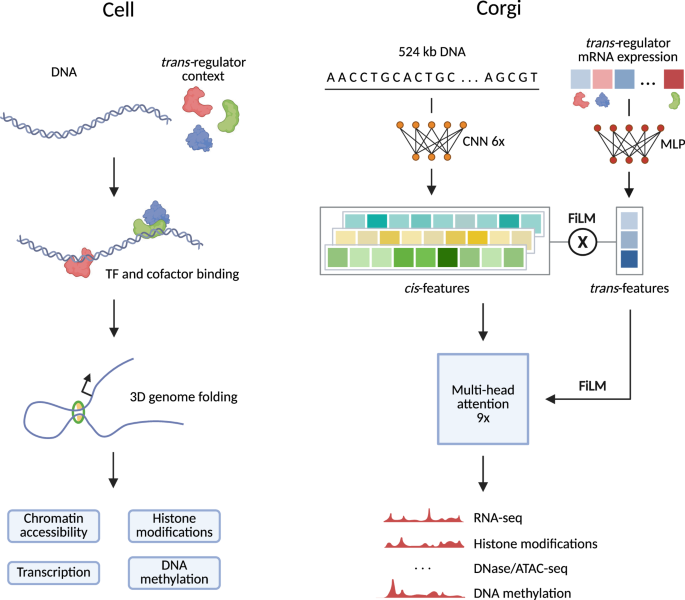
Understanding how DNA sequence dictates gene regulation and chromatin organization is a central challenge in genomics. Recent advances in high-throughput assays such as RNA-seq, ATAC-seq, ChIP-seq, and DNA methylation profiling have generated vast amounts of data, yet integrating these signals to predict cell-type-specific regulatory activity remains difficult. In a major step forward, researchers have developed **Corgi**, a transformer-based deep learning model that leverages DNA sequence and *trans*-regulator expression to predict multiple chromatin and transcriptomic features across the human genome.
—
### Data and Model Design
Corgi was trained on a comprehensive and carefully curated dataset comprising **580 biological samples** across diverse human cell types and tissues. These samples were sourced from public databases including ENCODE, FANTOM5, and CATlas, and included a combination of bulk RNA-seq, single-cell RNA-seq, ATAC-seq, ChIP-seq, and CAGE-seq experiments. To ensure robustness and minimize data leakage, samples were clustered by *trans*-regulator expression and split into **488 training**, **28 validation**, and **37 test samples**.
The model defines *trans*-regulatory factors as a broad set of **2,891 genes**, including transcription factors, transcriptional co-activators, chromatin modifiers, and RNA-binding proteins, whose activities are proxied by gene expression levels (TPM). Genomic input consisted of **524,288 bp sequences**, tiled across the genome, with **6144 bins of 64 bp** as the prediction target.
Corgi’s architecture is based on a **nine-layer transformer** with FlashAttention, containing approximately **196 million trainable parameters**. It predicts coverage and activity tracks for 22 genomic assays, including histone modifications, CTCF binding, DNA methylation, and multiple RNA-seq modalities.
—
### Training and Evaluation
Training used a modified Poisson multinomial loss with channel-wise weighting to balance contributions from different assays. The model was optimized using AdamW, mixed precision training, and rotary positional encodings. To prevent overfitting given the large number of training sequences per sample, extensive **data augmentation** was applied, including random sequence shifting, reverse complementation, and SNP perturbation.
Corgi was benchmarked against both **ground-truth experimental data** and two existing models: **Borzoi** and **EpiGePT**. Performance was evaluated using Pearson and Spearman correlations at both nucleotide and gene levels, across **cross-sequence**, **cross-cell-type**, and **cross-both** settings. Results show that Corgi consistently outperforms or matches prior models, particularly in predicting cell-type-specific regulatory activity.
—
### Key Applications and Insights
Beyond prediction, Corgi supports **interpretability and hypothesis generation**. Using integrated gradients and input x gradient methods, the model enables **contribution scoring** at both *trans*-regulator and nucleotide levels. Gene set enrichment and motif analysis reveal biologically meaningful regulators and binding sites.
The authors also performed **in silico mutagenesis** and **variant effect prediction**, demonstrating Corgi’s utility for interpreting non-coding genetic variation. By integrating eQTL data from GTEx, the model can prioritize causal variants and estimate their effects on gene regulation in a tissue-specific manner.
—
### Frequently Asked Questions (FAQ)
**What types of data does Corgi use as input?**
Corgi uses DNA sequence (524,288 bp) and *trans*-regulator gene expression profiles (log TPM) as inputs. The expression vector includes transcription factors, co-activators, chromatin modifiers, and RNA-binding proteins.
**What genomic signals can Corgi predict?**
Corgi predicts coverage and activity for DNase-seq, ATAC-seq, multiple histone modifications (e.g., H3K4me3, H3K27ac), CTCF binding, DNA methylation, and various RNA-seq assays including bulk and single-cell data.
**How does Corgi handle batch effects across different assays?**
Gene expression data are harmonized using quantile normalization and batch correction (pyComBat) against a reference RNA-seq dataset. Output signals are normalized using assay-specific scaling and soft clipping, followed by aggregation to 64 bp resolution.
**What makes Corgi different from earlier models like Borzoi?**
Unlike Borzoi, Corgi uses a transformer architecture without U-Net upsampling, operates at 64 bp resolution, and incorporates *trans*-regulator expression directly into the model. This design reduces the need for hierarchical prediction and improves interpretability.
**Can Corgi be used for variant effect prediction?**
Yes. By comparing predictions with and without a variant allele, Corgi can estimate the effect of non-coding SNPs on chromatin and gene regulation in a tissue-specific context.
—
### Conclusion
Corgi represents a significant advance in **sequence-based prediction of chromatin regulation**, unifying diverse genomic assays into a single, interpretable deep learning framework. By combining transformer architectures with comprehensive *trans*-regulator expression data, Corgi achieves strong performance across prediction, imputation, and variant effect tasks. Its ability to link genetic sequence to functional chromatin and gene regulatory outcomes makes it a powerful tool for studying gene regulation, interpreting non-coding variation, and guiding future integrative genomics research.
