



**Canada Economy Just Outran America: Is Its Crypto Industry Next?**
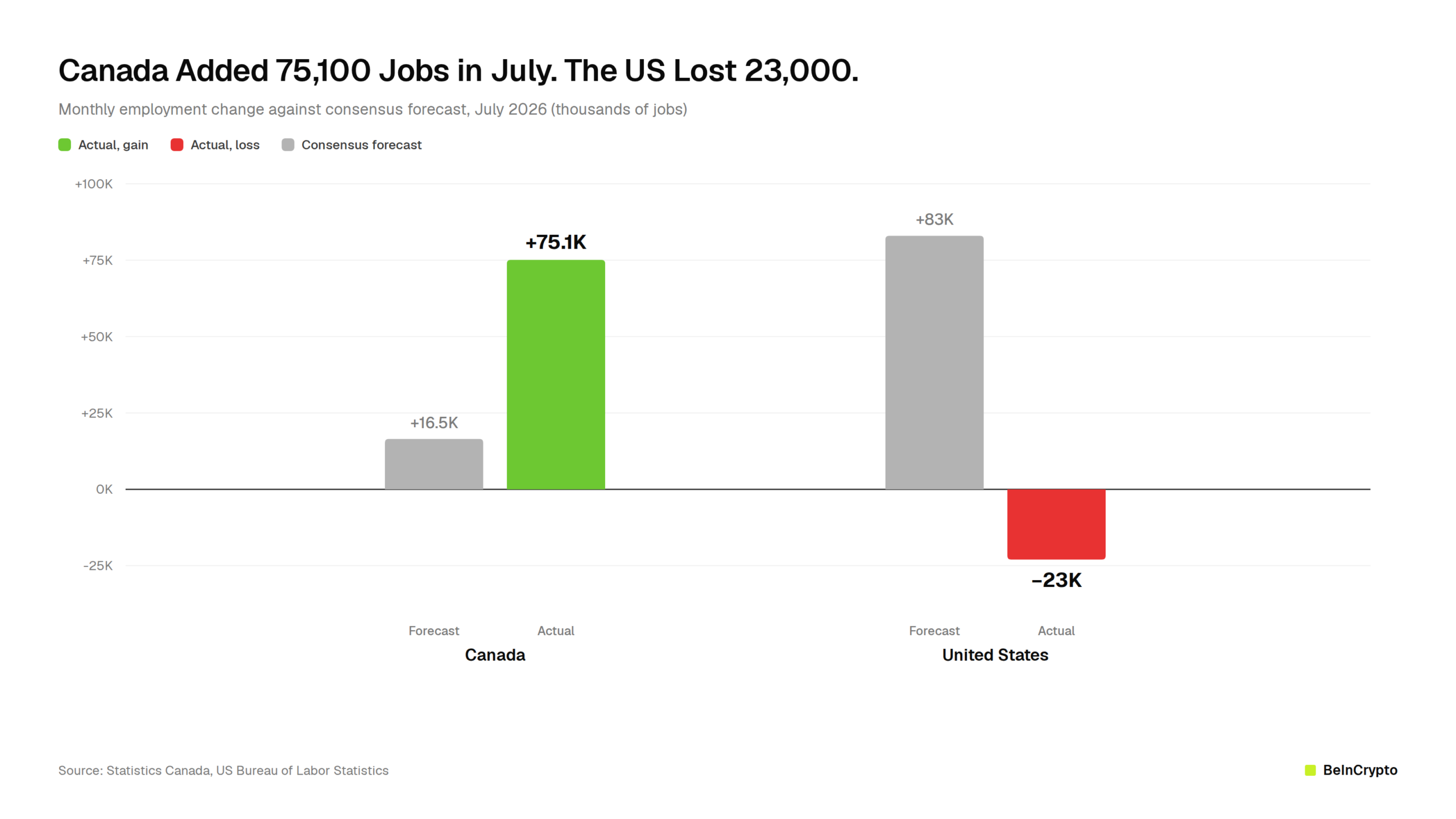
Canada’s July jobs report delivered a jolt to the North American economic landscape. The nation added a staggering 75,000 jobs, a figure that was approximately five times the forecasts of economists. This robust growth stands in stark contrast to the United States, which shed 23,000 jobs in the same period, widening its negative trajectory with further downward revisions. This dramatic divergence in labor market performance is more than just a statistical footnote; it is a pivotal development with significant implications, particularly for the burgeoning cryptocurrency sector in Canada. For the first time in months, the region offers a stronger, more dynamic home market for crypto firms than their American counterparts have experienced all summer.
***
### A Five Times Beat Meets a US Contraction
Economists had anticipated a modest increase of around 15,000 jobs for Canada in July. The reality was far more impressive, with 75,000 new positions created. This surge was not a lopsided victory for one sector; the gains were split almost evenly between full-time and part-time employment.
The industries leading this charge are particularly relevant to the digital asset space. Finance, insurance, and real estate added 18,000 jobs, while professional, scientific, and technical services contributed another 17,000. These are the very fields where blockchain and cryptocurrency firms are actively building their teams, from developers and engineers to compliance and legal experts.
Canada’s momentum is further underscored by the fact that the nation has now added 181,000 jobs since April, marking three consecutive months of positive growth.
> “Three straight months moving in the right direction is exactly how turning points begin. And if the breadth we saw in July holds into the fall, stabilization could quietly become the momentum Canada has been waiting for,” said Laura Ulrich, director of economic research at recruitment firm Indeed, in a statement.
*Follow us on X to get the latest news as it happens.*
In sharp contrast, the American report painted a grim picture. The US economy contracted, losing 23,000 jobs—well below the expected gains of 80,000 to 90,000. The situation was aggravated by revisions that erased an additional 103,000 jobs from the preceding two months. Over the past year, US hiring has averaged a mere 34,000 positions per month, highlighting a significant slowdown.
While it is true that the US unemployment rate of 4.1% remains lower than Canada’s 6.4%, this comparison misses the crucial narrative. The US rate has held flat while the economy shrank, whereas Canada’s unemployment rate fell in tandem with a massive hiring boom. The direction of travel, not just the static level, is the decisive story.
***
### Central Bank Paths Split as Bitcoin Holds $65,000
This dramatic split in economic fortunes is directly influencing the monetary policy trajectories of the Bank of Canada and the Federal Reserve. The divergence creates a scenario where Canadian authorities have the flexibility to wait, while the Fed faces pressure to act.
Royce Mendes, managing director at Desjardins, indicated that a Bank of Canada rate hike is unlikely before 2027. This patience is supported by cooling wage growth, which has slowed to 2.8%, the slowest pace in four years. Strong hiring without concurrent wage pressure provides the central bank with the confidence to maintain a观望 (wait-and-see) stance.
The Federal Reserve, however, is grappling with a different beast. A shrinking payroll makes the case for further interest rate hikes significantly harder to defend.
The market reaction was swift. Within hours of the report, Fed expectations were thrown into flux as traders repriced US interest rates. For crypto markets, which had initially rallied on stronger-than-expected US data in June, this new wave of weak US information is being interpreted as a positive signal for liquidity.
Bitcoin (BTC) reacted accordingly, trading near the $65,000 mark on Friday, up 0.8% over a 24-hour period. Its overall market capitalization hovers around $1.31 trillion.
***
### Can the Canada Crypto Industry Capitalize?
The question on everyone’s mind is whether Canada can translate this macroeconomic strength into tangible gains for its crypto industry. The nation has a precedent for moving first, most notably with the Toronto Stock Exchange launching the world’s first spot Bitcoin ETF in February 2021. The Purpose Bitcoin ETF, launched at that time, now holds approximately 18,500 BTC valued at $1.7 billion CAD. It took US regulators almost three more years to approve comparable domestic products.
The regulatory framework is also evolving. The Stablecoin Act, passed through Budget 2025’s Bill C-15, places fiat-backed stablecoin issuers under the oversight of the Bank of Canada. These rules mandate one-to-one reserves and require redemption at par. They are set to take effect in 2027.
Major industry players are already positioning for this new landscape. Eric Richmond, CEO of Coinbase Canada, stated in July that the company aims to build an “everything exchange” for Canadians. This vision encompasses crypto, stocks, and prediction markets, all integrated into a single application. He explicitly linked the full rollout of this ambitious plan to the implementation of the stablecoin regulations.
However, headwinds remain. British Columbia has permanently banned new grid connections for crypto mining, steering the province’s clean energy resources toward AI and industrial applications instead. Furthermore, liquidity in US venues remains far deeper, and Andrew Grantham, a senior economist at CIBC, noted that Canadian unemployment is still approximately half a point above the level of full employment.
The coming month will provide critical data points. Draft stablecoin rules are scheduled for release in the Canada Gazette, and payroll data from both nations will be published. Together, these events will indicate whether July’s divergence represents a lasting trend or a temporary blip.
***
### FAQ
**Q1: How many jobs did Canada add in July, and how did it compare to forecasts?**
A1: Canada added 75,000 jobs in July, which was about five times the forecasts of economists who had anticipated around 15,000 new positions.
**Q2: How does the US job market compare in the same period?**
A2: The US economy shed 23,000 jobs in July, and revisions to previous months erased an additional 103,000 jobs, resulting in a contraction that missed forecasts by over 100,000 positions.
**Q3: Which sectors in Canada are driving this job growth, and why is it important for crypto?**
A3: The sectors leading the growth are finance, insurance, and real estate (18,000 jobs), and professional, scientific, and technical services (17,000 jobs). These are key hiring areas for digital asset firms, which rely on such talent pools for development and operations.
**Q4: What is the current state of the Bank of Canada’s policy compared to the Federal Reserve’s?**
A4: The Bank of Canada is in a position to wait, with policy hikes not expected before 2027, due to controlled wage growth. Conversely, the Federal Reserve is facing pressure to pause or reverse tightening due to a shrinking labor market.
**Q5: How has the jobs data affected Bitcoin’s price?**
A5: The divergence in data has been interpreted by crypto markets as a signal of future liquidity. Bitcoin has traded near $65,000, reflecting optimism in the wake of the weaker-than-expected US economic performance.
**Q6: What long-term regulatory changes are underway in Canada for the crypto industry?**
A6: Canada passed the Stablecoin Act (Bill C-15) through Budget 2025, which will put fiat-backed stablecoin issuers under Bank of Canada oversight, requiring full reserves and on-demand redemption starting in 2027.
***
### Conclusion
Canada’s July jobs report was a resounding success, adding 75,000 positions and pulling far ahead of a struggling US economy. This divergence creates a uniquely favorable environment for the Canadian crypto industry, offering a deeper domestic talent pool and a more supportive regulatory trajectory. While challenges remain—notably competition from deep US liquidity and specific provincial energy policies—the momentum is clearly on the side of Canadian crypto. As the nation moves toward stablecoin regulation and prepares for the next set of employment data, the foundations look stronger than they have all summer for Canada to build a leading global hub for digital assets.
