



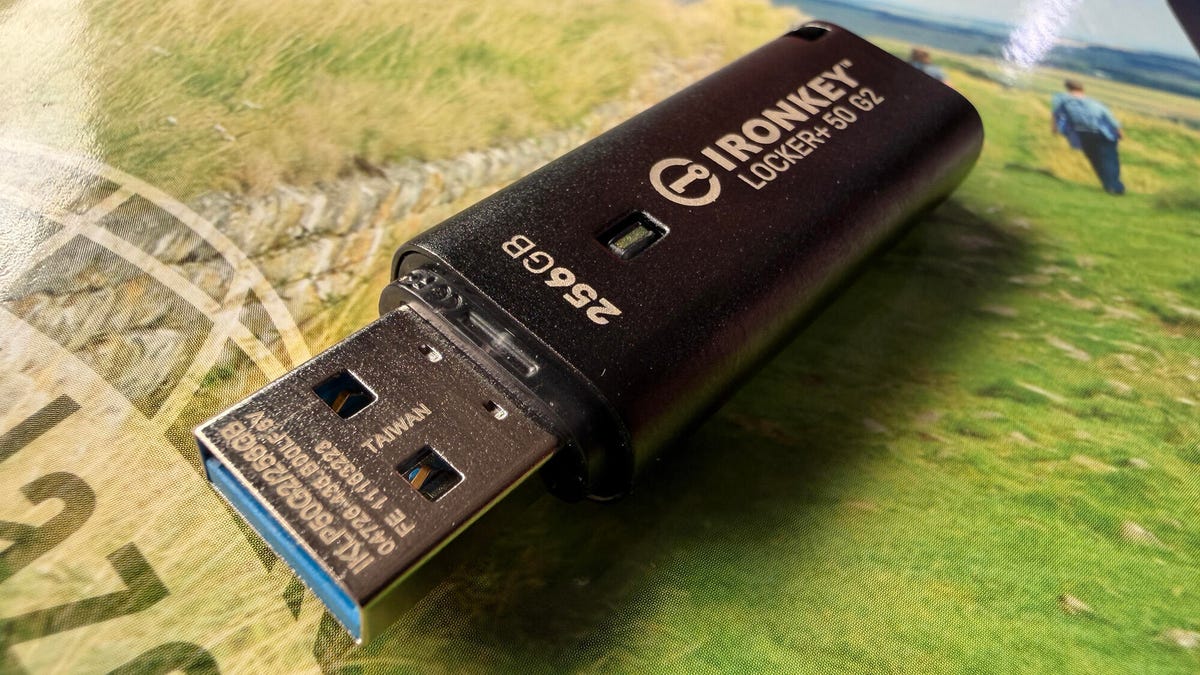
Kingston IronKey Locker+50 G2
pros and cons
- Military-grade encryption
- Built-in brute-force protection
- Starts at only $50.
- USB-A connector, so it needs a dock or converter for modern systems
- Cap is easily lost
- No lanyard.
Follow ZDNET: Add us as a preferred source on Google.
Transporting data on unencrypted drives is a recipe for disaster. Misplace the drive, and you don’t just lose the hardware—you hand over all your information to whoever picks it up. For businesses, this kind of loss can quickly lead to penalties and compliance issues. My advice? Anyone who relies on flash storage should switch to hardware-encrypted drives.
With an encrypted drive, if it goes missing, all you lose is the physical device.
Also: A common charging habit was quietly killing my iPhone’s battery – here’s the fix
I’ve spent the last few weeks putting the Kingston IronKey Locker+50 G2 flash drive through its paces. It’s not without flaws, but for most users, it’s a solid pick.
Hardware vs. software encryption
The IronKey Locker+50 G2 is a hardware-encrypted USB flash drive, which sets it apart from drives that rely on software-based encryption. Software encryption carries risks—data might remain unencrypted on the drive, or traces of cached files could still be recovered. Hardware encryption, on the other hand, uses a dedicated chip inside the drive to ensure that every bit of user-writable storage is always protected.
Also: I stress-tested this SSD enclosure with a bulldozer – here’s how it held up
Without the correct password, the data is completely unreachable. The moment the drive is unmounted, everything is locked down with strong encryption.
Because hardware encryption operates independently of the host computer, the drive is far less exposed to malware or hacking. That’s why I always recommend hardware-level security alongside software encryption for maximum protection.
Military-grade security
This drive uses 256-bit AES-XTS encryption—a military-grade standard that secures your data and adds tamper resistance. Simply plug it in (compatible with Windows and Mac), launch the IronKey app, type in your passcode, and the main storage partition unlocks. Unmount or disconnect the drive, and your data is instantly locked away again.
Also: 1 in 2 security leaders say they’re not ready for AI attacks – 4 actions to take now
One standout feature is brute-force protection. Imagine someone glimpsed part of your password over your shoulder and tries to guess the rest. After 10 incorrect attempts, the drive destroys the encryption keys stored on it, rendering the data permanently inaccessible.
I tested this on my own IronKey, and the moment I entered the 10th wrong password, all the test data on the drive was wiped. That information was gone for good.
There are a few other handy security features as well. A virtual on-screen keyboard helps you bypass key loggers. It also lets you randomize the keyboard layout—a smart move for touchscreens, where smudges or thermal imaging could reveal which keys were tapped.
The randomizer feature in action.
Screenshot by Adrian Kingsley-Hughes/ZDNET
There’s also a screenlogger protection mode that blanks the keyboard display while you type. That said, even with this feature turned on, I could still figure out which keys were pressed. This particular feature could use some refinement.
Also: How to easily encrypt your files on an Android phone – for free
On top of that, hardware-encrypted drives are designed to resist physical tampering. The internals are potted with epoxy resin, making it nearly impossible to access the chips without destroying them.
A few gotchas
There are a few things worth noting. First off, this is a USB-A flash drive, so if you’re using a modern laptop, you’ll need a converter or a docking station. It’s a minor inconvenience, but without a USB-C adapter, you might find yourself stuck.
I always carry a dock in my laptop bag for situations like this.
Adrian Kingsley-Hughes/ZDNET
The cap that protects the USB-A connector is something I’ll probably lose within weeks. It would be much better if there were a way to keep it attached to the drive.
There’s a lanyard hole on the drive, but Kingston doesn’t include a lanyard—a bit of a missed opportunity in my view.
Also: I bought a $40 earwax camera and keep finding reasons to use it
Despite these small complaints, I think the IronKey Locker+50 G2 is an excellent flash drive for today’s needs.
ZDNET’s buying advice
Kingston sells the IronKey Locker+50 G2 in four sizes: 32GB, 64GB, 128GB, and 256GB. Prices range from $50 to $240. I appreciate that the drive comes in multiple capacities—it means you only pay for the storage you actually need.
If you’re carrying data on a flash drive, encryption is essential to keep your personal information safe. For what it offers, the IronKey Locker+50 G2 delivers great value, and I can confidently recommend it to most people.
