



# The Rise of Purpose-Built Robotic Hands: Why Simplicity Outperforms Human-Like Design
The field of humanoid robotics has reached a fascinating crossroads. For years, engineers have chased the dream of replicating the human hand in all its complexity. A major robotics developer has now taken a bold step away from that philosophy, unveiling a four-fingered robotic hand that deliberately leaves out the pinky — and the results may reshape the industry’s approach to dexterity.
## A Hand Built for Real Work
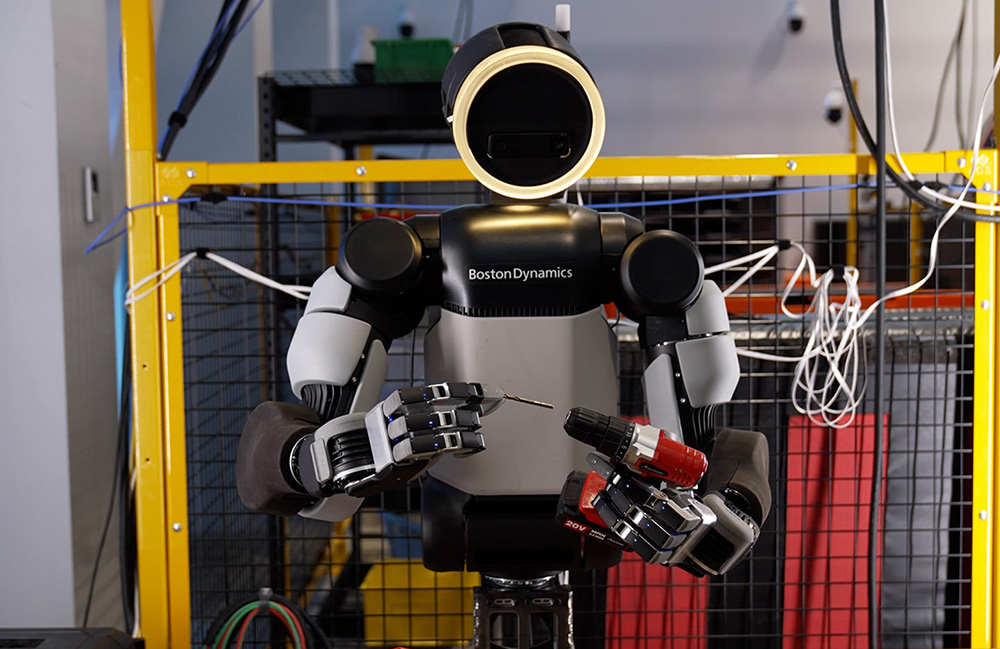
The latest hand design features 13 degrees of freedom across four fingers, with each digit directly actuated by a single actuator type. Unlike earlier models that prioritized the sheer variety of objects a robot could grip, this new iteration is engineered for manipulating those objects with precision — including powering tools like drills, torque drivers, grinders, nail guns, and welding torches.
What makes the hand particularly notable is its mass-manufacturable design. Every joint uses transparent, direct actuation with completely encapsulated motors, meaning no fragile cables cross through moving joints. This approach draws from the same design principles used in the robot’s overall body architecture, prioritizing reliability over biological mimicry.
## The Case Against a Pinky Finger
Designing a robotic hand involves countless trade-offs. Should it have one thumb or two? Is a fifth finger worth the added complexity? Engineers grappled with these questions before arriving at the final four-finger configuration.
To test whether the pinky was truly necessary, the team asked a simple experiment: tape the pinky and ring finger together and go about a normal day. Afterward, the consensus was clear — the additional degrees of freedom a pinky would provide simply weren’t worth the increase in size, power consumption, and mechanical complexity.
The result is a hand roughly the size of a large human hand, capable of in-hand reorientation, recovering from slipping grasps, and pressing tool triggers while maintaining a firm grip. Dense pressure tactile sensors cover the fingertips and palm, giving the hand the ability to detect even the smallest contact signals.
## Built for Simulation-Based Learning
Perhaps the most significant design choice isn’t visible from the outside. The hand was purpose-built for high-fidelity simulation, enabling sim-to-real reinforcement learning — a training paradigm where robotic behaviors are refined in virtual environments before being deployed on physical hardware.
Rigid-drive actuation and backdrivable transmission, paired with control innovations that compensate for cogging and friction, allow the hand to behave almost identically in simulation and reality. This fidelity means reinforcement learning algorithms can train robust control policies by exposing the virtual hand to randomized motor torque profiles, surface friction variations, object geometries, and unexpected disturbances.
Early results suggest this approach works. Behaviors trained entirely in simulation have transferred successfully to physical hardware, relying only on high-speed proprioceptive feedback from the actuators themselves.
## The Bigger Picture
The timing of this hand’s debut coincides with the opening of a dedicated robotics application center at a major automotive manufacturing facility. The center is intended to train humanoid robots for integration into vehicle production lines — and a tool-capable, reliable hand is central to that mission.
As the industry moves from experimentation to real-world deployment, the lesson from this design is clear: sometimes the best robotic hand is the one that doesn’t try to be human.
—
## Frequently Asked Questions
**Q: Why does the robotic hand have only four fingers?**
A: The design team determined that removing the pinky finger eliminates three additional degrees of freedom and their associated complexity, size, and power demands — without significantly sacrificing capability. Testing showed the remaining four fingers cover the vast majority of manipulation tasks.
**Q: What does “degrees of freedom” mean in this context?**
A: Degrees of freedom refer to the independent directions a joint can move. More degrees of freedom generally mean more possible positions and orientations, which translates to greater dexterity — but also greater mechanical complexity.
**Q: Why is simulation-based training important for robotic hands?**
A: Simulation allows engineers to train control policies on thousands of virtual variations of tasks, surfaces, and objects in a fraction of the time it would take to train on physical hardware. High-fidelity simulation ensures that what the robot learns virtually translates effectively to the real world.
**Q: What kinds of tools can the new hand operate?**
A: The hand is designed to trigger tools including drills, power torque drivers, grinders, nail guns, and welding torches — making it suitable for both manufacturing and field-service applications.
**Q: How does the hand maintain strength despite being smaller?**
A: Through several unique actuation technologies, the team preserved comparable strength to the previous hand design while reducing overall size and complexity.
**Q: What role do tactile sensors play in the hand’s operation?**
A: Dense pressure tactile sensors across the fingertips and palm allow the hand to detect subtle contact events, enabling fine control during delicate manipulation and tool use.
—
## Conclusion
The evolution of robotic hands is moving away from simply copying human anatomy and toward optimizing for specific real-world tasks. By stripping away unnecessary complexity and focusing on simulation-ready design, this four-fingered hand represents a pragmatic shift in how the robotics community thinks about dexterity. As humanoid robots move from research labs into factories and worksites, purpose-built simplicity may prove more valuable than biological perfection.
Thank you for reading
