



**Big Tech Earnings Week: The Real Winners and Losers**
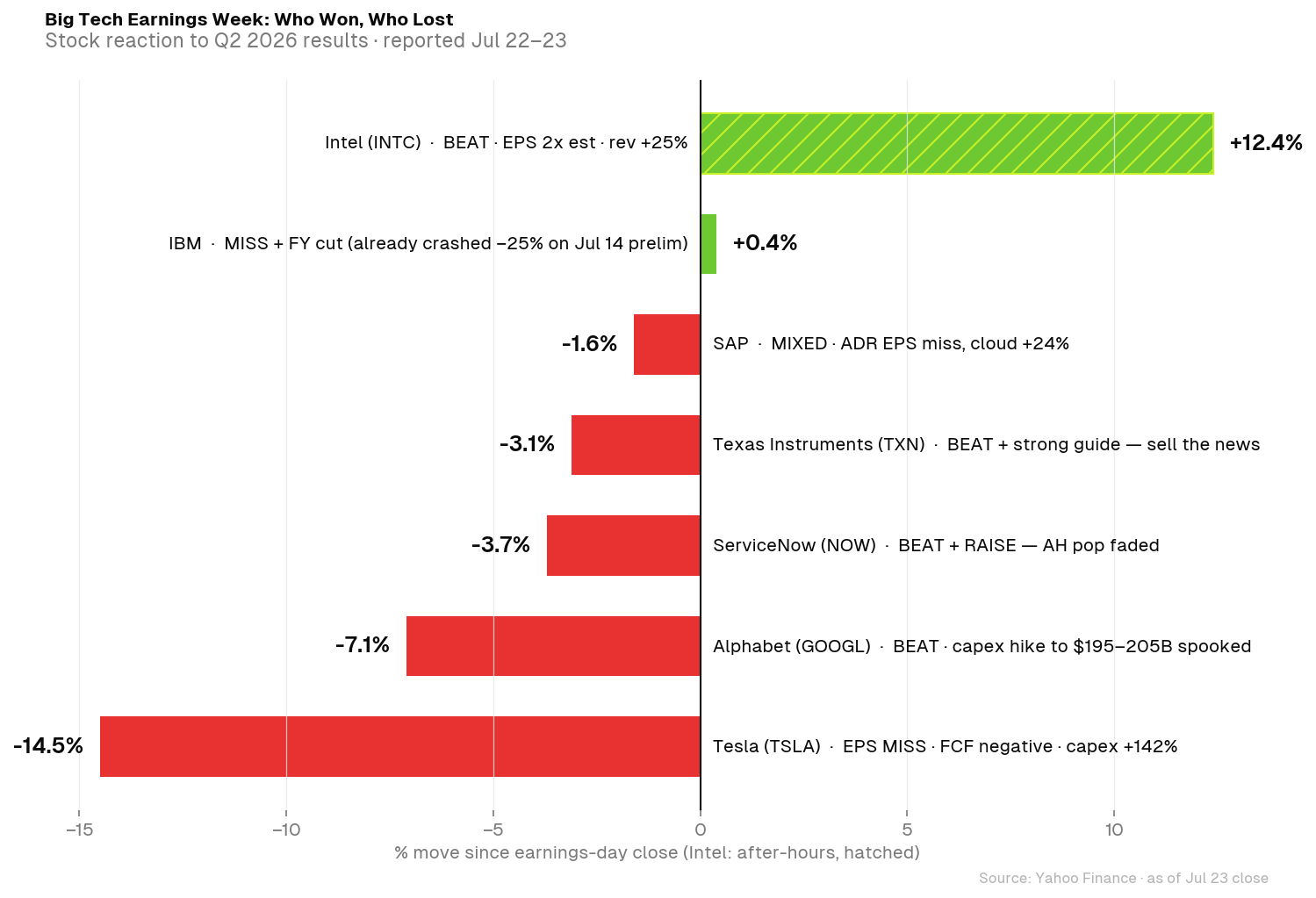
Big tech earnings week closed with a strange scoreboard. Most companies beat Wall Street’s estimates, yet almost every stock fell, and hundreds of billions of dollars in market value vanished in two sessions. This divergence highlights that price reaction, money flow, options positioning, and analyst revisions tell the true story of who won the week.
### Why This Big Tech Earnings Week Mattered
Seven tech giants reported earnings over four days, serving as the first major test of whether massive AI capital expenditures are translating into profit. Collectively, these companies shed about $800 billion in market value in a single day, one of the worst such episodes in recent history.
Spending guidance has become more critical than raw earnings results for these stocks. Investors were looking for proof that the record data center budgets are driving sustainable growth, not just one-time charges.
### Who Won Big Tech Earnings Week
Only two companies emerged as clear winners. One succeeded on strong reported results, while the other gained quietly through improved market positioning.
**Intel (Winner on Results)**
Intel delivered the cleanest earnings beat. Revenue jumped 25% to $16.1 billion, its fastest growth in nearly 15 years, and earnings per share doubled expectations. The stock surged more than 12% after hours. However, institutional money flow remained cautious, and put/call open interest showed growing hedging activity. Analysts raised price targets, though some maintained neutral or sell ratings, suggesting optimism was tempered.
**ServiceNow (Winner on Positioning)**
ServiceNow fell after its report, but the detailed results were strong. Subscription revenue grew 24.5%, and the company raised its full-year outlook. Money flow indicators initially lagged, but put/call ratios fell, signaling bullish positioning. Analysts interpreted the post-earnings dip as a buying opportunity, with several raising targets.
### Who Lost Big Tech Earnings Week
The losers were punished more for heavy spending than for weak performance. Markets rejected the idea that increased capital outlays would immediately translate into profitability.
**Tesla**
Tesla failed on multiple metrics. Earnings per share missed estimates, free cash flow turned negative, and capital spending surged 142%. The stock posted its worst single-day drop in over a year. Persistent concerns about margins and execution drove down institutional confidence, leading to widespread target cuts.
**Alphabet**
Alphabet reported strong revenue and cloud growth but raised its 2026 capital spending guidance to as much as $205 billion. This pushed quarterly free cash flow negative for the first time in more than 20 years. Despite beating earnings expectations, the stock fell as investors worried about the massive cash outlay required for AI buildouts. Institutional buyers reduced exposure during the week.
### Three Stocks Ended the Week Neutral
Three companies showed mixed signals, making them important names to watch in the coming days.
**Texas Instruments** saw broad analyst upgrades, but put volume doubled as traders took profits. Overall money flow remained slightly negative.
**IBM** missed estimates and cut guidance, yet the stock held gains due to prior selling pressure and improving money flow. Several analysts maintained higher targets.
**SAP** missed earnings while cloud backlog grew strongly. Put volume collapsed as speculators reduced hedges, though some protection remained in place.
### Key Takeaways from the Week
The pattern from big tech earnings week is clear: markets reward companies that benefit from AI spending and punish those that fund it. Stocks fall not because results are poor, but because future investments look risky or uncertain.
Intel appears positioned as the week’s loudest winner on execution, while Money Flow and options activity will determine if the gains hold. The coming week will test whether this narrative sustains or reverses.
### FAQ
**Why did most stocks fall even though earnings beat expectations?**
Markets focused on spending guidance and future risks. Heavy capital investments, especially in AI, raised concerns about near-term profitability and cash flow, causing investors to sell.
**What is Money Flow (CMF) and why does it matter?**
Chaikin Money Flow measures institutional buying and selling pressure. Negative CMF indicates sellers are dominant, while positive CMF suggests accumulation. It is a key confirmation signal for sustainable moves.
**Which stocks showed the strongest analyst support?**
Texas Instruments and IBM showed significant analyst upgrades. Intel saw the broadest target raises, while ServiceNow gained credibility through strong subscription growth.
**What drives options positioning after earnings?**
Put/call ratios and open interest reveal whether traders are hedging against downside or expecting further upside. Falling ratios usually indicate bullish sentiment, while rising ratios warn of increased caution.
### Conclusion
Big tech earnings week underscored a shift in market priorities from earnings results to spending discipline. Companies demonstrating clear paths to monetize AI investments were rewarded, while heavy spenders faced pressure despite solid performance. As the sector navigates this transition, watching money flow and options data will be crucial for understanding which winners and losers endure beyond the initial reaction. The week served as a reminder that in the current environment, how a company spends may matter as much as what it earns.
