



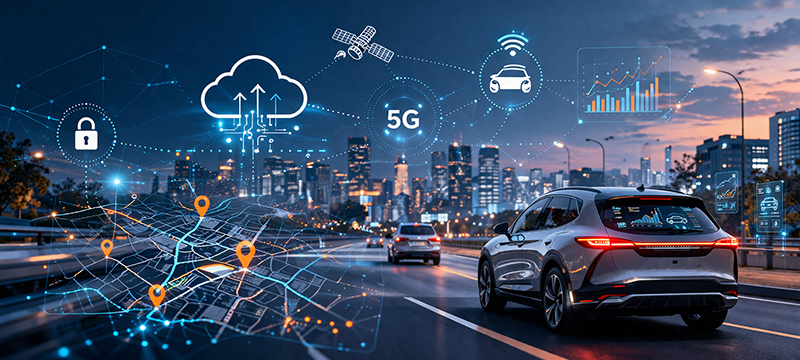
Automotive IoT has moved from a distinct segment functionality embedded in premium automobiles to a foundational layer of recent mobility techniques. As automobiles turn into more and more linked, they generate and eat massive volumes of knowledge that affect every thing from security techniques to fleet operations and buyer experiences. This evolution is reshaping how automobiles are designed, operated, and monetized throughout the automotive and transportation industries.
For IoT resolution makers and know-how leaders, understanding Automotive IoT is now not optionally available. It sits on the intersection of connectivity, cloud platforms, edge computing, and software-defined architectures. The convergence of those domains is driving a transition towards linked automobiles, superior telematics, and software-defined mobility ecosystems.
Key Takeaways
- Automotive IoT connects automobiles to cloud, edge, and infrastructure techniques, enabling real-time knowledge change and management.
- Telematics platforms are central to fleet administration, predictive upkeep, and usage-based providers.
- Software program-defined car architectures decouple {hardware} and software program, enabling steady characteristic updates.
- Mobile connectivity, edge computing, and standardized protocols are key enablers of scalable deployments.
- Safety, knowledge governance, and system complexity stay main challenges in Automotive IoT ecosystems.
What’s Automotive IoT?
Automotive IoT refers back to the integration of linked sensors, embedded techniques, and communication applied sciences inside automobiles to allow knowledge change with exterior techniques corresponding to cloud platforms, infrastructure, and different automobiles. It kinds the spine of linked automobiles, telematics options, and software-defined mobility providers.
Inside the broader IoT ecosystem, Automotive IoT acts as a cellular and distributed knowledge platform. Automobiles are now not remoted mechanical techniques; they’re networked endpoints able to sensing, processing, and transmitting knowledge in actual time. This functionality helps purposes starting from fleet optimization to superior driver help and over-the-air software program updates.
How Automotive IoT works
Automotive IoT techniques depend on a layered structure that mixes in-vehicle {hardware}, connectivity networks, edge processing, and cloud-based platforms. On the core are embedded digital management models (ECUs) and sensors that accumulate knowledge associated to car efficiency, location, surroundings, and driver conduct.
Information generated throughout the car is transmitted by means of a telematics management unit (TCU), which acts as a gateway between the car and exterior networks. The TCU manages communication by way of mobile applied sciences corresponding to LTE, LTE-M, NB-IoT, and more and more 5G. In some circumstances, short-range communication applied sciences corresponding to Wi-Fi or Bluetooth are additionally used for particular use circumstances.
As soon as transmitted, knowledge is processed both on the edge or within the cloud. Edge computing capabilities throughout the car or close by infrastructure enable for low-latency decision-making, corresponding to collision avoidance or real-time diagnostics. Cloud platforms, then again, deal with large-scale knowledge aggregation, analytics, machine studying, and utility orchestration.
The rise of software-defined automobiles introduces a brand new abstraction layer the place software program elements are decoupled from {hardware}. This permits steady updates, distant configuration, and the deployment of latest providers all through the car lifecycle.
Key applied sciences and requirements
Automotive IoT is determined by a mix of communication applied sciences, software program frameworks, and {hardware} elements. Key applied sciences embrace:
- Mobile connectivity: LTE, LTE-M, NB-IoT, and 5G present wide-area communication for linked automobiles.
- Automobile-to-The whole lot (V2X): Permits communication between automobiles, infrastructure, pedestrians, and networks.
- CAN, LIN, and Ethernet: In-vehicle communication protocols connecting sensors and management models.
- Telematics platforms: Techniques that accumulate, course of, and analyze car knowledge for fleet and operational insights.
- Edge computing: Native knowledge processing to scale back latency and bandwidth utilization.
- Over-the-Air (OTA) updates: Mechanisms to remotely replace software program and firmware.
- Cloud IoT platforms: Infrastructure for knowledge storage, analytics, and utility administration.
Requirements and business initiatives additionally play a key function in making certain interoperability and scalability throughout Automotive IoT deployments. These embrace automotive-grade Linux, AUTOSAR frameworks, and rising requirements for V2X communication.
Foremost IoT use circumstances
Automotive IoT allows a variety of purposes throughout a number of industries, extending past conventional passenger automobiles.
- Fleet administration: Actual-time monitoring, route optimization, gasoline effectivity monitoring, and driver conduct evaluation.
- Predictive upkeep: Steady monitoring of auto elements to detect failures earlier than they happen.
- Utilization-based insurance coverage: Insurance coverage fashions based mostly on driving conduct and car utilization knowledge.
- Good logistics: Integration with provide chain techniques to trace items and optimize supply operations.
- Related public transport: Monitoring and optimization of buses, trains, and shared mobility providers.
- Autonomous and assisted driving: Information change supporting superior driver help techniques (ADAS).
- Power and EV administration: Monitoring battery efficiency, charging infrastructure, and vitality consumption.
These use circumstances exhibit how Automotive IoT extends into industrial IoT, good metropolis infrastructure, and vitality techniques, creating interconnected mobility ecosystems.
Advantages and limitations
Automotive IoT delivers important operational and strategic advantages. It improves visibility into car efficiency, enhances security by means of real-time monitoring, and allows new enterprise fashions based mostly on data-driven providers.
- Operational effectivity: Optimized routing, lowered downtime, and higher useful resource utilization.
- Enhanced security: Actual-time alerts, distant diagnostics, and driver help options.
- New income streams: Subscription providers, knowledge monetization, and mobility-as-a-service fashions.
- Lifecycle administration: Steady software program updates and distant upkeep capabilities.
Nonetheless, a number of constraints and challenges stay:
- Connectivity limitations: Protection gaps and variable community efficiency can affect reliability.
- Latency necessities: Essential purposes require ultra-low latency that not all networks can assure.
- Safety dangers: Related automobiles develop the assault floor for cyber threats.
- System complexity: Integration of {hardware}, software program, and networks will increase growth and upkeep complexity.
- Information governance: Managing possession, privateness, and compliance throughout jurisdictions is difficult.
Balancing these advantages and limitations is a key consideration for organizations deploying Automotive IoT options at scale.
Market panorama and ecosystem
The Automotive IoT ecosystem consists of a number of stakeholders, every contributing to totally different layers of the worth chain.
- Automotive OEMs: Combine connectivity and software program capabilities into automobiles.
- Tier 1 suppliers: Present {hardware} elements corresponding to sensors, ECUs, and telematics models.
- Connectivity suppliers: Cell community operators and MVNOs enabling international connectivity.
- Cloud and platform distributors: Provide infrastructure for knowledge processing and utility growth.
- Software program suppliers: Develop working techniques, middleware, and utility frameworks.
- System integrators: Mix applied sciences into end-to-end options for enterprises.
The shift towards software-defined mobility can also be altering aggressive dynamics. Conventional automotive gamers are more and more collaborating with know-how firms, whereas new entrants concentrate on software program platforms and knowledge providers.
Future outlook
The evolution of Automotive IoT is intently tied to advances in connectivity, computing, and software program architectures. The rollout of 5G and future 6G networks is predicted to allow greater knowledge throughput and decrease latency, supporting extra superior use circumstances corresponding to cooperative driving and real-time car coordination.
Software program-defined automobiles will proceed to realize traction, enabling steady characteristic deployment and lowering dependency on {hardware} upgrades. This shift will probably speed up the adoption of subscription-based providers and new income fashions.
Edge computing can even play a bigger function, significantly for purposes requiring fast decision-making. On the similar time, growing regulatory scrutiny round knowledge privateness and cybersecurity will form how Automotive IoT techniques are designed and operated.
General, Automotive IoT is shifting towards a extra built-in and platform-driven mannequin, the place automobiles are a part of a broader digital ecosystem spanning transportation, vitality, and concrete infrastructure.
Regularly Requested Questions
What’s Automotive IoT?
Automotive IoT refers to the usage of linked sensors, communication applied sciences, and software program platforms in automobiles to allow knowledge change with exterior techniques corresponding to cloud providers and infrastructure.
What’s a linked car?
A linked car is a car outfitted with web connectivity and communication techniques that enable it to ship and obtain knowledge in actual time.
What’s telematics in Automotive IoT?
Telematics is the know-how that mixes telecommunications and knowledge analytics to observe car location, efficiency, and utilization.
What’s a software-defined car?
A software-defined car is a car the place performance is primarily managed and up to date by means of software program relatively than fastened {hardware} configurations.
What connectivity applied sciences are utilized in Automotive IoT?
Automotive IoT generally makes use of mobile applied sciences corresponding to LTE and 5G, in addition to short-range communication applied sciences like Wi-Fi and Bluetooth.
What are the primary challenges of Automotive IoT?
Key challenges embrace connectivity reliability, cybersecurity dangers, system complexity, and knowledge privateness administration.
