




Antioch says simulation may also help robotic builders overcome testing bottlenecks. | Supply: Antioch
Validating a robotic’s habits in the true world usually means renting bodily area, manually staging environments, and resetting {hardware} between each run, in keeping with Antioch. It’s costly, sluggish, and covers solely a fraction of the eventualities a system will face in manufacturing, stated the startup.
Antioch immediately stated it has raised $8.5 million to maneuver improvement and analysis of autonomous programs out of the bodily world and into cloud-based simulation. The corporate‘s said objective is to remove the necessity for {hardware} and elaborate bodily testing.
“Robotics teams are spending weeks staging warehouses and investing millions into test facilities to validate their systems,” stated Antioch co-founder Harry Mellsop, who beforehand labored on Tesla‘s Autopilot staff. “Meanwhile, companies like Tesla, Waymo, and Anduril spend hundreds of millions a year on simulation infrastructure to minimize exactly that. We think every autonomy team should have access to that level of tooling.”
Antioch founders draw from safety, AI expertise
Three of Antioch’s 5 co-founders, Mellsop, Alex Langshur, and Michael Calvey, beforehand based Transpose, a safety and intelligence platform acquired by Chainalysis in 2023. Langshur stated the nationwide safety thread has carried over.
“The only economically viable path to reindustrialization runs through robotics and automation, and scalable testing is the rate-limiting step.” he stated.
New York-based Antioch was based in Could 2025. The founding staff additionally included Colton Swingle, beforehand at Google DeepMind, and Collin Schlager, beforehand at Meta Actuality Labs. The corporate now has a workers of eight.
“The industries LLMs [large language models] are disrupting — software, professional services, knowledge work — represent maybe $8 trillion of the global economy,” asserted Mellsop. “Manufacturing, logistics, construction, energy, and agriculture represent $50 trillion. AI penetration in those physical industries is basically zero today. The industrial revolution that’s coming in physical AI isn’t going to be a sequel to the LLM revolution; it’s going to dwarf it.”
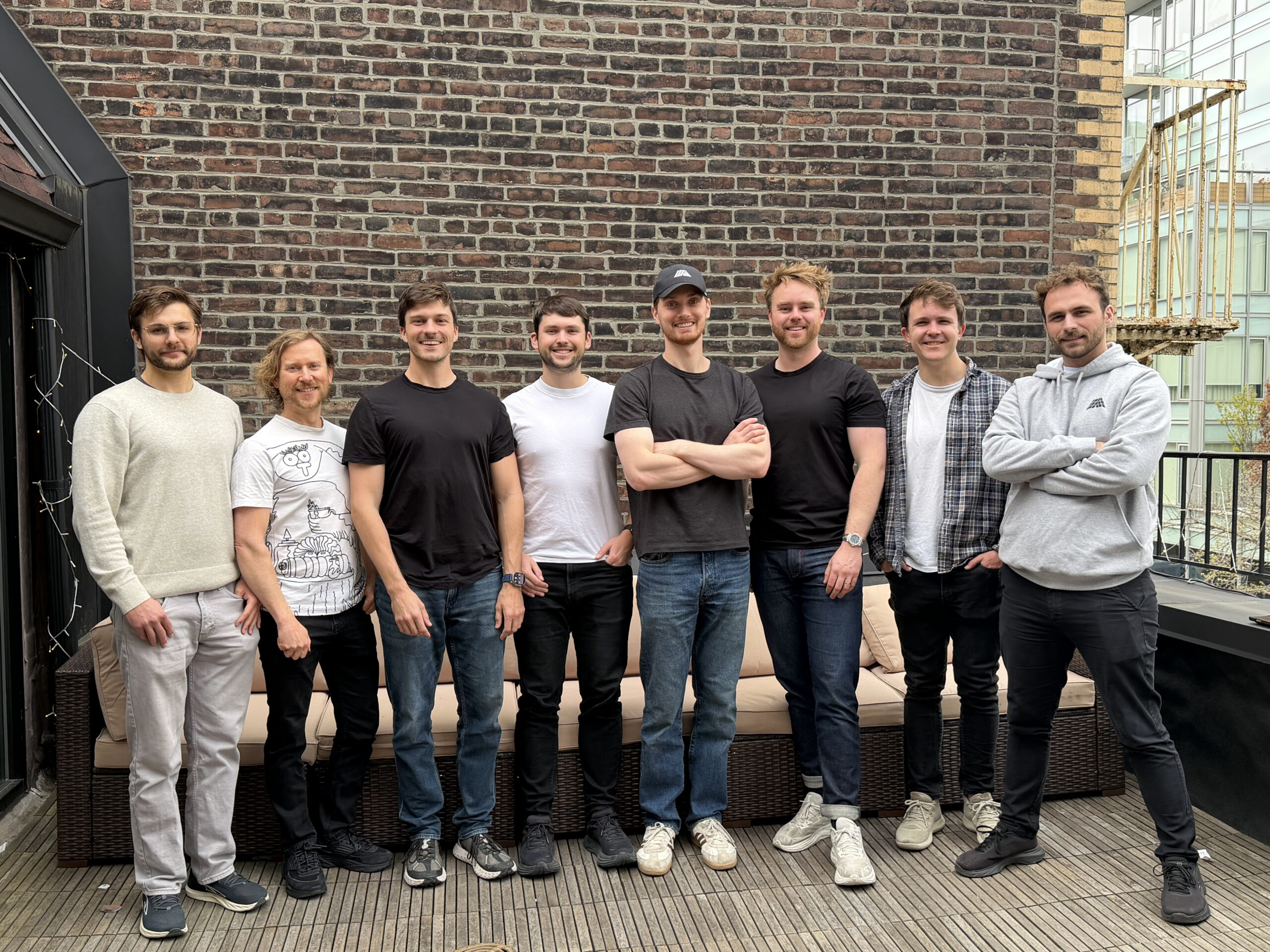
From left to proper, Jackson Vachal, Josiah Jordan, Michael Calvey, Colton Swingle, Alex Langshur, Harry Mellsop, Collin Schlager, Oliver Dyer. | Supply: Antioch
Simulation offers reliable testing, says Antioch
Many corporations don’t wish to spend the sources wanted to maintain up with new instruments, fashions, and suppliers, even earlier than composing disparate instruments into usable workflows, famous Antioch.
The corporate claimed that the simulation ecosystem has matured to the purpose the place testing and validation at the moment are doable with minimal real-world inputs. Physics and rendering engines similar to NVIDIA Isaac Sim and Unreal Engine present more and more highly effective primitives, and generative methods like world fashions from World Labs are making it simpler to synthesize life like environments at scale, stated Mellsop.
By sharing physics engines and world fashions throughout prospects, Antioch ensures that its baseline mannequin is calibrated to the real-world information they accumulate, he advised The Robotic Report. This helps all prospects trust within the fashions with out forcing them to rebuild their infrastructure.
“We’re working with teams within our biggest customer account to model the perception systems that will ultimately go into their robots,” Mellsop stated. “The first thing we do with all of our customers is to replicate the existing sets of tests they do in the real world and replicate them 1:1 in Antioch simulation.”
“Now your engineers can run exactly those kinds of physical tests that you were running, but now that it’s on a tablet in the palm of their hands, they can run it as many times as they want, and it’s instantaneous,” he defined. “That slashes costs for these companies and accelerates their engineering and development efforts.”
Editor’s word: On the 2026 Robotics Summit & Expo on Could 27 and 28 in Boston, there might be classes on growing embodied and bodily AI. Registration is now open.

AI fashions may also help consider edge instances
“Once we’ve done replicated their tests and have built trust in the results of the simulation, we’re then able to think about situations that were previously impossible to actually stage, whether that’s because they were too expensive, too dangerous, or just impractical,” added Mellsop. “How does your robot perform when it’s in the snow or fog? Or maybe the the warehouse is on fire, and you want to test that your safety protocols are still working appropriately.”
“One of the key workflows that I’ve seen some of our customers use is to ask our AI assistant to switch from using one SLAM [simultaneous localization and mapping] algorithm to a more up-to-date version,” he recalled. “In Antioch, your robot is entirely represented as code. Swapping one for the other in simulation is really easy for this agent to do.”
“But then it can go and it can run 1,000 different scenarios and report back what got better, what got worse, what regressions happened,” Mellsop stated. “Because you can short-circuit the evaluation loop, it’s ultimately where I think we probably all see robotics going, which is that everything is becoming more composable: the hardware side, the software side.”
Antioch has efficiently developed simulation for sensor modalities together with lidar, radar, and cameras, stated Mellsop. Subsequent, the corporate plans to deal with deformables, fluid dynamics, and dexterity modeling, which have been tough to do in simulation.
Additionally it is taking a look at upgrading embodied AI notion programs for every little thing from autonomous automobiles and warehouse planning to sensible safety and development web site mapping.
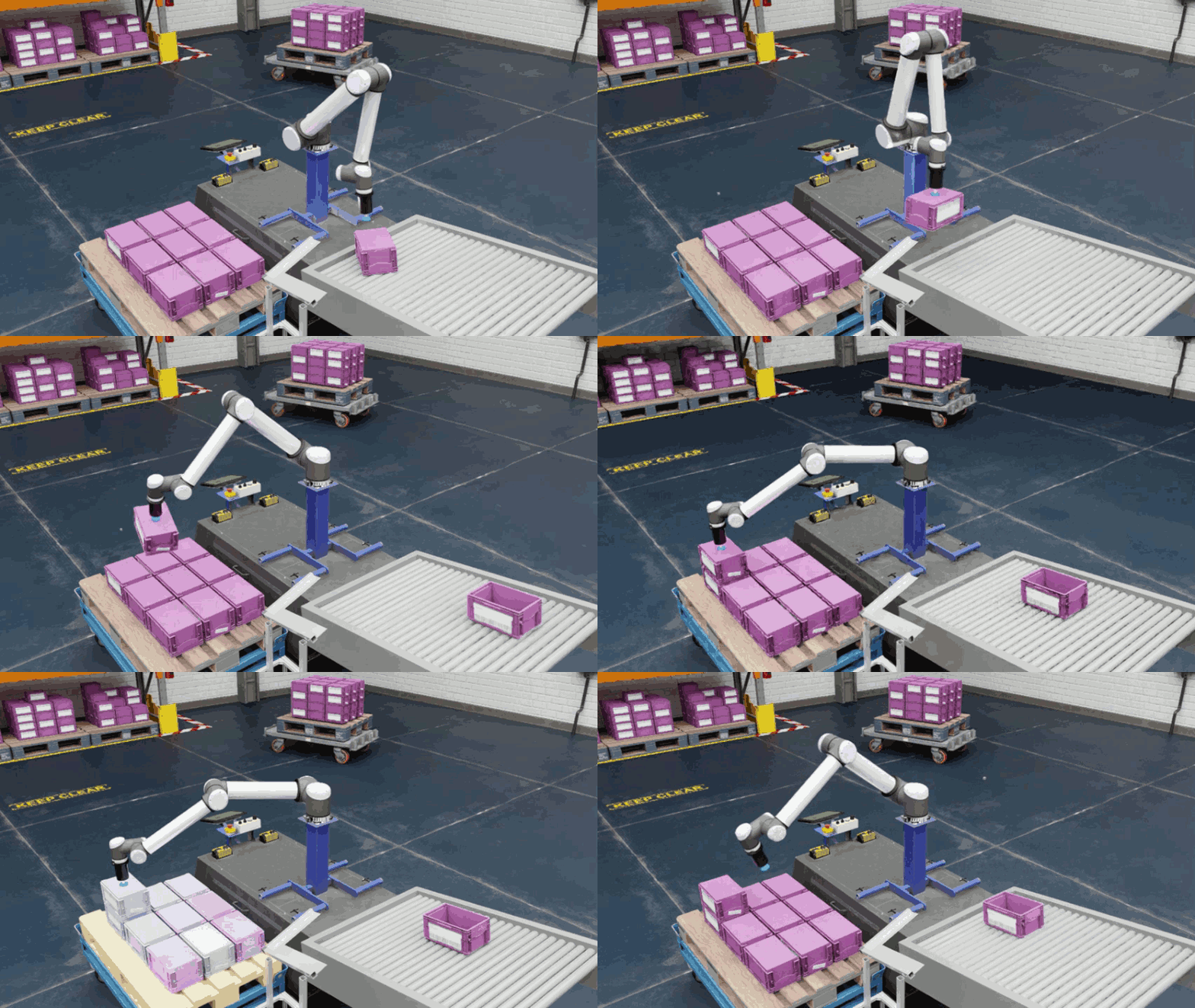
Antioch says cloud simulation can deal with a a lot wider vary of variance than expensive bodily testing. Supply: Antioch
Funding follows FAANG prospects
Antioch stated it’s already working with Fortune 500 expertise and logistics corporations, in addition to FAANG (Fb/Meta, Amazon, Apple, Netflix, and Google/Alphabet) engineering groups.
“We spent the first six months heads-down building with a deep conviction about what the product should be,” Mellsop stated. “Then in November, we started onboarding these massive customers. We learned a lot from those early engagements, and that was great ratification for us that companies across the board experienced these problems we were working on.”
A* and Class Ventures led Antioch’s newest funding. MaC Enterprise Capital, Summary, Field Group, and Icehouse Ventures additionally participated, as did angel buyers together with Shyam Sankar, chief expertise officer of Palantir, and Adrian Macneil, CEO of Foxglove. The corporate raised pre-seed funding in December 2025.
“Antioch sits on the intersection of AI and robotics and can unlock the science-fiction future we’ve usually dreamed of,” stated Bennett Siegel, co-founder and normal associate of A*.
“The platform removes the friction from physical-world testing, and enables a new generation of embodied AI startups to scale their inventions globally,” he added. “Companies are currently spending hundreds of millions a year to have a horse in the AI robotics race, but Antioch’s technology reduces the hurdles considerably, giving more businesses a chance to innovate.”
Antioch is trying to scale with its newest funding. “One of the most niche, hardest-to-find, and most important roles for us is what we call a simulation engineer,” famous Mellsop. “These are folks who have real-world experience with the sensors that go onto robots, but they’ve also had some experience of working with simulation engines, whether they’re robot-specific like Isaac or more general like physics and rendering engines. Finding people who’ve got those two skill sets together is really hard.”

Simulation can now assist robotic builders overcome testing bottlenecks, say Antioch’s founders.
The publish Antioch raises funding to carry ‘software program velocity’ to robotic improvement appeared first on The Robotic Report.
