



**US Refiners Profit from Record Margins as Analyst Names Three Mid-Cap Energy Picks**
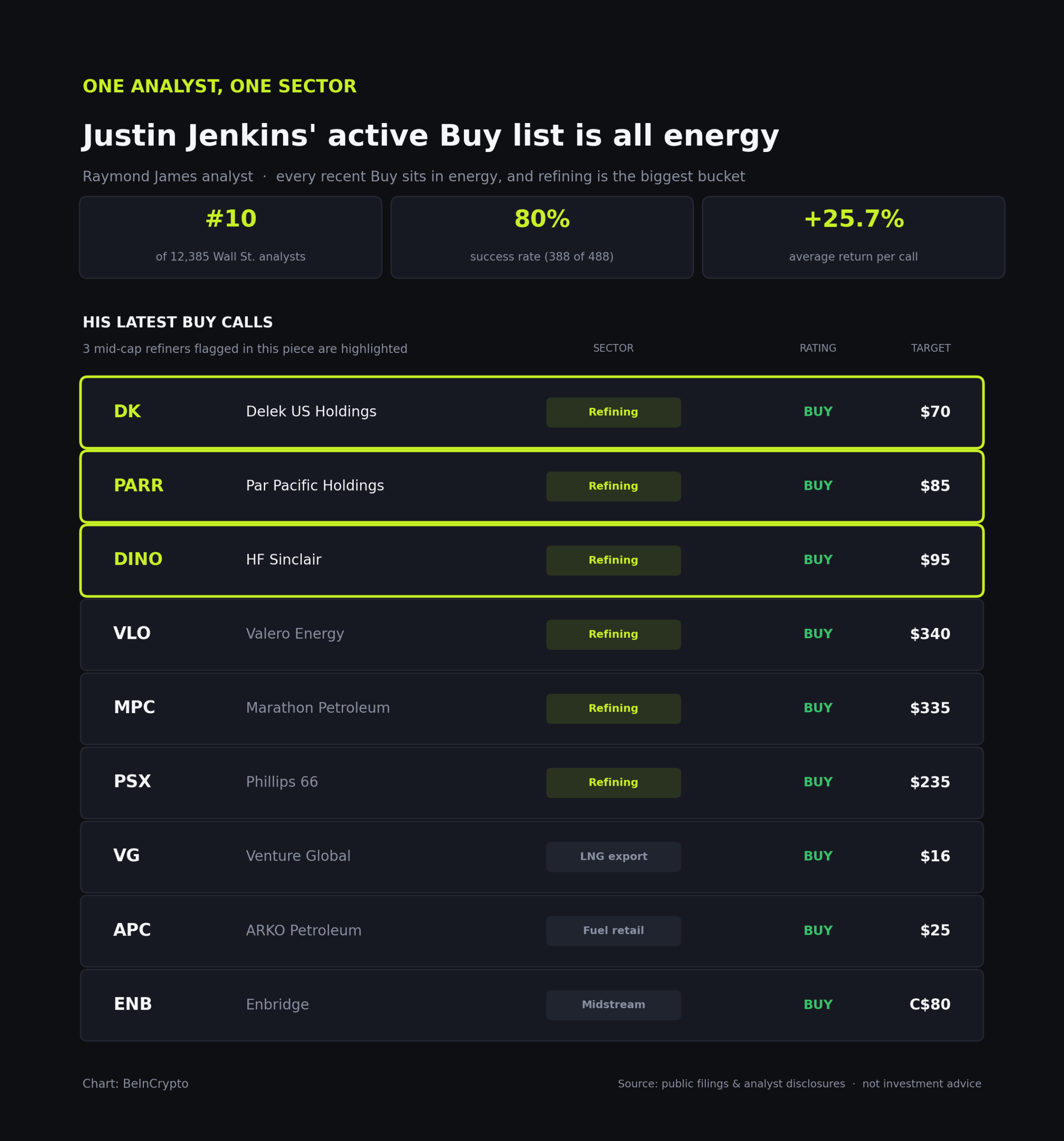
The US refining sector is experiencing a period of unprecedented profitability, driven by a significant gap between crude oil costs and the price of refined fuel products. This “crack spread” has reached record highs, creating substantial earnings potential for refiners. Wall Street analyst Justin Jenkins of Raymond James, who boasts an impressive 80% success rate, has identified three lesser-known mid-cap refiners poised to benefit from this trend. His selections are not the large, well-known oil majors, but rather companies more directly exposed to the refining margin surge.
Jenkins has reiterated “Buy” ratings on his three picks, which have drawn attention from other institutional investors. BeInCrypto analyzed the money flow behind each of these stocks to assess the strength of the bullish thesis.
***
### **Delek US Holdings (NYSE: DK)**
Delek US Holdings stands out as the most focused play on refining within Jenkins’ list. With minimal diversification into other energy sectors, the company is almost entirely dependent on the performance of the crack spread. This makes it a direct and leveraged bet on the current record margins.
The crack spread hit a peak of nearly $59 per barrel in July, a level nearly triple where it started the year. This environment allows Delek to generate significant cash even if crude oil prices remain stagnant. Jenkins set a price target of $70 for the stock on July 13, a target that has since been matched by Goldman Sachs, which raised its target to $73. JPMorgan raised its target to $62, a level the stock has already surpassed. The stock is up over 127% year-to-date. Technical analysis shows institutional buying, with the Chaikin Money Flow indicator breaking out of a downtrend and pushing to multi-month highs, signaling strong accumulation.
[Image: Delek US (DK) Price Chart]
*DK Price Action: Yahoo Finance*
### **HF Sinclair Corporation (NYSE: DINO)**
HF Sinclair is the largest and most diversified company on the list, with operations spanning refining, marketing, and renewable fuels. While its scale provides stability, its valuation appears the most extended based on its year-long performance. Jenkins maintained a “Buy” rating with a Street-high $95 price target, standing in contrast to the more cautious stance of much of Wall Street, which predominantly rates the stock as “Hold.”
The stock has had a remarkable year, rising 99%, which has pushed its price above several prior analyst targets. However, technical indicators have given pause to some observers. A bearish divergence has emerged in the Chaikin Money Flow (CMF) indicator; while the stock made a new high in July, the money flow failed to confirm, suggesting that the momentum may be waning. A close above the key 0.51 level would be needed to alleviate this concern. Despite this, options desks have indicated fresh call buying activity.
[Image: HF Sinclair (DINO) Price Chart]
*DINO Price Action: Yahoo Finance*
### **Par Pacific Holdings (NYSE: PARR)**
Par Pacific Holdings has been the standout performer of the trio, with its stock surging approximately 129% this year. The company’s strategic focus on niche markets—including Hawaii, the Pacific Northwest, and the Rocky Mountains—has insulated its fuel supply. This insulation allowed Par Pacific to ride the refining margin wave particularly effectively.
All three analysts are bullish on this energy stock, with Jenkins lifting his target to $85 to match the rating from JPMorgan. Mizuho has also reiterated a “Buy” rating with a target of $80, a price level the stock has already reached. This alignment among major brokerages marks $85 as a shared near-term ceiling. The stock’s strength is supported by strong institutional accumulation, as evidenced by a Chaikin Money Flow indicator that made a fresh high before pulling back.
[Image: Par Pacific Holdings (PARR) Price Chart]
*PARR Price Action: Yahoo Finance*
However, this rally has prompted some strategists to issue warnings. With record margins already priced in, there is a concern that refiners may have run too far, too fast. A graphic from noted strategist Jack Prandelli highlights the unprecedented nature of the current margins but also questions the sustainability of the rally, pointing out that companies like VLO, MPC, and PSX are already up 40%.
A crucial factor supporting the high margins is the significant offline status of more than half of Russian refining capacity due to geopolitical events. This supply squeeze helps to underpin the elevated crack spreads that these companies are benefiting from.
***
### **FAQ**
**Q1: What is the “crack spread” and why is it important?**
The crack spread is the difference between the price of crude oil and the price of the refined products (like gasoline and diesel) that are produced from it. It represents the profit margin for refineries. A record-high crack spread means refiners are earning significantly more per barrel of crude processed, leading to booming profits for the sector.
**Q2: Why did the analyst choose mid-cap refiners over major oil companies?**
Analyst Justin Jenkins specifically selected mid-cap refiners because they are more directly exposed to the refining business. Large oil majors like Exxon or Chevron have more diversified revenue streams, which can dilute the impact of refining profits. The selected stocks offer a more direct and potentially higher-percentage play on the current refining margin boom.
**Q3: What are the risks associated with these investments?**
The primary risk for all three stocks is the crack spread itself. These wide margins are historically unsustainable and could narrow significantly if crude oil prices rise sharply or if the supply of refined products increases. Additionally, some analysts have noted that the stocks may already be overextended in the short term, as seen in the technical divergence for HF Sinclair.
**Q4: What is the analyst’s track record?**
The analyst, Justin Jenkins of Raymond James, has a success rate of 80%, which is a strong indicator of his ability to identify winning stock opportunities.
***
### **Conclusion**
The US refining sector is in a powerful position due to record-wide crack spreads, creating a unique opportunity for investors willing to look beyond the major oil companies. Analyst Justin Jenkins has pinpointed three mid-cap refiners—Delek US Holdings, HF Sinclair, and Par Pacific Holdings—that are well-positioned to capitalize on this environment. While Delek offers the most direct exposure, HF Sinclair provides diversification, and Par Pacific showcases strong performance in niche markets. As with any investment, potential investors must consider the inherent risks, particularly the volatility of the crack spread, but the current setup presents a compelling case for these energy stocks to watch.
