




Infostealers like Atomic MacOS Stealer (AMOS) signify excess of a standalone malware. They’re foundational elements of a mature cybercrime economic system constructed round harvesting, buying and selling, and operationalizing stolen digital identities.
Quite than appearing as the tip aim, trendy stealers operate as large-scale information assortment engines that feed underground markets, the place stolen credentials, periods, and monetary information are purchased and offered to gasoline account takeovers, fraud, and follow-on intrusions.
What makes these campaigns notably efficient is their extremely opportunistic social engineering strategy: attackers constantly adapt to expertise developments, abusing trusted platforms, standard software program, serps, and even rising AI ecosystems to trick customers into executing malware themselves.
This mixture of industrialized information monetization and adaptive social engineering has made infostealers one of the crucial dependable and scalable entry factors in at this time’s cybercrime panorama.
Within the new 2026 Enterprise Infostealer Id Publicity report, Flare researchers spotlight the rising dominance of infostealers inside the cybercrime economic system and the increasing affect of identification publicity on organizations.
On this article, we study the AMOS infostealer as a case examine, exploring its evolution, operational mannequin, and real-world exercise throughout its lively years.
How Do Infostealers Work?
Infostealers function as one of the crucial important enablers within the trendy cybercrime kill chain as a result of they rework a single an infection into large-scale credential, session, and identification compromise.
Generally, as soon as executed on a sufferer machine, an infostealer quickly enumerates browsers, system credential shops, crypto wallets, messaging apps, and native information, extracting authentication information, session cookies, and delicate paperwork earlier than exfiltrating them to attacker-controlled infrastructure.
ClawHavoc – The Most Latest Marketing campaign
Latest analysis by Koi safety reminded us that AMOS infostealer dissemination strategies are cunningly designed to search out weaknesses and exploit each phase of expertise customers to steal their credentials.
The analysis describes ClawHavoc as a large-scale supply-chain marketing campaign concentrating on the OpenClaw and ClawHub ecosystem (A very fashionable private AI assistant) by poisoning the talent market itself.
Whereas the precise particulars are spectacular, what issues extra is the underlying tactic. AMOS distributors are capitalizing on OpenClaw’s reputation as AI-hyped software program.
As customers rush to put in it for private or organizational good points, attackers see a possibility to bundle AMOS malware inside it to steal beneficial PII, credentials, and delicate information.
The supply mannequin: attackers uploaded expertise (OpenClaw add-ons) that appeared respectable: crypto instruments, productiveness utilities, YouTube helpers, finance or Google Workspace integrations, and many others.
As soon as put in, the malware may steal credentials, crypto pockets information, browser periods, SSH keys, and different delicate information, highlighting how AI agent extension ecosystems can develop into high-impact distribution channels when market vetting is weak.
That is the newest marketing campaign, let’s bear in mind how it began…
Flare tracks over 1 million new stealer logs weekly from darkish internet markets and Telegram channels.
Detect compromised credentials, lively session cookies, and company entry earlier than risk actors weaponize them in account takeover assaults.
Begin Free Trial
AMOS the Malware – First Sighting of AMOS
AMOS first appeared round Might 2023 on a Telegram channel.
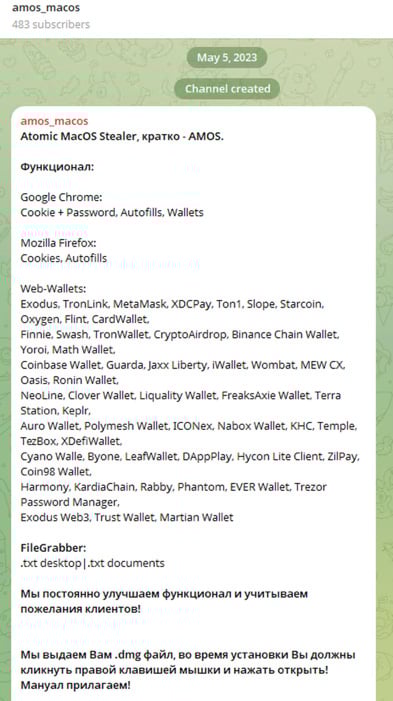
Stating its capabilities, which embrace exporting passwords from the Mac keychain, file grabber, system data, and macOS password exfiltration, browser session theft, crypto pockets information theft with numerous infostealer administration capabilities (web-panel, exams, Telegram logs, and many others).
Again then, the fee was $1000 per thirty days, paid by USDT(TRC20), ETH, or BTC.
Since then, AMOS infostealer has develop into part of the underground ecosystem, risk actors are prepared to purchase stealer logs that had been extracted from infostealers (corresponding to AMOS) so as to use them as an preliminary entry to their very own nefarious enterprise.
For example, beneath you’ll be able to see {that a} Russian-speaking risk actor coping with Crypto pockets theft is on the lookout for related AMOS logs.
View in Flare – join a free trial to entry
AMOS Modus-Operandi
Historically, AMOS is disseminated like each identified and standard infostealers, corresponding to phishing hyperlinks, phishing emails, trojanized installers, and click on baits, however all through current years we now have additionally seen some extra noticeable campaigns.
Concentrating on LastPass Customers
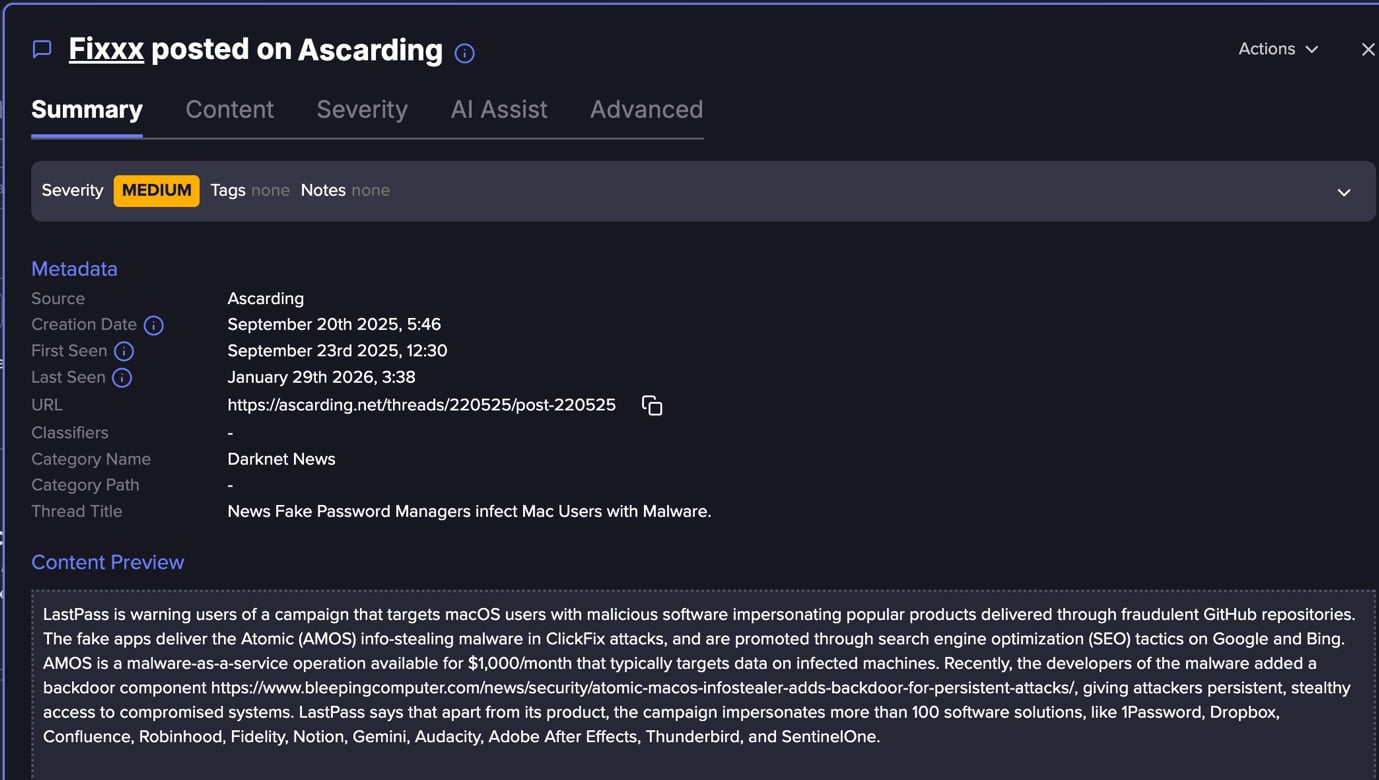
In an underground discussion board, we noticed a put up about LastPass that warned of an ongoing AMOS marketing campaign.
This marketing campaign was concentrating on macOS customers by pretend purposes distributed through fraudulent GitHub repositories, the place attackers impersonate over 100 well-known software program manufacturers to extend legitimacy.
The operation depends on website positioning poisoning throughout Google and Bing to push these malicious repositories into search outcomes, finally main victims to ClickFix-style pages that socially engineer them into pasting Terminal instructions, which obtain and execute the AMOS payload.
The marketing campaign is especially resilient as a result of attackers constantly generate new GitHub repositories utilizing automated account creation, highlighting how trusted developer platforms and serps are more and more abused as scalable malware distribution infrastructure.
AI-Pushed Dissemination Channels
ClawHavoc wasn’t AMOS’s first AI marketing campaign. In December 2025, Huntress reported that AMOS is concentrating on ChatGPT customers. The risk actors used the ChatGPT shared chat function to host malicious “installation guides” immediately on a trusted area (chatgpt.com), making the lure considerably extra convincing.
Victims are pushed there primarily through paid search advertisements (website positioning poisoning/malvertising) selling a pretend “ChatGPT Atlas browser for macOS”, then instructed to run a one-line terminal command, successfully turning the person into the execution mechanism.
This instance exhibits but once more that risk actors are weaponizing AI content material hype as a part of their malware distribution.
Conventional Dissemination Channels
Trendy macOS infostealer campaigns rely closely on social engineering–pushed distribution moderately than technical exploits. Risk actors generally create pretend installers for standard software program corresponding to Tor Browser, Photoshop, or Microsoft Workplace, packaging malware inside realistic-looking DMG disk photos.
In parallel, they use malvertising by platforms like Google Adverts to drive victims to spoofed obtain websites that carefully mimic respectable distributors.
For instance, customers looking for respectable software program could also be redirected to look-alike domains internet hosting malicious installers that silently deploy stealers corresponding to AMOS.
One other rising tactic is the usage of instruction-based execution strategies (usually referred to as ClickFix), the place victims are guided to run instructions themselves within the macOS Terminal.
As an alternative of exploiting system vulnerabilities, attackers depend on convincing set up directions, which finally execute the malware payload. For example, asking customers to pull information into Terminal or paste instructions.
Collectively, these strategies replicate a shift towards abusing person belief, model impersonation, and bonafide distribution channels to bypass conventional safety controls and enhance an infection success charges.
The Underground Financial system Mannequin
The AMOS ecosystem operates as a structured Malware-as-a-Service (MaaS) provide chain, the place the builders (usually tracked in underground boards as AMOS sellers or associates) present the stealer platform, updates, infrastructure elements, and typically administration panels for a subscription value traditionally marketed round ~$1,000 per thirty days, usually paid in cryptocurrency.
Downstream risk actors buy entry to the stealer equipment, customise lures or distribution channels (malvertising, pretend installers, phishing, website positioning poisoning, supply-chain abuse, or social engineering campaigns), and concentrate on maximizing an infection quantity.
The first output is a listing of stolen credentials, PII, and session logs. This turns into a tradable commodity in underground markets.
These stealer logs are bought by secondary actors corresponding to entry brokers, account takeover specialists, and crypto cash-out operators, who use them for follow-on operations, together with SaaS account compromise, monetary fraud, ransomware preliminary entry, or cryptocurrency theft.
This multi-stage monetization mannequin turns AMOS infections right into a repeatable income pipeline, the place every actor within the chain focuses on growth, distribution, or monetization, reflecting the broader industrialization of the trendy infostealer economic system.
In contrast to conventional malware that focuses on persistence, protection evasion, lateral motion, or destruction, infostealers prioritize velocity, information protection, and stealth, permitting attackers to shortly convert stolen information into usable entry.
The ensuing “stealer logs” are then offered or traded in underground markets, the place different risk actors use them for account takeover, lateral motion, fraud, or follow-on assaults, defacto making infostealers a foundational data-supply layer for the broader cybercrime economic system.
The distributor layer is the place we usually see the “innovative” or “creative” aspect of those campaigns – and it’s what often makes the headlines. That is the layer behind narratives like “AMOS is now targeting AI apps” or “AMOS campaigns are hitting LastPass users.”
In actuality, the core malware builders usually stay constant, often including a brand new function or enhancing packaging and evasion, however the underlying functionality set modifications incrementally.
The downstream log customers additionally are likely to function with established, repeatable monetization strategies.
The distributors, nonetheless, are those driving actual marketing campaign evolution: they resolve who to focus on, outline marketing campaign scope, select distribution channels, and constantly refine the psychological and social engineering strategies used to control victims as a part of their operational playbook.
Study extra by signing up for our free trial.
Sponsored and written by Flare.
