



**Weekly Threat Recap: Exploits, Ransomware, and Trust Failures in July 2026**
This week’s security landscape reflects a familiar pattern: old tricks, new twists, and persistent over-reliance on weak links. From phishing campaigns delivering modular malware to custom ransomware locking Russian enterprises, the threats mirror a broader truth—organizations remain vulnerable not because of unknown exploits, but because of known weaknesses in identity, access, and third-party trust.
Below is a recap of the most notable incidents observed over the past week, compiled from multiple threat intelligence sources.
—
### **Key Incidents This Week**
**1. Phishing Delivers XWorm**
A cybercrime group (xplogs22) has been using phishing emails to deliver XWorm malware, primarily targeting Russian and CIS-region banking customers. The group, active since 2023, previously used Formbook and Snake Keylogger, transitioning to XWorm in mid-2025. Complementary Android malware such as LunaSpy—disguised as antivirus software—has also been used to capture audio, video, and screen activity.
**2. Custom Ransomware “GenieLocker” Targets Russia**
The extortion group Toy Ghouls (aka Bearlyfy/Labubu) has deployed a custom ransomware family named GenieLocker against Russian organizations in manufacturing, finance, retail, and technology. Initial access was gained via exposed OpenVPN connections from third-party partners, followed by lateral movement using RDP and SSH. Both Windows and Linux systems were encrypted using PE and ELF variants of the ransomware.
**3. Crypto-Stealing Payloads via CastleLoader**
CastleLoader, a multi-stage malware loader, has been distributing crypto-stealing payloads, including a Rust-based desktop wallet spoofer and a Golang-based malicious browser extension installer. The campaign, dubbed “Noidret,” also involves a new shellcode loader variant spreading through digitally signed installers, signaling an increased focus on cryptocurrency theft and browser-level persistence.
**4. Fileless WebDAV Execution**
A ClickFix variant was observed that requires victims to paste a single command into the Windows Run dialog. The command retrieves a payload from a WebDAV endpoint and executes it via `rundll32.exe`, leaving no traditional file artifacts on disk—making detection significantly harder.
**5. Fake “Claude” Installation Guide Spreads MacSync Stealer**
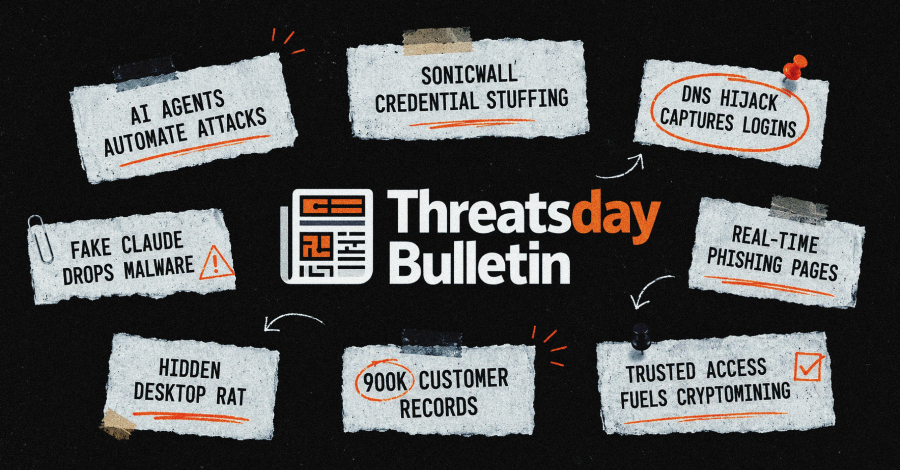
Victims searching for how to install Claude on macOS were redirected to a malicious “install guide” that appeared as an Apple Support page. The guide instructed users to paste a terminal command, leading to the execution of MacSync Stealer—a six-stage attack chain involving hidden AppleScripts, a Mach-O RAT, and wallet-stealing trojans.
**6. Operation STANDOFF: Hybrid Intrusion and Influence Operations**
A Russian-speaking threat group conducted multi-pronged attacks combining commodity malware (including Raccoon Stealer and RedLine), proxy-botnet infrastructure, hands-on-keyboard intrusions, and AI-driven influence campaigns using Telegram bots and AI-generated personas to amplify content and promote fraud-related services.
**7. Fleet Takeover via Unauthenticated APIs**
Security researcher Eaton Zveare exposed a vulnerability in My Eicher—a fleet management system used in India—that allowed unauthenticated access to internal and administrative APIs. This enabled attackers to hijack entire fleets, potentially compromising hundreds of vehicles. The flaw was patched within 17 days of responsible disclosure.
**8. AI-Automated Exploitation Chain**
A Chinese-speaking threat actor (aliases: knaithe, KnYuan) leveraged AI tools such as DeepSeek (via Hermes Agent), Claude Code, Codex, and Qwen Code to autonomously scan, exploit, and compromise systems. Targets included vulnerabilities in Langflow, n8n, Citrix NetScaler, Apache Tomcat, and Palo Alto PAN-OS. The operation demonstrated the growing feasibility of fully automated, large-scale cyberattacks.
**9. Trusted Access Abused for XMRig Botnet**
Group-IB revealed a Linux-based XMRig cryptomining campaign that exploited trusted third-party access to breach environments. The attackers weaponized PAM (Pluggable Authentication Modules) to impersonate low-privilege users, creating forensic noise and evading detection while establishing redundant persistence mechanisms.
**10. Fake Recruiter Delivers Stealer Malware**
Threat actors posed as recruiters, tricking victims into installing “Relay”—a fake AI meeting tool designed to steal credentials, wallet data, Keychain information, and Telegram sessions. The malware targeted both Windows and macOS users.
**11. Supply Chain Security Improvements at GitHub**
GitHub announced a series of hardening measures, including improved account protection for high-impact users, safer GitHub Actions defaults, workflow network firewalls, staged publishing, and expanded credential revocation APIs—all aimed at mitigating supply chain and CI/CD pipeline attacks.
**12. Critical Chrome Vulnerabilities Patched**
Google patched 370 vulnerabilities in Chrome 151.0.7922.71/72, seven of which were rated critical. None were known to be actively exploited at the time of patching. The bugs were detected using a combination of fuzzing and sanitizers.
**13. DNS Hijacking Exposes Credentials at CubePilot**
CubePilot suffered a DNS hijacking attack that allowed threat actors to intercept traffic to internal systems and obtain TLS certificates for all subdomains. Customers who reused passwords across services were urged to rotate credentials immediately.
**14. Spear-Phishing Delivers SpyGlace (APT-C-60)**
APT-C-60 continued targeting Japanese organizations via spear-phishing emails containing Proton Drive links. These delivered RAR archives with LNK files that fetched secondary payloads from jsdelivr, demonstrating continued reliance on legitimate services for malicious distribution.
**15. AI Agents Validate Exploits: Google’s CodeMender**
Google previewed CodeMender, an AI agent capable of identifying, verifying, and generating fixes for exploitable security flaws. The tool runs exploit code in an isolated sandbox to confirm risk before prioritizing remediation—marking an important step toward AI-assisted secure development.
—
### **FAQ**
**Q: What is ClickFix?**
A: ClickFix is a social engineering technique that tricks users into pasting malicious commands into their terminal or Run dialog. These commands silently download and execute payloads without writing files to disk, helping attackers evade detection.
**Q: Why are threat actors using fake AI installation guides?**
A: These guides abuse trust in well-known brands (like Claude or Apple) to make malicious instructions appear legitimate. Users are more likely to follow directions that seem official, lowering the barrier to execution.
**Q: How can organizations defend against supply chain attacks?**
A: Securing the software supply chain requires a layered approach: monitoring third-party access, enforcing least privilege, using signed and verified artifacts, enabling audit logs, and educating users about social engineering.
**Q: Are all Chrome vulnerabilities being actively exploited?**
A: No. While many vulnerabilities are discovered quickly, this week’s Chrome updates show none of the patched flaws had confirmed in-the-wild exploitation prior to patching.
**Q: What makes Operation STANDOFF unique?**
A: It blends traditional cybercrime (stealer malware, botnets) with modern influence operations using AI-generated personas and automated content amplification—effectively merging financial and ideological motivations under one infrastructure.
—
### **Conclusion**
This week’s threats reinforce a critical truth: the most dangerous vulnerabilities are often not technical—but human. Phrases like “trusted partner,” “installer,” or “support guide” remain the easiest entry points. As attackers grow more sophisticated—leveraging AI, automation, and brand impersonation—defense must evolve beyond signatures and patches. Strong identity controls, least-privilege access, continuous validation, and user skepticism are no longer optional. They are the baseline.
Security isn’t about preventing every attack. It’s ensuring that when something slips through, it doesn’t slip *us* by.
