



Stay updated with ZDNET: Set us as your preferred source on Google.
2026 has proven to be an impressive year for Windows-based laptops designed for content creation. One powerful device after another has hit the market, each boasting robust hardware, quality audio, and vivid screens. The Galaxy Book6 Ultra and Dell XPS 16 stood out as leading examples of this wave. I assumed those two would set the standard for the category—until a new contender arrived: the Lenovo Pro 9i Aura Edition.
Also: Top Lenovo laptops in 2026: Tested and reviewed by experts
Lenovo’s latest offering steps in as a strong third choice, disrupting what seemed like a two-device showdown. It finds a compelling middle ground while also introducing unique features that give the Pro 9i its own identity—resulting in a well-balanced three-way competition among elite creator laptops.
This week’s top laptop deals
Deals are curated by the CNET Group commerce team and may not be related to this article.
Thoughtful design
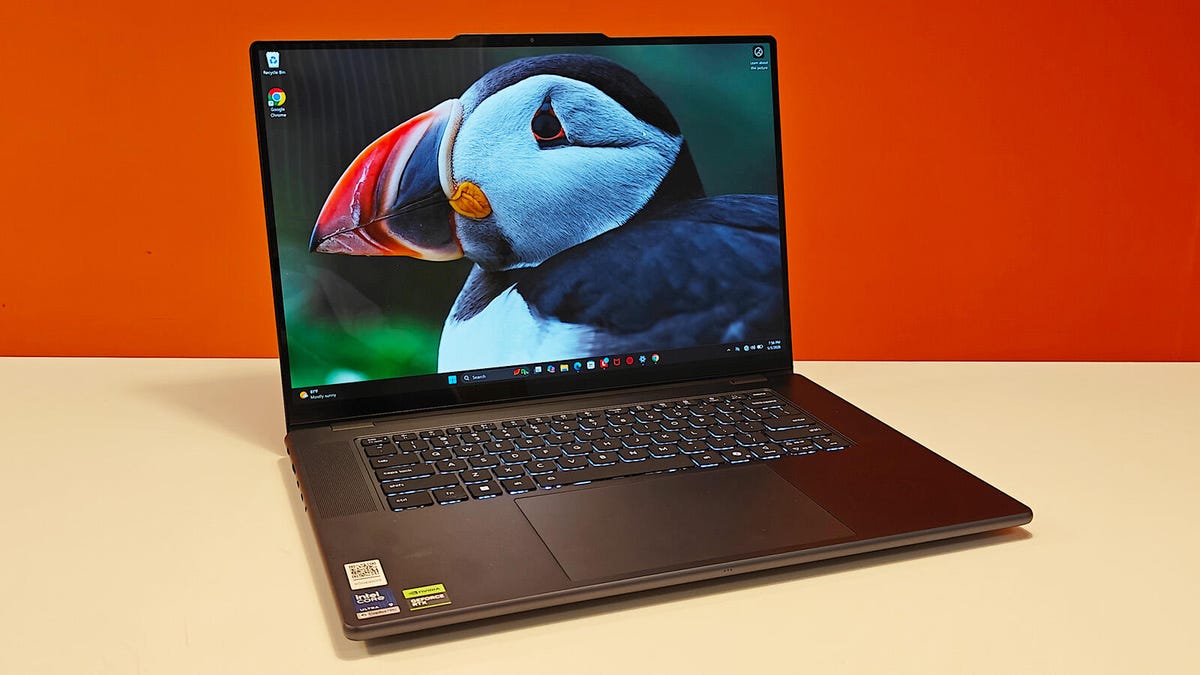
As its name implies, this laptop is tailored for professionals—especially those in creative fields. That purpose is evident throughout, from the internal components to the overall build. Right away, I noticed how closely the Pro 9i resembles the Galaxy Book6 Ultra in size and shape. Their dimensions are nearly identical.
The Lenovo model measures 0.68 x 14.20 x 9.76 inches and weighs 4.2 pounds, while the Samsung version is 14.05 x 9.76 x 0.6 inches and just under four pounds. The keyboard layout on the Pro 9i mirrors the Galaxy Book’s, featuring low-profile keys with rubberized caps—but Lenovo’s execution feels more refined. The typing experience is crisper and less spongy.
This improvement may stem from the more compact trackpad, which leaves ample space on the wrist rest while remaining highly responsive. It also works with the Yoga Pen Gen 2 stylus, letting users sketch directly on its surface like a small drawing tablet. Note that the stylus isn’t included by default—it’s an additional purchase on top of an already premium-priced machine.
Update: Lenovo has clarified that every configuration of the Pro 9i Aura Edition does include the Yoga Pen Gen 2. No separate purchase is needed.
Also: Why this 16-inch gaming laptop is a smarter choice than a desktop in 2026
Where the Pro 9i truly sets itself apart is thermal management. One of my biggest complaints about the Galaxy Book6 Ultra was how quickly it heated up under sustained workloads. The Lenovo Pro 9i tackles this head-on.
Generous vents tucked behind the sturdy hinge expel hot air efficiently. The laptop rests on a “thermal bump”—essentially a thick rubber foot—that lifts it slightly to allow cool air intake from below. During testing, the device stayed comfortably cool in nearly every scenario. There was one exception where it warmed up noticeably—I’ll cover that shortly.
For a content creation machine, a top-tier display is essential—and the Pro 9i delivers. Lenovo has outfitted the Aura Edition with a visually stunning screen.
The 3.2K PureSight Pro Tandem OLED panel comes packed with advanced features: X-Rite Pantone certification for precise color accuracy, VESA DisplayHDR 1000 for deep contrast, and support for multiple color spaces, among others. In short, the display quality is exceptional.
Powerful performance
My review unit of the Lenovo Pro 9i Aura Edition was configured with high-end specs: an Intel Core Ultra 9 386H processor, 32GB of RAM, and an Nvidia GeForce RTX 5060 GPU. This is workstation-grade hardware, and it performs accordingly.
Also: I tested an M.2 PCIe enclosure for storage—and it dramatically sped up my file transfers
To assess its capabilities, I ran a mix of benchmark and real-world tests across various creative tasks. The results were outstanding. As expected, this laptop excels in demanding creative workflows. Working in Adobe Photoshop and Lightroom felt seamless and snappy.
That same fluidity extended to video editing apps, where timeline scrubbing was smooth and responsive. The powerful CPU ensures fast rendering and export times for high-res images and videos. The Pro 9i handles heavy multitasking effortlessly—even under intense loads, it never stuttered.
The cooling system generally keeps temperatures well-controlled, though there are moments when the Pro 9i can get quite warm. During a 3D rendering stress test, the chassis heated up significantly, and the fans spun aggressively. That said, this is a rare edge case—the test ran at high resolution for several minutes before the laptop became too hot to hold. Most users won’t encounter this. Still, it’s worth noting.
Below is a table comparing the benchmark scores of the Lenovo Pro 9i Aura Edition against the Dell XPS 16 and Samsung Galaxy Book6 Ultra.
Interestingly, all three machines deliver nearly identical performance. While the Pro 9i falls slightly behind, the difference is negligible in everyday use—you’re unlikely to notice it. What truly distinguishes Lenovo’s laptop are its exclusive features, such as the stylus-compatible trackpad and advanced thermal design.
Also: This critical Linux vulnerability threatens millions of systems—here’s how to stay safe
Before closing, I should address battery life. It’s underwhelming. The Lenovo Pro 9i lasted about 10.5 hours on a single charge (with battery saver turned off). While decent, it lags far behind its rivals—the Galaxy Book6 Ultra, for instance, ran for 20 hours. On the bright side, charging is remarkably fast: it can go from empty to 70% in roughly 30 minutes.
ZDNET’s recommendation
The Lenovo Yoga Pro 9i Aura Edition is now available directly from Lenovo’s website, starting at $2,660. Customization options are limited, but you can upgrade to the 3.2K display and choose the Nvidia GeForce RTX 5060 GPU if desired. At the time of publication, Lenovo is automatically applying a $140 discount, bringing the effective starting price down to approximately $2,560.
All things considered, the Pro 9i Aura Edition is an excellent content creation laptop that I wholeheartedly recommend. In my view, it strikes a smart balance between the Galaxy Book6 Ultra and Dell XPS 16 in terms of value. Samsung’s model offers far superior battery life, while Lenovo’s is more affordable. The Dell XPS 16 costs less but comes with fewer features.
Ultimately, your choice depends on your priorities. Each laptop has its own strengths and compromises—so the best pick is the one that aligns most closely with what you need.
