




Route choice technique and comparative analysis of the Shu Street line
Jinniu Street and Baoxie Street are the core parts of the traditional Shu Street transportation system, and are typical examples of finding out the great dynamic adaptation of historic transportation to bodily geography, social economic system, and navy politics. By way of bodily geography, Jinniu Street, as the primary line of the southern part of Shu Street, connects Hanzhong and Sichuan Basin, and turns into the primary axis of the Sichuan-Shaanxi official street, reflecting the knowledge of utilizing the river valley hall to beat the terrain on the sting of the basin. Counting on the Baoxie Twin River Valley to type a low mountain go, the Baoxie Street has lengthy assumed essential transportation and navy capabilities as an official publish street. By way of navy and political dimensions, Jinniu Street was the strategic lifeblood of the central energy to handle the southwest and management Bashu; The Baoxie Street connects the political core Guanzhong with the strategic Hanzhong, and has change into a key navy hall for transmitting authorities orders and dispatching troops. Within the socio-economic dimension, the 2 roads, as the primary roads between Sichuan and Shaanxi with an earlier opening time and comparatively quick mileage, are the core financial arteries that keep the circulation of supplies between Guanzhong and Chengdu and promote the prosperity of commerce and commerce33. It’s the superposition of this multidimensional core operate that has made the routes of Jinniu Street and Baoxie Street bear frequent changes and expansions over hundreds of years, and its change trajectory profoundly displays how historic street building dynamically responds to strategic wants and modifications in financial dynamics beneath complicated geographical constraints. Subsequently, these two roads are chosen not solely due to their lengthy historical past and vital modifications in routes, but in addition as a result of their route choice and diversion course of totally replicate the dynamic adaptation relationship between pure geographical situations and the social wants of historic street building.
The drawing of the schematic diagram of the 2 routes of Shu Street (Fig. 3) comprehensively refers to historic paperwork, archeological discoveries, trendy technical evaluation, and different supplies. By systematically combing by paperwork such because the “Yuanhe County Map” and “Studying Historical past Fangyu Minutes”, mixed with the positioning information of archeological excavations, the routes and factors of the Shu Street are verified. In accordance with totally different historic durations, the Baoxie Street may be divided into the Qin and Han Baoxie Roads (Han and Wei Baoxie Roads) and the Tang and Music Baoxie Roads. The Lianyun Plank Street, which was expanded in the course of the Yuan, Ming and Qing dynasties, was developed on the idea of the Baoxike Street of the Tang and Music Dynasties, and within the a whole bunch of years from the Yuan Dynasty to the Republic of China, the site visitors between Sichuan and Shaanxi virtually fully relied on the Lianyun Plank Street and the Jinniu Street (as proven within the image). The northern part of Jinniu Street has undergone three essential realignments, which occurred within the Qin and Han dynasties, the Tang and Music dynasties, and the Ming and Qing dynasties. Within the Ming Dynasty, the route of the southern part of Jinniu Street was adjusted from Guangyuan-Deyang-Chengdu to Guangyuan-Langzhong-Chengdu39.
a Qin and dynasties. b Tang and Music Dynasties. c Yuan, Ming, and Qing dynasties. d Ming and Qing dynasties.
Line choice and comparability of the northern part of Jinniu Street
Within the research of the route choice technique of the northern part of Jinniu Street, the road choice technique adopted within the northern part of Jinniu Street within the Qin and Han dynasties, Tang and Music dynasties, in addition to within the Ming and Qing dynasties, is summarized, as proven in Desk 340. In subsequent mannequin evaluation, we are going to make use of the Random Forest algorithm to check the significance of key elements reminiscent of topography, water methods, and administrative nodes. Moreover, we are going to make the most of SHAP dependency plots to interpret threshold results of things like river space and elevation.
An in-depth evaluation of the route choice methods of the northern part of Jinniu Street within the Qin, Han, Tang, Music, Ming, and Qing dynasties can establish its commonalities and variations in pure terrain dependence and transportation (Desk 4). These elements not solely replicate the evolution of technological growth in historic durations but in addition reveal the dynamic relationship between the geographical surroundings and human actions.
Choice and comparability of the southern part of Jinniu Street
The route of the southern part of Jinniu Street was considerably adjusted within the Ming Dynasty. The southern part of Jinniu Street in the course of the Ming Dynasty was rerouted by Langzhong, which was not solely the results of avoiding the terrain but in addition intently associated to the executive changes in northern Sichuan in the course of the Ming interval. The institution of the Shouxun Dao (patrolling circuits) for the reason that Ming Dynasty elevated the standing of Langzhong, with the Northern Sichuan Circuit’s administration based mostly in Baoning Prefecture. The Sichuan Gazetteer of the Zhengde interval, Quantity 3, Provincial Administration – Chronological Desk of Successive Dynasties Half 2, states: Dividing Sichuan into East, West, South, and North circuits, with one rotation every year… and assigning governance to East, West, South, and North circuits every year, every circuit having left and proper political advisors to help. This elevation in administrative hierarchy instantly resulted in changes to the official publish roads to strengthen management and connectivity with Langzhong42. To be able to strengthen the management and connection of this key node in Langzhong, the core route of the southern part of Jinniu Street was modified from the Yuan Dynasty and the previous Guangyuan-Zitong-Chengdu line to the Guangyuan-Langzhong-Yanting-Santai-Chengdu line by Langzhong. In contrast with the previous street passing by Jianmen Go, the general site visitors node from Guangyuan to Langzhong within the Ming Dynasty was smoother and extra handy than the route from Guangyuan to Liugou City within the Qing Dynasty (as proven in Figs. 4 and 5). Though the detour to Langzhong and Yanting elevated the whole mileage by greater than 300 miles, avoiding the extraordinarily rugged terrain of Jianmen’s pure risks tremendously improved the security and comfort of the street, which turned an essential technical optimization when implementing the political line. On the identical time, the previous street that initially handed by Jianmen stays, offering two elective routes for pedestrians. The route choice technique for the southern part of the Golden Ox Street in the course of the Qing Dynasty leveraged pure topographical benefits whereas integrating navy protection necessities. The Jianmen County Continuation Annals information, within the fourth month of the twenty-ninth yr of the Kangxi reign, Gar Tu, the Governor of Sichuan, repaired the traditional Jianmen Go street spanning 600 and twenty li. Benefiting from the farming low season, he reduce timber, quarried stone, constructed bridges, and constructed boats to facilitate journey, thus remodeling it right into a clean and stage street. In areas with steep cliffs, such because the Jiange area, the development of cliffside plank roads decreased the problem of traversing harmful mountains, making certain the secure passage of autos and horses. Moreover, the institution of passes just like the Damushu Station not solely assured the security and clean move of site visitors but in addition enhanced navy protection capabilities33.
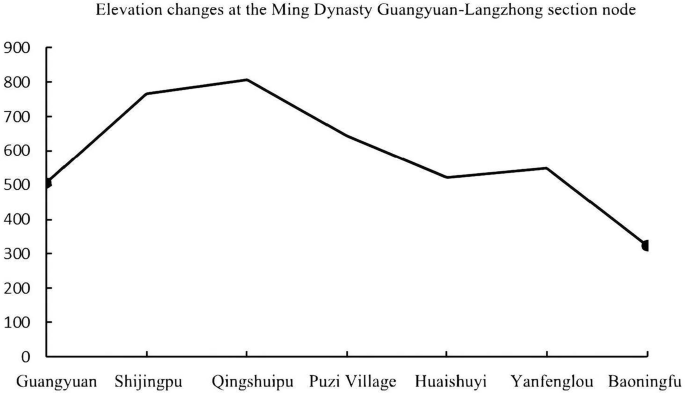
Elevation map of Mingguangyuan Langzhong Transportation Node.
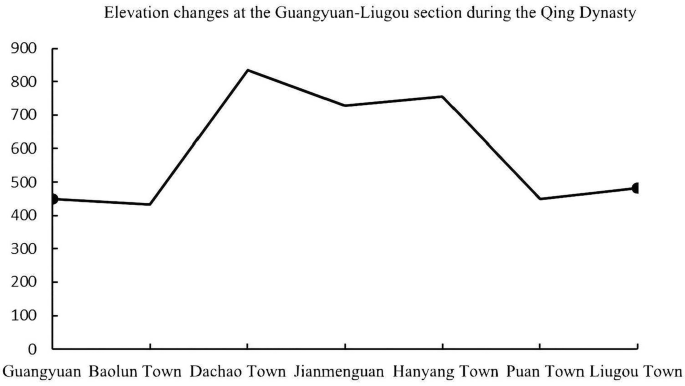
Elevation map of transportation nodes in Qingguangyuan Liugou City.
Within the line choice methods of the Ming and Qing Dynasties alongside the Golden Ox Path, there are each commonalities and vital variations between the 2 (Desk 5). The Ming Dynasty emphasised security and smoothness in route choice, avoiding the steepness of Jianmen and choosing gentler routes. In distinction, the Qing Dynasty relied extra on pure topography whereas additionally contemplating navy protection.
Baoxie Street route choice and comparability
The Data of the Grand Historian: Treatise on Rivers and Canals states, now, by excavating the Baoxie Go route, we scale back the steep slopes and shorten the space to just about 4 hundred li. Furthermore, the Bao River connects to the Min River, and the Xie River connects to the Wei River, each of which may be navigated by boats for transport. In the course of the Qin and Han dynasties, the Baoxie Street made full use of pure situations to hunt probably the most favorable street route within the complicated mountainous areas. Just like the northern part of Jinniu Street, its predominant route can also be positioned alongside rivers and streams, making use of the river and canyon areas for street engineering building to cut back the workload. On the identical time, attempt to keep away from passing by overly steep ridges and harmful cliff sections, and choose comparatively flat areas as a lot as attainable for engineering building to facilitate the development course of. When encountering mountain ranges blocking the way in which, the Baoxie Street adopts a circuitous strategy, reminiscent of utilizing low passes like Wuli Po as a watershed. In the course of the building of the Shimen Tunnel, the terrain was ingeniously utilized, and the tunnel website was positioned in a comparatively open place, thereby considerably lowering the site visitors distance. As well as, for some extraordinarily troublesome areas, a picket plank street construction with chisel stone and wooden frames was adopted to make sure the security and stability of vacationers33. The Data of the Grand Historian additional spotlight the Baoxie Go’s significance within the Western Han economic system. Emperors Xiao and Zhao ruled Xianyang, establishing it because the Han capital. Chang’an, with its imperial tombs… to the south lay Ba and Shu. Ba and Shu had been additionally fertile lands, wealthy in jade, cinnabar, sandalwood, stone, copper, iron, bamboo, and timber….But surrounded by 4 pure limitations, with a thousand-mile-long mountain path connecting all areas, solely the Baoxie Go serves because the gateway, exchanging abundance for shortage44.
In the course of the Tang and Music Dynasties, the Biaoxie Street thought-about terrain, navy, and social elements when deciding on its route, and new constructions had been added to the present street. The brand new route usually adopted the terrain and made intensive use of previous roads, particularly specializing in the troublesome part from Sanguan to Baocheng. The brand new route prevented the treacherous sections and complicated water environments of the unique Biaoxie Street, opting as a substitute for comparatively flat, steady, and safer areas to facilitate journey, leading to a considerably smaller elevation distinction between essential transportation hubs from Baoji to Fengzhou in the course of the Tang and Music Dynasties in comparison with the larger elevation distinction between the stations from Meixian to Wuguan in the course of the Qin and Han Dynasties (Figs. 6 and seven). Moreover, by adopting a phased building methodology and scheduling the work throughout navy breaks, native manufacturing actions and residents’ lives weren’t disrupted. Moreover, totally different strategies had been employed to excavate large rocks and break cliffs in response to the terrain traits, finally making certain the security of the street. Furthermore, this new route continued alongside the trail of the Baogu River, considerably lowering the amount of earthwork and preserving its unique historic continuity33 (Desk 6).
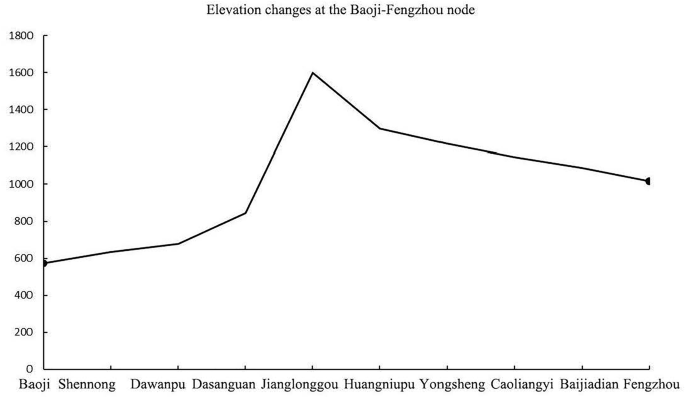
Elevation map of transportation nodes from Baoji to Fengzhou in the course of the Tang and Music dynasties.
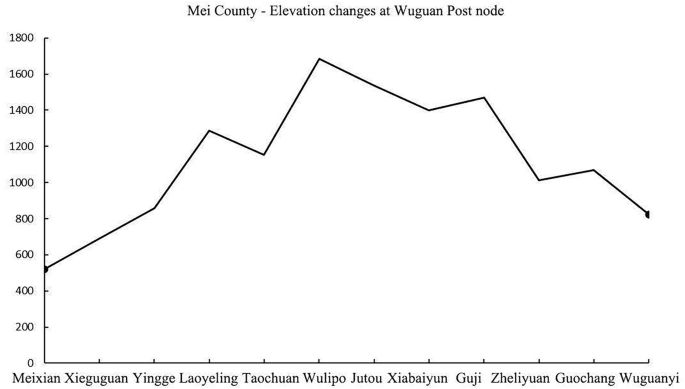
Elevation Map of Transportation Nodes from Meixian County to Wuguanyi in the course of the Qin and Han Dynasties.
The choice technique for the Baoxie Street in the course of the Qin-Han and Tang-Music durations not solely made full use of the pure geographical options but in addition mirrored the flexibleness demonstrated by historic individuals in responding to topographical challenges. The road choice in each durations took into consideration the necessity for transportation comfort. Nevertheless, with the event of historical past and the evolution of technological ranges, the choice methods for this street have proven vital variations, as illustrated in Desk 7, which highlights the modifications within the choice technique for the Baoxie Street in the course of the Qin-Han and Tang-Music durations. It must be famous that for the reason that Ming and Qing Lianyun plank roads had been constructed alongside the previous route of the Tang and Music Baoxie Street, this research divides the Baoxie Street into the Qin-Han and Tang-Music durations, and doesn’t take into account the Ming and Qing as a separate section33.
By means of a typical case evaluation of the Jinniu Street and Baoxie Street, it’s evident that the route collection of the Shu Roads is basically adjusted dynamically round three dimensions: adaptation to pure terrain, navy strategic wants, and socio-economic elements. The choice logic of those two routes not solely encompasses the expertise of adapting to the complicated terrain of the Qinling and Daba Mountains but in addition displays the collaborative mechanism of political, navy, and financial elements, making them consultant and typical. Case-based evaluation not solely supplies empirical factors for subsequent machine studying evaluation of the complete Shu Street community but in addition clarifies the core hypotheses that should be particularly examined, specifically, whether or not the three elements—adaptation to pure terrain, navy strategic wants, and socio-economic elements—exhibit nonlinear relationships and synergistic results all through the Shu Street community. The next will use machine studying fashions to conduct a quantitative evaluation of the complete Shu Street community to additional confirm and reveal extra macro-level driving mechanisms behind route choice.
Mannequin efficiency comparability
In analyzing the mechanism by which indicators have an effect on Shu Street route choice, we constructed 4 prediction fashions to judge their efficiency (Fig. 8). These fashions embody RF, CatBoost, XGBoost, and LightGBM. Use AUC to quantify mannequin efficiency. Within the evaluation of the prediction mannequin constructed for the important thing affect indicators of the Shu Street route choice, we evaluate and consider the efficiency of 4 mainstream ensemble studying algorithms, specifically Random Forest, CatBoost, XGBoost, and LightGBM. The great evaluation reveals that though CatBoost and XGBoost have barely larger AUCs on the coaching set, their generalization capacity (AUC) on the check set is barely inferior to that of the random forest (about 0.0026 and 0.0023 decrease, respectively), and the hole between the AUC of the random forest coaching set and the check set (0.0826) is comparatively small, displaying higher stability and decrease threat of overfitting. Specifically, it’s price emphasizing that the random forest mannequin has vital benefits within the evaluation of indicators involving a number of sources and should comprise complicated nonlinear relationships and interactions, reminiscent of Shu Street route choice, and its inherent random characteristic subset choice mechanism successfully reduces the correlation between variables and improves the mannequin’s capacity to establish key impartial influencing elements. On the identical time, the tree group construction constructed by it naturally has the flexibility to seize complicated nonlinear patterns and supply intuitive characteristic significance rating, which is essential for understanding how multidimensional elements reminiscent of topography, geology, navy, politics, and economics have an effect on route choice choices. Subsequently, we lastly selected random forest because the mannequin for the evaluation of the affect index of the Shu Street route choice.
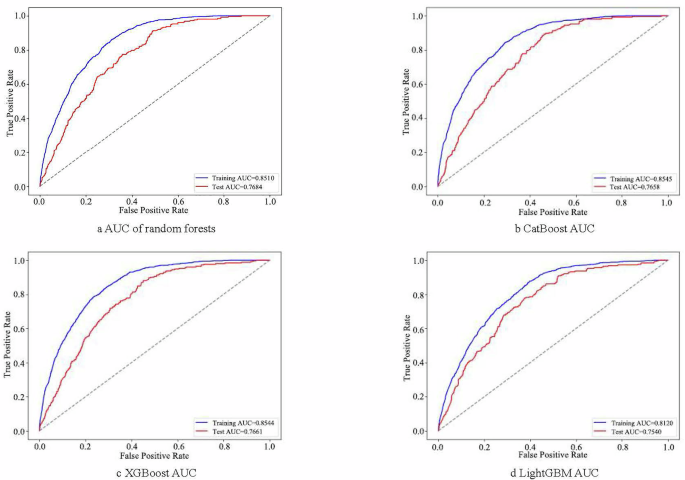
a AUC of random forests. b CatBoost AUC. c XGBoost AUC. d LightGBM AUC.
The relative significance of the Shu Street route choice variable
To be able to analyze the nonlinear traits and relative weights of assorted influencing elements within the resolution of Shu Street route choice, the random forest mannequin and the SHAP methodology had been used to judge the significance of options. The left determine of Fig. 9 reveals the typical absolute SHAP worth (world significance) calculated based mostly on the samples of all street sections, reflecting the general affect of every influencing issue (reminiscent of topography, river, city, go, and many others.) on the ultimate route choice resolution. The determine on the best reveals the person variations within the significance of every issue and its scope by plotting the distribution of Shapley values (native significance) of every influencing issue on every particular street part. Within the determine, the Y axis represents the influencing issue, the X axis is the SHAP worth (constructive worth signifies that the issue tends to advertise the route to decide on the trail, adverse worth means tendency to keep away from the trail), every level corresponds to the SHAP worth of a street part pattern, and its shade represents the unique worth of the influencing issue on the street part pattern (blue is the low worth; pink is excessive).

a Imply(|SHAP worth|)(common affect on mannequin output magnitude). b SHAP worth.
Determine 4 reveals the outcomes of the significance evaluation of every variable affecting the collection of the Shu Street line. From the attitude of the mannequin, the class of things that reveals the strongest spatial distribution correlation with the historic routes of the Shu Roads is socio-economic elements. Amongst these, the post-impact index is a key indicator. It’s particularly price noting that this robust correlation might reveal a bidirectional suggestions and co-evolutionary relationship between the Shu Street routes and the socio-economic actions alongside them. On one hand, present settlements and inhabitants facilities generate transportation demand, attracting street connections; then again, the choice and opening of official roads tremendously promote the institution of publish stations alongside the route, and the long-term steady operation of those publish stations, in flip, stimulates new business settlements and inhabitants clusters. Subsequently, the excessive correlation between socio-economic indicators and these routes captured by the mannequin doubtless displays the path-dependent traits of the Shu Roads as an official transportation artery throughout its long-term operation. As soon as the street system was established, it strongly formed the human and financial geography alongside the route. In different phrases, at a static stage, the mannequin outcomes uncover the shut symbiotic relationship between the route and socio-economic nodes, and the formation of this relationship doubtless originates from deeper political-military calls for and pure geographic constraints.
Pure environmental elements are the second greatest influencing issue. Amongst them, elevation is the only most essential metric of all variables. Excessive altitude means steep terrain, enormous engineering issue, and poor site visitors situations, so the route choice tries to keep away from the excessive altitude space, which is strongly negatively correlated. In distinction, the affect of geological construction, topography and rivers on route choice is comparatively small, and their affect on route choice is complicated, with each favorable and unfavorable sides, which can be as a result of the steady geological construction can present a stable basis for street building and scale back the chance of street collapse, however the complicated geological construction will enhance the problem of building, which can result in street instability, landslides and different geological disasters; Rivers can present passages, and river valleys are sometimes comparatively flat, which is handy for street building. It might additionally deliver issues reminiscent of flooding and sediment accumulation, growing the problem of street building and upkeep prices. In some instances, rugged terrain reminiscent of sure ridgelines can function pure watersheds; Nevertheless, the landform will increase the problem of building because of the rugged terrain, which is negatively correlated with the route choice.
The mannequin outcomes reveal the dynamic traits of Shu Street formation. Pushed by strategic management wants, passes had been first established at key topographical factors, whereas official roads had been routed to attach or traverse these nodes to satisfy defensive capabilities. Equally, the format of higher-level administrative facilities mirrored the spatial distribution of state energy, with official roads serving to hyperlink these facilities. Thus, the correlations captured by the mannequin point out roads’ adaptation to and reinforcement of present political-military constructions. The comparatively low correlation energy might stem from these macro-level elements defining the primary framework of transportation corridors, thereby constraining micro-level route choice.
The marginal impact of the Shu Street route choice variable
The SHAP mannequin can generate scatter plots, visually present the affect of a single variable on the mannequin’s prediction outcomes, and reveal complicated nonlinear relationships and threshold results. The horizontal axis represents the precise values of the pattern information factors, whereas the SHAP values on the vertical axis quantify the contribution of those information factors to the mannequin’s output. To be able to extra clearly reveal the affect of variables on the prediction outcomes of the mannequin, a reference line was drawn with the SHAP worth equal to zero. To be able to eradicate the affect of dimensions and enhance the convergence of the mannequin, this paper standardizes all space options, that’s, converts them to dimensionless values by subtracting the imply and dividing by the usual deviation. In a SHAP dependency plot, the abscissa of a characteristic represents a normalized space worth, and the bigger the worth, the bigger the realm of the kind of terrain within the mesh, and vice versa.
Determine 10 reveals the affect mechanism of assorted geographical, military-political, and socio-economic elements within the decision-making of the Shu Street route choice. On the entire, aside from topography, the affect of different elements reveals a nonlinear pattern. Among the many pure environmental elements, the elevation between 500 and 1200 meters has a constructive affect on the route choice coverage, indicating that the geographical situations inside this elevation vary are conducive to street building and site visitors. The complexity of geological construction has a constructive impact between 0.3 and 0.8, however on the entire, the affect of geological construction on route choice is considerably complicated. The affect of topography and landform on the Shu Street route choice coverage is constructive, reflecting the consideration of the particular terrain within the strategy of route choice. After the river space exceeds a sure threshold, its affect on route choice turns into constructive, in all probability as a result of massive rivers facilitate the transportation of sources reminiscent of timber, thereby facilitating route choice choices.
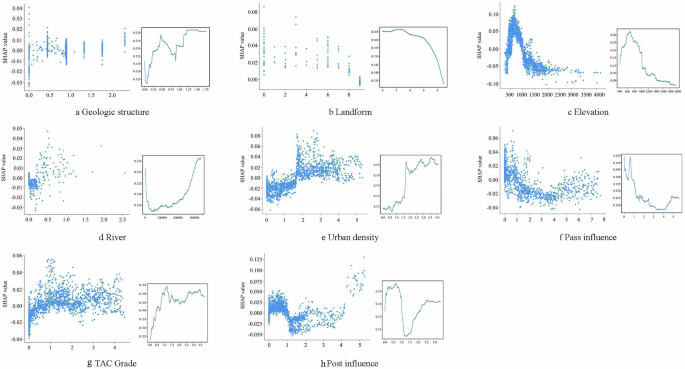
a Geologic construction. b Landform. c Elevation, d River, e City density, f Go affect, g TAC Grade, h Publish affect.
Among the many socio-economic elements, the affect of the post-station affect index confirmed a constructive impact between 0 and 1, however with the rise of the affect index, the affect on the Shu Street route choice coverage steadily weakened, after which elevated once more, indicating that when the variety of publish stations reached a sure stage, the affect tended to be saturated and there was a rebound impact. Though there are fluctuations within the course of, the general affect on the Shu Street route choice has steadily elevated with the development of urbanization. Among the many navy and political elements, the affect of the go confirmed extra adverse results within the vary of two–5. In different intervals, the affect of the go is constructive. The affect of the executive heart is proven to be a nonlinear constructive development, indicating that with the institution and growth of the executive heart, its affect on the Shu Street route choice coverage has steadily elevated. On the entire, the affect of assorted elements presents the traits of a posh mixture of linearity and nonlinearity, displaying the multidimensional consideration and complexity of the Shu Street route choice resolution.
Native interplay results
By using SHAP interplay values, pairs of variables with vital interactions may be recognized. Determine 11 illustrates the native interplay results between some variables. Every information level within the graph represents a pattern, the horizontal axis represents the worth of variable X1, and the colour of the dots represents the worth of variable X2. The SHAP interplay values displayed on the vertical axis present the contribution of the interplay between variables X1 and X2 to the mannequin prediction outcomes.

a City density and Go affect. b City density and TAC Grade. c River and City density. d Elevation and River. e Elevation and TAC Grade. f Elevation and Go affect. g Elevation and Publish affect. h Elevation and City density. i River and Publish affect. j Geologic construction and Elevation. ok Go affect and TAC Grade. l Go affect and Publish affect.
Among the many socio-economic elements affecting the collection of Shu Street, when the city affect index is between 0 and 1, whatever the affect of the go, the 2 have a adverse impact on the route choice. Nevertheless, with the rise of the affect of the city, the affect of the go steadily elevated, and the fluctuation vary of its SHAP worth additionally expanded, which started to have a sure constructive impact on the collection of Shu Street. Particularly in areas with excessive city affect, the protection wants of the go and the transportation demand are intertwined, and collectively they play a job within the resolution of route choice. The mixed impact of city density and TAC grade on Shu Street alignment choice displays its highest interplay time period at an city density stage of roughly 2.5–3.5, indicating reasonable street accessibility inside this vary. As city grades enhance additional and administrative heart indices deepen, the interplay time period declines as a substitute, even approaching adverse values. Larger-grade administrative facilities might not exert equal route attraction, doubtlessly as a consequence of terrain, protection issues, or different elements offsetting their potential benefits. Among the many bodily geographical elements, the interplay impact between rivers and cities is important, particularly in areas with excessive city affect, and with the rise of river elements, its interplay with excessive city density has a constructive affect on the collection of Shu Street routes. The interplay between elevation and river is manifested in the truth that when the altitude is at 500–1000 meters, the bigger the river space, the extra apparent the constructive impact on the Shu Street route choice. The connection between elevation and administrative heart is that within the vary of 0–1000 meters above sea stage, the synergy impact between the 2 on the Shu Street route choice is principally manifested. When the altitude exceeds 1000 meters, with the rise of altitude, the affect of the executive heart is low, and the 2 have a constructive impact on route choice. The interplay between elevation and go reveals that with the rise of altitude, the upper the affect of the go, the stronger the synergistic impact between the 2 on the collection of Shu Street routes. Equally, the interplay between elevation and post-station can also be manifested in the truth that with the rise of altitude, the upper the affect of the post-station, the extra vital the synergistic impact between the 2 on the collection of Shu Street routes. Nevertheless, the interplay between elevation and cities is totally different, and with the rise of altitude, the synergistic impact between the 2 on the collection of Shu Street is stronger when the affect of low cities is robust. The interplay evaluation between rivers and publish stations reveals that the SHAP worth steadily will increase within the areas with nice river affect, which signifies that the assist impact of rivers on Shu Street route choice is extra vital in such areas, totally displaying that the interplay between rivers and publish stations has a powerful supporting impact on Shu Street route choice. Lastly, the interplay between geological construction and elevation reveals a adverse affect; that’s, with the rise of geological construction complexity and altitude, the mixed impact of the 2 has an antagonistic impact on the Shu Street route choice.
By way of navy and political elements, when the strategic go affect worth is between 0 and a couple of, it will probably synergize with the executive heart’s hierarchy, however when this worth exceeds 2, the connection turns adverse. It is because the optimum geographical places of passes and administrative facilities typically misalign, as geographical constraint factors, passes prioritize routes that meet site visitors and protection necessities, thereby deviating from the optimum path connecting administrative facilities, inflicting their influences to offset one another. Equally, the connection between passes and publish stations additionally entails dynamics of synergy and competitors. In areas the place each influences are comparatively low, pure constraints are restricted, permitting the Shu Street routes to flexibly accommodate each wants and exhibit synergistic results. Nevertheless, when the go affect index exceeds 2, its interplay with publish stations in route choice turns into adverse. This primarily stems from variations in useful positioning, passes deal with navy protection, and are normally positioned in rugged terrain, which considerably will increase the associated fee and issue of street building close by; in distinction, publish stations present materials transport and relaxation, preferring places on flat terrain that facilitate useful resource allocation. When each influences are robust, routes should concurrently meet protection necessities and transportation comfort, making coordination troublesome and leading to mutual constraints.
