A joint research effort from Perplexity and Harvard provides real-world evidence on how AI agents are transforming knowledge work. The study leverages production data from two Perplexity offerings: Search and Computer.
The design creates a natural side-by-side comparison. Search operates as a conversational answer engine, while Computer functions as an agent that plans and carries out tasks from start to finish. Since the same users interact with both tools, the research team can keep the type of task roughly consistent across the two.
What the Study Actually Measures
The study spans a 90-day period, running from February 27 through May 27, 2026. Computer launched just two days before that window began.
The core methodology involves pairing nearly identical queries across the two products. Researchers identified 10,000 session pairs with a cosine similarity above 0.99 — meaning each pair represents essentially the same task attempted through both modes.
Computer sessions are filtered to only include those that trigger an execution tool. These ‘do’ tools cover code execution, browser operations, file writes, and connector calls. This filter guarantees that every Computer session involves genuine autonomous work.
Adoption climbed steadily throughout the window. Cumulative Computer queries hit 84 times their first-week volume. A matched analysis also found that using Computer increased users’ daily Search queries by 1.05, suggesting the two products complement each other rather than compete.

The Cost-Structure Framework
The study builds its findings on a straightforward task-based model. Every task consists of a certain number of steps, and longer tasks tend to carry somewhat higher value.
Agents reshape the cost equation. They come with a higher fixed cost per task — accounting for delegation and review — but a lower marginal cost per step, since the system handles the actual execution.
This creates a breakeven point measured in step count. Below that threshold, the conversational mode remains more economical. Above it, the agent mode comes out ahead. Simple lookups stay conversational; complex workflows shift to the agent.
Autonomy: 26 Minutes vs 33 Seconds
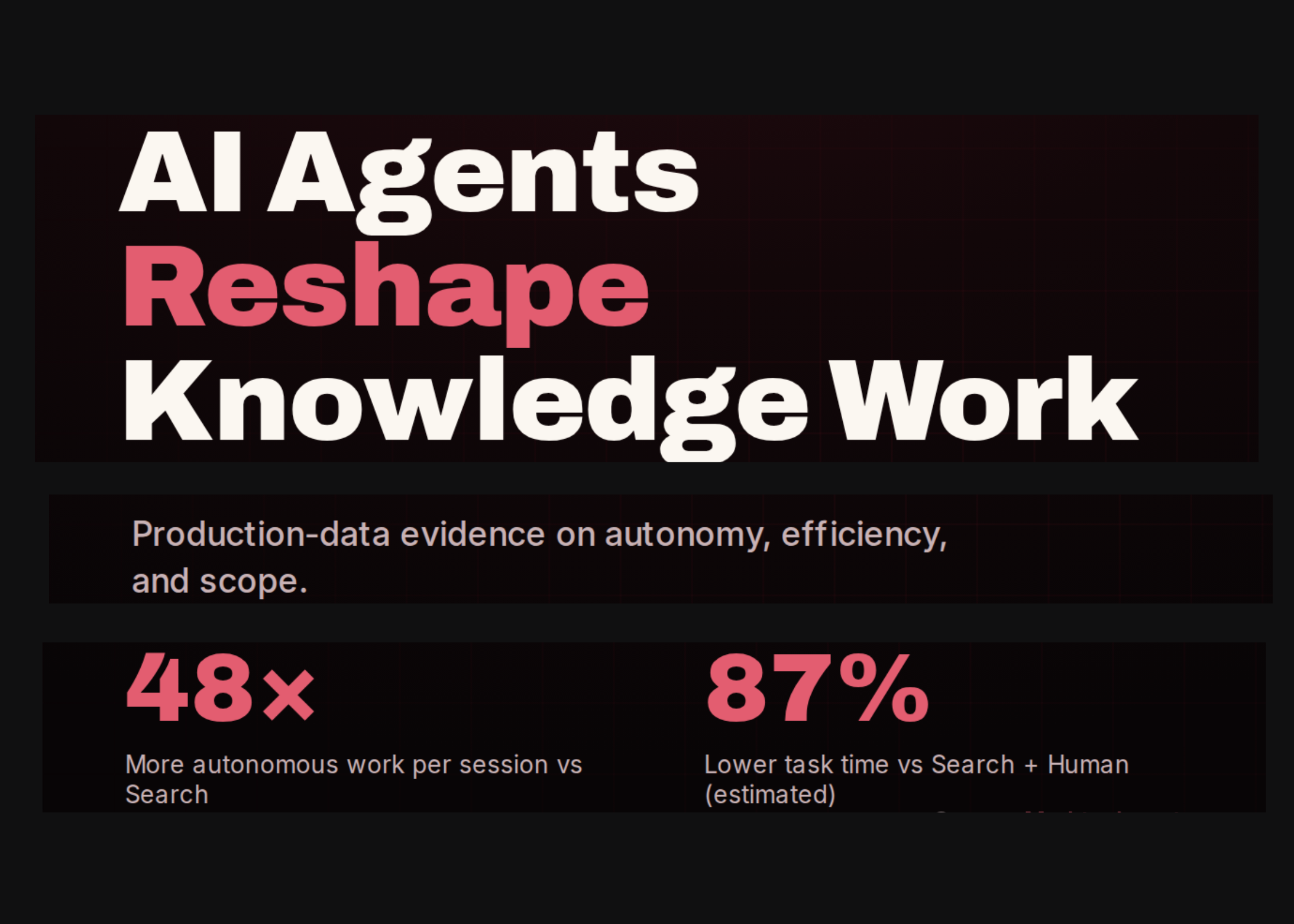
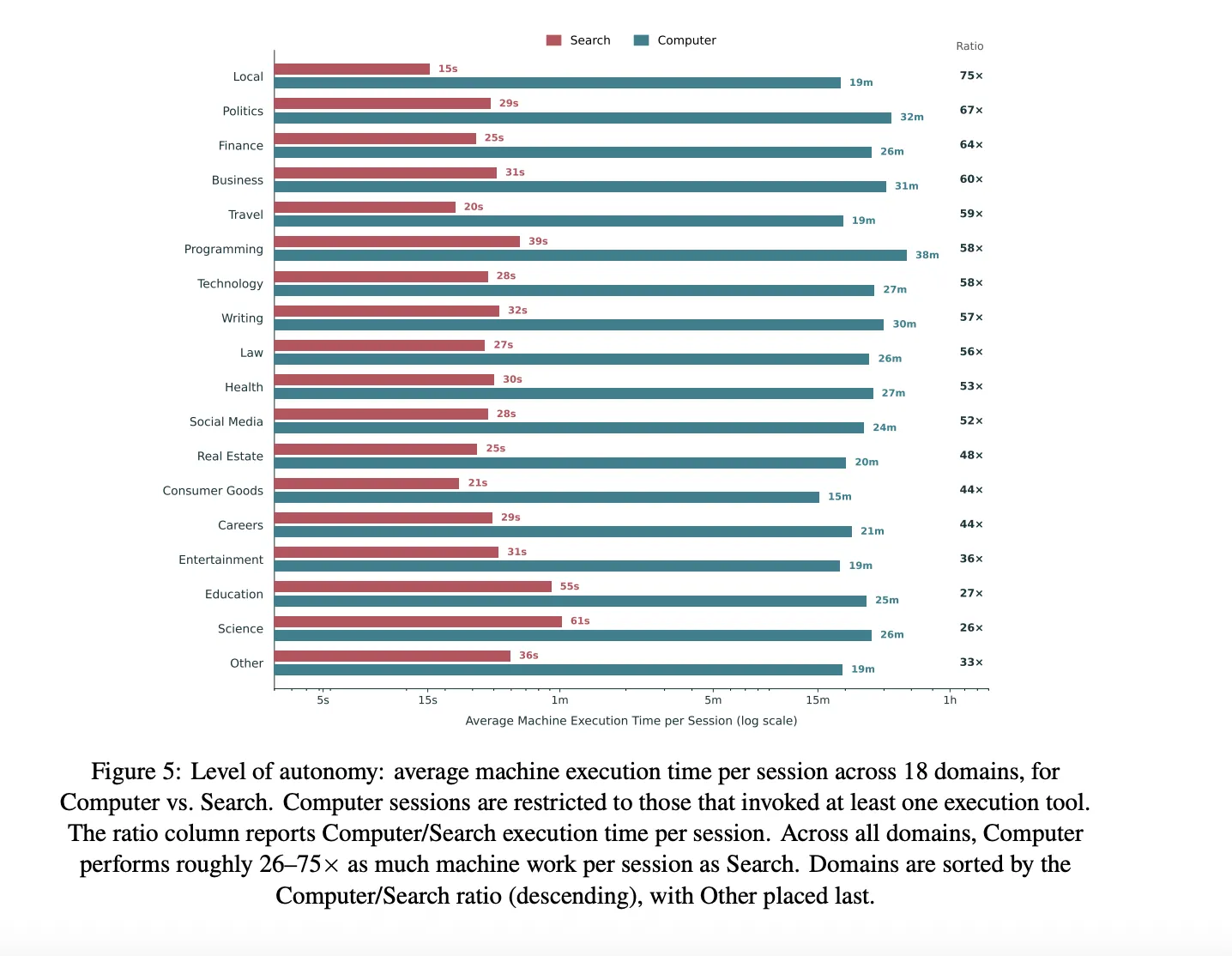
The first measure of autonomy focuses on execution time. Computer dedicates an average of 26 minutes of machine work per session, compared to just 33 seconds for Search — a 48× difference.
Median figures tell a similar story: 9 minutes on Computer versus 14 seconds on Search. The gap varies depending on the domain. Local tasks show a 75× gap, while Science shows 26×, since straightforward answers are often sufficient there.
Greater autonomy didn’t come at the expense of quality here. The research team measured next-turn dissatisfaction based on what users did afterward. Computer’s meaningful dissatisfaction rate was 1.3%, versus 2.9% for Search — a 55% reduction.
Follow-up conversation turns also shifted slightly toward review and extension on Computer. Connector usage showed an even clearer change. Computer invoked at least one connector in 7.9% of sessions, compared to 1.8% for Search. In other words, Computer chains together external tools that Search users would otherwise need to operate manually.
Efficiency: Where the Savings Come From
The efficiency analysis estimates a Search-plus-human counterfactual. A human relying on Search alone spends about 269 minutes per matched task. With Computer and a human, that drops to just 36 minutes.
That translates to an 87% reduction in time and a 94% reduction in total cost. The cost savings outpace the time savings because higher domain wages amplify the effect. Computer’s model cost ranges from $4–10 per task, while Search runs about $0.05.
The marginal numbers reinforce the framework. Computer plus human costs $0.16 per step, compared to $2.05 for Search plus human. Matched Computer sessions also featured longer prompts — 652 characters versus 448.

This result aligns with the assumption of higher fixed costs for agents. It shows that each agent session carries more setup and orchestration overhead.
A breakeven calculation shows that a professional would need to complete all manual steps in under 20 minutes to justify using Computer over Search. The team validated this figure using an independent large language model (LLM) estimate and user interviews. The LLM-based analysis reported 84% time savings and 93% cost savings. Participants in interviews described speedups ranging from 5× to 300×.
Horizontal and Vertical Expansion
The scope of this study goes beyond earlier research. Autonomy doesn’t merely accelerate existing workflows; it fundamentally changes what work users are willing to take on.
In the horizontal dimension, Computer queries frequently span multiple job categories. The average cross-occupation share on Computer was 59%, compared to 50% on Search. The largest gap appeared in Management and Entrepreneurship, where the difference reached 19 percentage points.
In the vertical dimension, Computer queries are significantly more complex. According to Bloom’s Revised Taxonomy, 76% of Computer queries demanded higher-order thinking skills, versus 55% for Search. Creative-level tasks made up 50% of Computer queries, compared to just 26%.
Computer tasks also draw on a broader range of knowledge areas. On average, each query covered 2.40 O*NET Knowledge domains, versus 1.74 for Search. Computer was almost three times more likely to require expertise from three or more domains simultaneously.
Task complexity increases as the O*NET classification hierarchy becomes more granular. At the Task Statement level, Computer engaged with 60% more distinct activities. Roughly 23% of Computer queries addressed a Task Statement that the same users had never submitted through Search.
Comparison Table: Search vs Computer
| Dimension | Perplexity Search | Perplexity Computer |
|---|---|---|
| Mode in the framework | Conversational answer engine | Agent orchestrator |
| Machine time per session | 33 seconds (median 14s) | 26 minutes (median 9m) |
| Queries per session | 2.8 | 5.3 |
| Meaningful (mid+high) dissatisfaction | 2.9% | 1.3% |
| Sessions with a connector call | 1.8% | 7.9% |
| Counterfactual task time | 269 min (Search + Human) | 36 min (Computer + Human) |
| Cost per step | $2.05 | $0.16 |
| Model cost per task | ~$0.05 | $4–10 |
| Cross-occupation query share | 50% | 59% |
| Higher-order Bloom cognition | 55% | 76% |
| O*NET Knowledge domains per query | 1.74 | 2.40 |
Key Takeaways
- Computer handles 26 minutes of autonomous work per session, compared to just 33 seconds for Search—a 48-fold difference.
- For comparable tasks, the Computer + Human combination reduces estimated time by 87% and cost by 94% over the Search + Human approach.
- Computer’s meaningful dissatisfaction rate stands at 1.3%, versus 2.9% for Search, marking a 55% improvement.
- Computer queries cross occupational boundaries more often (59% vs 50%) and require deeper cognitive effort (76% vs 55% on higher-order Bloom levels).
- Around 23% of Computer queries target Task Statements that the same users never submitted through Search.
Marktechpost’s Visual Explainer
Research Guide
Harvard × Perplexity
Jeremy Yang (Harvard) · Kate Zyskowski, Noah Yonack, Jerry Ma (Perplexity) · arXiv:2606.07489v1
Practitioner-first AI/ML research coverage, decoded for engineers.