



Animals
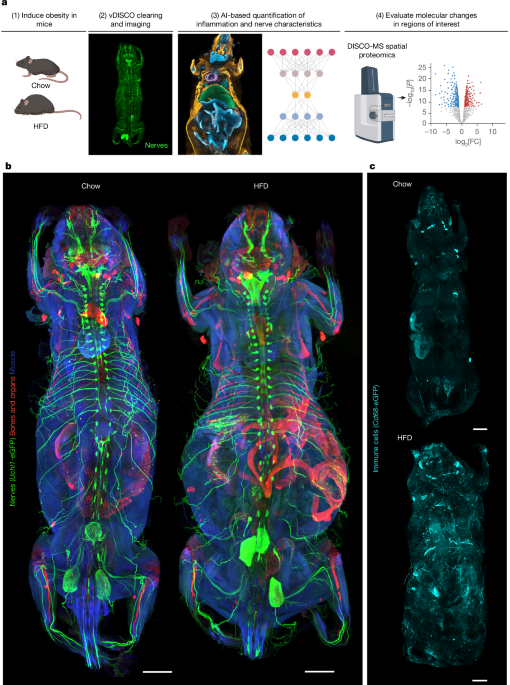
Male Uchl1-eGFP and Cd68-eGFP mice (8 weeks old) on the C57BL/6J background, along with wild-type C57BL/6J mice, were given either a standard chow diet or a high-fat diet (60% fat, D12492i from Research Diets) for 16–18 weeks, with food available at all times. The animals were kept on a 12-hour light–12-hour dark cycle. The animal facility was maintained at 20–24 °C with 45–65% humidity. Body composition was assessed using an EchoMRI-100H system (EchoMRI). For insulin-tolerance tests, mice were fasted for 6 hours and then injected intraperitoneally (i.p.) with 0.75 U kg−1 insulin. Blood glucose levels were measured from the tail vein at specified time points using glucose test strips. Mice were euthanized after deep anesthesia with a ketamine-xylazine mixture, followed by intracardiac perfusion with heparinized PBS (10 U ml−1 heparin) and then perfusion with 4% paraformaldehyde (PFA). Mice were post-fixed overnight in 4% PFA and subsequently washed five times with PBS while shaking (300 rpm) at room temperature for 1 hour per wash step. All animal experiments were conducted in accordance with European Union directives and the German animal welfare act (Tierschutzgesetz). They were approved by the state ethics committee and the government of Upper Bavaria (ROB-55.2-2532.Vet_02-21-133, ROB-55.2-2532.Vet_02-16-117, ROB-55.2-2532.Vet_02-17-49, ROB-55.2-2532.Vet_02-19-166).
Human participants
Trigeminal ganglion samples were collected post-mortem from body donors at the Institute of Anatomy, University of Leipzig, Germany, and fixed in 4% Histofix. Body donors provided informed written consent for the use of their cadavers for research and educational purposes (ethical approval number 129/21-ck, Medizinische Fakultät Ethik-Kommission). Participants were categorized as lean (BMI < 25) or obese (BMI > 30). Details on age and sex are available in Supplementary Table 11. Three regions of interest were dissected from each trigeminal ganglion per individual for proteomic profiling.
Whisker stimulation test
The whisker test paradigm was adapted from previously described methods40,41,42,43 and the Neuroscore test44. To prevent confounding variables, mice remained in their home cages. A cotton swab with a wooden handle was used for the test. First, the cotton swab was presented in front of the mouse’s head and allowed to make contact. This was followed by four consecutive strokes, first to the whiskers on the right side and then on the left side of the face. Responses to the cotton swab stimulation were evaluated using a modified whisker score test. A normal behavioral response, such as turning the head toward or away from the cotton swab or initiating grooming, was scored as one. No response to the stimulation was scored as zero. Both sides of the face were stimulated four times, and scores were recorded by an evaluator blinded to the experimental conditions. The maximum whisker score was 8, indicating the mouse responded to all stimuli. The total score was then averaged for both sides. High scores (3–4) indicated normal responses, while low scores (0–2) suggested a lack of reaction, consistent with sensory deficits.
vDISCO nanobody labelling and clearing
vDISCO was carried out as previously described2,45 in combination with active pumping GFP-Nanobooster labelling (Atto647N-conjugated anti-GFP nanobooster Chromotek, gba647n-100) for 6 days and passive labelling for 3 days. This method amplifies the endogenous eGFP signal in reporter mice and shifts it into the far-red spectrum, greatly improving signal-to-noise ratios throughout the tissue. Mice underwent DISCO clearing46 using a tetrahydrofuran (THF)/H2O series (50% THF, 70% THF twice, 90% THF, 100% THF) for 24 hours per step, followed by incubation in dichloromethane for 6 hours. Tissues were then incubated in benzyl alcohol/benzyl benzoate (BABB, 1:2 (v/v)) until tissue transparency was achieved (>48 hours).
WildDISCO antibody labelling and clearing
WildDISCO antibody labelling was performed as previously described, combined with anti-UCHL1 (14730-1-AP1, Proteintech, 26 µl per 200 ml immunostaining buffer) and anti-CGRP (ab36001, Abcam, 26 µl per 200 ml immunostaining buffer)28. Mice underwent DISCO clearing as described above.
Fluorescence light-sheet imaging
Light-sheet imaging of whole-mouse bodies was performed using a dipping ×1.1 objective lens (Miltenyi BioTec) on an Ultramicroscope Blaze (Miltenyi BioTec) with ImspectorPro (v.5.1) software. Tiling scans (×1) were acquired using two-sided illumination with 35% overlap, 100% sheet-width, 0.1 NA, 100 ms exposure, and a 6 µm z-step size. Images were captured at 16-bit depth with a nominal resolution of 5.9 μm per voxel on the xy axes. Stitching of tile scans was performed using Fiji’s stitching plugin with the ‘Stitch Sequence of Grids of Images’ feature47 and custom Python scripts. Higher-resolution imaging of mouse bodies was conducted using a ×4 objective lens (Miltenyi BioTec) on the same system, with tiling scans acquired using LightSpeed Mode at 20% overlap, 80% sheet-width, 0.35 NA, 5 ms exposure time, and a 6 µm z-step size. Images were captured at 16-bit depth with a nominal resolution of 1.62 μm per voxel on the xy axes.
3D reconstruction
Dorsal and ventral scans were fused as previously described2 using Arivis (v.3.0.1 and v.3.4), and the exported whole-body TIFF stacks were used for image analysis.
VR data annotation
Annotation of ground-truth data was performed in VR7 using syGlass software (v.2.0.0) as previously described. To develop a robust and generalizable nerve segmentation model, a large and diverse dataset was curated from Uchl1-eGFP mouse scans imaged with the ×1.1 objective and annotated in VR. In total, the dataset comprised 1,217 patches (300 × 300 × 300 voxels) derived from 84 small subvolumes (300 × 300 × 300 voxels) and 8 larger subvolumes (~1,000 × 1,000 × 1,000 voxels). All large subvolumes were uniformly cropped into patches of 300 × 300 × 300 voxels to standardize the dataset. The training set included 28 patches from Uchl1-eGFP volumes covering a range of anatomical contexts, 537 patches from 5 larger subvolumes of trigeminal nerves, and 118 patches from 1 larger subvolume of vertebral nerves. Together, these samples capture broad variations in nerve morphology and topological organization across the mouse body. To further enhance discriminative performance, particularly in regions prone to false-positive predictions, 29 negative sample patches containing structures such as adipocytes were included. For model evaluation, the testing set consisted of 7 patches from different parts of the mouse body, 478 trigeminal nerve patches cropped from 2 larger subvolumes of trigeminal nerves, 6 patches containing vertebral nerves, and 14 negative patches. This design ensured thorough assessment of both segmentation accuracy and model generalizability across anatomical scales and tissue environments.
VR-annotation for Cd68-eGFP+ cells was performed
From Cd68-eGFP whole-mouse imaging data, we extracted five volumetric patches, each measuring 256 × 256 × 256 voxels, taken from key regions of interest. These patches were annotated using both the autofluorescence and Cd68-eGFP signal channels. Each patch was then subdivided into 40 smaller sub-patches of size 128 × 128 × 128 voxels, which served as training data for 3D deep learning networks designed to segment specific biological markers. Additionally, five separate 128 × 128 × 128 voxel patches were independently annotated to form a test set for model evaluation.
To build the Tissue-Module, we manually labeled 27 target organs (listed in Supplementary Table 7) across 12 downsampled mouse scans (reduced tenfold in resolution). These scans came from two mouse lines—6 from Cd68-eGFP and 6 from Uchl1-eGFP—with half fed a standard chow diet and half on a high-fat diet (HFD). Annotations were performed using syGlass software, leveraging both autofluorescence and propidium iodide (PI) channels, which together provided sufficient contrast to clearly distinguish all organs of interest. For generating high-quality reference labels for tissue segmentation, we began by annotating three full-resolution patches, each 1,024 × 1,024 × 1,024 voxels in size. This initial dataset included approximately 500 million voxels of fat tissue (visceral, subcutaneous, and brown), 145 million voxels of muscle, 16 million voxels of bone, and 8 million voxels of bone marrow. We progressively expanded this dataset by running inference on unannotated regions, then manually correcting any segmentation errors in the predicted outputs.
Peripheral nerve segmentation
The Nerve-Module in MouseMapper was created by fine-tuning a pretrained foundation model called VesselFM14, using our custom-curated nerve dataset (described earlier). VesselFM was originally trained on a large collection of 3D vascular images and designed primarily for blood vessel segmentation. To repurpose it for nerve detection, we employed an incremental learning technique known as Learning without Forgetting (LwF)48. This method enables the model to learn new nerve-specific patterns while preserving its previously acquired knowledge of vascular structures—minimizing the risk of catastrophic forgetting49. By doing so, the model effectively transfers its understanding of tubular anatomical features to the task of nerve segmentation, leading to more stable and efficient learning.
During fine-tuning, we used input patches of 128 × 128 × 128 voxels, an initial learning rate of 1 × 10⁻³ with scheduled decay, and optimized the network using stochastic gradient descent (SGD). The loss function combined Cross Entropy and Dice loss50 to improve segmentation accuracy. With the LwF approach, every training batch produced two outputs: predictions from the current (fine-tuned) model for nerve segmentation and “soft targets” from the original, frozen VesselFM model representing vessel-like structures. The total loss was calculated as the sum of the nerve segmentation loss and a distillation loss based on Kullback–Leibler divergence, which penalizes large deviations from the pretrained model’s behavior. A weighting factor balanced these two components; in our experiments, a value of 0.4 for the distillation loss yielded the best results. The model was trained for a total of 1,250 epochs.
Before feeding patches into the network—whether for training or testing—we applied sample-wise intensity normalization. For training, we computed the 0.5th and 99.5th percentiles of voxel intensities across each group of patches (including whole-body, trigeminal nerve, vertebral nerve, and negative samples) to define dynamic intensity thresholds. Voxels outside this range were clipped, and the remaining values were rescaled via min–max normalization. The same procedure was applied to the entire test dataset during evaluation. This normalization enhanced image contrast by stretching the useful intensity range and removing extreme outliers, thereby highlighting nerve structures and boosting segmentation performance.
We benchmarked our nerve segmentation model against several state-of-the-art 3D segmentation architectures50 (see Supplementary Table 1): VNet51, Attention U-Net52, nnFormer53, UNETR54, SwinUNETR55, nnU-Net56, and nnUNetRes56. All models were trained on identical datasets until convergence—defined as no improvement in training loss over ten consecutive epochs. We also included the original, unmodified VesselFM in the comparison to quantify the benefits of fine-tuning. To test MouseMapper’s versatility across labeling methods and species, we applied it to external datasets, including Thy1-eGFP mice labeled with vDISCO, wildDISCO samples stained with antibodies against tyrosine hydroxylase, UCHL1, and CGRP, and a publicly available human embryo dataset at post-conception week 7, stained for β3-tubulin (licensed under CC BY-NC 4.0).
Immune cell segmentation
To train the CD68 segmentation network (Immune-Module), we fine-tuned the VesselFM foundation model by freezing its encoder and only updating the decoder. This strategy allows us to retain the rich feature representations learned during pretraining while adapting the output layers to recognize CD68-positive immune cells in our data. As baseline comparisons, we implemented several established architectures: 3D UNet57, V-Net51, Attention U-Net52, nnFormer53, and UNETR54. All baselines were trained using the nnU-Net framework56, with a patch size of 128 × 128 × 128 voxels, channel-wise z-score normalization, learning rate decay, and SGD optimization. These models were trained for up to 1,000 epochs with initial learning rates of 0.0001, 0.001, and 0.01. In contrast, the best performance for VesselFM was achieved by fine-tuning only the decoder for 500 epochs with an initial learning rate of 0.01. We used fivefold cross-validation for training and evaluated performance using voxel-level Dice, instance-level Dice18, and reported the highest score per architecture. Based on these results, the fine-tuned VesselFM was selected for all subsequent quantitative analyses.
Organ and tissue segmentation
For segmenting internal organs, we trained five different 3D networks—3D UNet57, V-Net51, Attention U-Net52, nnFormer53, and Swin UNETR55—using eight annotated mice (from both Cd68-eGFP and Uchl1-eGFP lines). All models were trained via the nnU-Net pipeline56, incorporating z-score normalization per channel and foreground oversampling to address class imbalance. Training was conducted with the SGD optimizer, a batch size of 2, patch dimensions of 64 × 256 × 128 voxels, initial learning rates of 1 × 10⁻⁴, 1 × 10⁻³, and 1 × 10⁻², and learning rate decay over 1,000 epochs. Model performance was evaluated on two Cd68-eGFP and two Uchl1-eGFP mouse reconstructions. We used fivefold cross-validation during training and generated final predictions by ensembling the five trained models. The best voxel Dice scores for each architecture are reported in Supplementary Table 7. The top-performing model was the 3D UNet, configured with 6 downsampling and 6 upsampling layers, 3 × 3 × 3 convolutional blocks, and a maximum of 320 features in the bottleneck layer, trained with an initial learning rate of 0.01.
Second,
We developed a model to identify and separate soft tissues in mice, including muscle and fat. To build a robust training set, we repeatedly ran predictions on unlabeled image patches, then manually fixed any errors in the segmentation. This iterative process led to a final dataset of 387 samples, encompassing 2 billion voxels of fat tissue and 2 billion voxels of muscle tissue. We then trained several neural network architectures on these patches: 3D UNet, V-Net, Attention UNet, and UNETR. Using five-fold cross-validation, we evaluated and selected the best-performing ensemble of the five resulting networks based on validation scores (see Supplementary Table 8). The networks were optimized using SGD with a batch size of 2, a patch size of 128 × 128 × 128 voxels, an initial learning rate between 1 × 10⁻³ and 1 × 10⁻², and learning rate decay over 1,000 epochs. Among the tested models, the 3D UNet achieved the highest performance.
The Tissue-Module’s final inference pipeline works in two stages: first segmenting organs, then segmenting tissues. Initially, the autofluorescence and PI channels from the LSFM scan are downsampled to a resolution of 59 × 59 × 60 μm per voxel and saved as a 3D NIfTI volume. This volume is processed by the organ segmentation network, which produces a 3D map of the 27 target organs. This map can later be used to locate specific structures within organs or to measure organ volumes. Next, the organ masks are upsampled, and a ‘non-organ’ mask is created and applied to the original high-resolution scan. This step isolates the mouse’s body volume excluding internal organs. This isolated volume is then processed using a sliding-window approach with the tissue segmentation model to generate a complete tissue map. Finally, by merging the organ and tissue maps, we produce a comprehensive spatial segmentation of the major organs and tissues throughout the mouse body.
Whole-body inference
To efficiently apply the nerve, immune, and tissue segmentation networks to full-resolution whole-body scans, we adapted the sliding window inference method, a technique previously used in medical image segmentation (MONAI)58 and mouse brain studies (DELIVR)7. Our implementation leverages the efficient ZARR file format and the DASK parallel computing framework, which allows for lazy loading and multiprocessing during data handling and writing, enabling rapid analysis of the entire body.
Before running the inference, we applied percentile normalization to each scan, mirroring the process used during model training. Due to the significant imbalance between nerve/CD68+ voxels and background voxels in whole-body scans, we calculated the 0.10th and 99.9th percentiles of all non-zero voxel intensities to set the minimum and maximum thresholds. This step effectively enhances the contrast between nerves and the surrounding background. During the inference process, we use the same patch normalization protocol as during training, and the patch size is chosen to fit within the available memory.
Cd68-eGFP segmentation quantification
The binary masks generated from CD68 marker segmentation were divided into individual components using the cc3d library59 for connected component analysis on subregions of the full-resolution scans. Each identified component was then post-processed to record its location, volume, center of mass, and shape27. Based on the center of mass location, we automatically assigned each segmented Cd68-eGFP+ cluster to either an internal organ or a segmented tissue. Clusters not located within any of these regions were discarded as false positives. We also discarded components with an elongated, string-like shape, as these are often artifacts representing high-contrast blood vessels or nerves. Finally, the detected Cd68-eGFP+ clusters were grouped into three size categories based on their volume (number of voxels): small (fewer than 50 voxels), medium (50 to 500 voxels), and large (over 500 voxels). These categories were chosen because each represents a similar proportion (approximately 30%) of the total segmented CD68+ volume. For each mouse and each organ or tissue, we then analyzed the percentage composition of these categories and compared the differences between the chow and HFD groups.
While applying the CD68 segmentation network to whole-mouse bodies, we observed that it demonstrated zero-shot transfer learning capabilities when applied to certain novel tissues, where we detected positive signals. To validate these findings, we performed two checks: (1) a visual inspection of the segmentation results, and (2) a VR-based manual annotation of a representative test patch in the tissue of interest. We compared the automatic segmentation against the manual annotation to assess the network’s transfer learning ability. We only accepted quantifications where the network achieved a Dice score greater than 60%.
Uchl1-eGFP segmentation quantification
Following inference, we obtained a whole-body nerve segmentation map for Uchl1-eGFP mice. We then performed connected component analysis to post-process the results, removing large false-positive segments caused by high-intensity regions within the body. Subsequently, we quantified nerve voxels and density from three perspectives: the entire body, individual tissues, and specific organs.
For whole-body nerve quantification, the organ and tissue segmentations from the Tissue-Module were combined to create a binary mask of major organs and tissues. By dilating this mask, we generated a whole-body mask covering the entire mouse, allowing us to calculate nerve voxels and density within it. For tissue-specific quantification, the tissue segmentation was used to measure nerve voxels and density in fat and muscle. To further distinguish fat compartments, we manually separated visceral and subcutaneous fat within the tissue mask using the abdominal wall mask from the organ segmentation as a reference. For organ-specific nerve quantification, we included structures near the organs by expanding the organ segmentation by 500 µm to calculate organ-wise statistics. For the head mask, we overlaid the dilated brain mask with the whole-body mask and performed minor manual refinement to create a precise mask for quantifying nerve voxels. For the 4× scan analysis, we included limbs as regions of interest. Using the whole-body mask and referencing the head and heart masks as anatomical landmarks, we defined an initial limb region located lateral to the head and superior to the top of the heart. This preliminary region was then manually refined to produce the final limb mask used for nerve voxel and density analysis.
Graph extraction
Graph extraction was carried out following previously established methods21,60. Similarly, we generated a skeletonization, created a depth map, and extracted a graph from the resulting skeleton. All small, isolated subgraphs were removed during this process.
Here is the paraphrased version of the provided HTML content, with the text rewritten for clarity and readability while preserving the original structure and language:
—
From the graph, since the resulting image data was too large to fit into a reasonable amount of RAM, we divided the entire image into smaller sub-blocks using nibabel. We then extracted graphs from each sub-block and combined them. Nodes at the borders of adjacent blocks were merged if their Euclidean distance was below a specified threshold, with new edges created to connect them. Node and edge thickness was quantified using the depth map, along with node degree and the count of leaf nodes (those with a degree of 1).
Computational load of MouseMapper
The experiments in this study used a group of 19 mice (10 fed a high-fat diet, 9 fed standard chow). The nine 1× Uchl1-eGFP whole-body scans (4 chow, 5 HFD) produced 105,948 2D z-slices and 10.926 trillion voxels, taking up 9.42 TB after ZARR compression. Additionally, nine 4× UCHL1 ventral scans from the same mice, plus two 4× dorsal scans from two of them (1 chow, 1 HFD), generated 64,968 2D z-slices and 54.888 trillion voxels, occupying 56.1 TB compressed. The ten 1× Cd68-eGFP whole-body scans (5 chow, 5 HFD) resulted in 112,515 z-slices and 10.779 trillion voxels, using 7.48 TB after compression. Two extra 4× Cd68-eGFP ventral scans (1 chow, 1 HFD) added 11,706 2D z-slices and 9.726 trillion voxels, requiring 9.8 TB compressed. To accurately measure these datasets, we created substantial annotation sets. For the Nerve Module, we manually labeled 72 GB of data. For the Immune Module, we annotated 350 MB from representative areas in visceral and subcutaneous fat, and the peritoneum. The Tissue Module’s organ segmentation network was trained with 10 GB of downsampled organ data, while its tissue segmentation network (for fat, muscle, bone, and bone marrow) used 46 GB of full-resolution annotations, combining manual and automatic labeling. Training the networks for our MouseMapper pipeline, and running the predictions and quantifications in this paper, was done using the Helmholtz Zentrum Munich High-Performance Computing cluster, allowing for parallel processing and greater efficiency.
We estimate about 500 GPU hours for training and evaluating multiple models, 265 GPU hours for 1× segmentations (nerves, CD68+ cells, tissues), around 550 GPU hours per 4× scan, and 0.1 GPU hours for organ inference per scan. For nerve voxel and density calculations, we estimate roughly 330 CPU hours for all 1× scans and about 60 CPU hours per 4× scan. Post-processing CD68+ blobs took approximately 100 CPU hours for all 1× scans. Graph extraction and post-processing were done entirely on CPU, with an estimated 216 CPU hours for 1× graph extraction.
Spatial proteomics sample preparation
For spatial proteomics of Uchl1-eGFP mouse trigeminal ganglia, 18G needle punches were taken from rehydrated ganglia and prepared for proteomics as described previously11. Briefly, samples were resuspended in 6% SDS buffer, heated at 95°C for 45 minutes at 600 rpm in a thermoshaker, sonicated on high for 30 cycles (30 seconds on, 30 seconds off) (Bioruptor Plus, Diagenode), and precipitated with 80% acetone overnight at −20°C. The next day, samples were centrifuged, and the pellet was resuspended in SDC lysis buffer (2% SDC, 100 mM Tris-HCl pH 8.5). This suspension was sonicated on high for 15 cycles (30 seconds on, 30 seconds off) (Bioruptor Plus, Diagenode), then heated again at 95°C for 45 minutes at 600 rpm. Proteins were digested overnight with trypsin and LysC (1:50 protease-to-protein ratio) at 37°C with 1,000 rpm shaking. Peptides were acidified with 1% trifluoroacetic acid (TFA)/99% isopropanol (1:1 volume-to-volume), vortexed, and centrifuged to pellet debris. The supernatant was transferred to fresh tubes and cleaned using in-house StageTips with three layers of styrene divinylbenzene reversed-phase sulfonate (SDB-RPS; 3M Empore) membranes. Peptides were loaded onto activated StageTips (using 100% acetonitrile, 1% TFA in 30% methanol, and 0.2% TFA), passed through the SDB-RPS membranes, and washed with ethyl acetate containing 1% TFA, isopropanol with 1% TFA, and 0.2% TFA. Peptides were eluted with 60 µl of elution buffer (80% acetonitrile, 1.25% NH4OH) and dried in a vacuum centrifuge (40 minutes at 45°C). Finally, peptides were reconstituted in 8–10 µl of loading buffer (2% acetonitrile, 0.1% TFA) and stored at −80°C until use.
For proteomics profiling of human trigeminal ganglia, samples were reduced and denatured in lysis buffer (2% SDC, 10 mM TCEP, 100 mM Tris-HCl pH 8.5, 40 mM chloroacetamide) at 95°C for 45 minutes in a PCR thermocycler, sonicated on high for 30 cycles (30 seconds on, 30 seconds off; Bioruptor Plus; Diagenode), and heated again at 95°C for 45 minutes. Contaminants and detergents were removed via SP3-based precipitation and washing on 5 µl magnetic beads61. Briefly, 100 µl ethanol was used for precipitation, 50 µl ethanol for washing, and proteins were dried in a SpeedVac before adding trypsin and LysC proteases. A second overnight digestion step was included to improve efficiency, as previously described11.
Evotip PURE clean-up of human samples
One microgram of each tissue digest was desalted per Evotip. The Evotip PURE protocol was adapted for offline C18 clean-up in a 96-well format as described previously10. First, Evotip PURE tips were rinsed with 20 µl of buffer B (80% acetonitrile, water, 0.1% formic acid) and spun at 800g for 60 seconds. Tips were conditioned with 10 µl isopropanol, centrifuged for 1 minute at 100g and then 1 minute at 400g to empty them. PURE Evotips were washed and equilibrated with 200 µl of buffer A (0.1% formic acid). Samples were acidified with 5% TFA, and the Evotip was emptied by centrifuging at 800g for 1 minute. Acidified samples were loaded onto the PURE Evotips and spun at 800g for 1 minute. Samples were washed with 200 µl of buffer A and centrifuged at 800g for 1 minute. Elutions were collected in PCR strips using 20 µl of buffer B, centrifuging first at 100g for 1 minute, then at 450g for 1 minute. Peptides were dried in a SpeedVac and resuspended in 40 µl of 0.1% TFA with 0.015% DDM for MS analysis. Up to 2 µl (or 50 ng of peptides) was injected per MS run.
LC–MS
MS data for mouse samples were acquired in data-independent acquisition (DIA) mode. Liquid chromatography–tandem mass spectrometry (LC–MS/MS) was performed using an EASY nanoLC 1200 system (Thermo Fisher Scientific) connected to a trapped ion mobility spectrometry quadrupole time-of-flight single-cell proteomics mass spectrometer (timsTOF SCP, Bruker Daltonik) via a CaptiveSpray nano-electrospray ion source. Peptides (50 ng) were loaded onto a 25 cm Aurora Series UHPLC column with CaptiveSpray insert (75 µm inner diameter, 1.6 µm C18) at 50°C and separated using a 50-minute gradient (5–20% buffer B over 30 minutes, 20–29% buffer B over 9 minutes, 29–45% buffer B over the remaining time).
—
Let me know if you’d like any further refinements!Here is the paraphrased version of the provided HTML content, with the text rewritten for clarity and ease of understanding while preserving the original HTML structure and scientific meaning:
The gradient was run as follows: 5% to 45% buffer B over 6 minutes, 45% to 95% buffer B over 5 minutes, a 5-minute wash with 95% buffer B, then a return from 95% to 5% buffer B over 5 minutes, all at a flow rate of 300 nl/min. Buffer A consisted of water with 0.1% formic acid by volume, while buffer B was a mixture of 80% acetonitrile, 20% water, and 0.1% formic acid by volume. Mass spectrometry (MS) data were collected in a single-shot, library-free data-independent acquisition (DIA) mode using the timsTOF SCP instrument operated in DIA/parallel accumulation serial fragmentation (PASEF) mode under high-sensitivity, low-sample-amount conditions. Ion accumulation and ramp time were both set to 100 ms to achieve nearly full (100%) duty cycle. Collision energy was linearly ramped based on ion mobility: starting at 59 eV at 1/K₀ = 1.6 Vs/cm² and decreasing to 20 eV at 1/K₀ = 0.6 Vs/cm². Isolation windows were set as 24 segments of 25 Th each, covering an m/z range from 400 to 1,000. For human samples, MS data were acquired using a similar protocol as previously described, employing a 5.5 cm mPAC HT column to reduce carryover and speed up column cleaning and maintenance between different sample types10.
Proteomics data processing
Mouse diaPASEF raw data were analyzed using DIA-NN62 against the mouse UniProt database. Peptides ranging from seven amino acids in length were included in the search, along with consideration of N-terminal acetylation. Methionine oxidation was treated as a variable modification, and cysteine carbamidomethylation as a fixed modification. Trypsin/P was specified as the digestion enzyme, allowing up to two missed cleavages. The FASTA digest option was enabled to support library-free spectral prediction. False discovery rate (FDR) was controlled at 1% for both precursor and protein levels. The “Match between runs” feature was activated, and quantification was performed using the Robust LC (high precision) mode. Protein groups were identified based on the protein group column in DIA-NN’s output, and PG.MaxLFQ values were used for differential expression analysis. Human data were processed similarly using DIA-NN version 2.0.
Proteomics data analysis
Mouse proteomics data were analyzed in Python (v.3.10) using scanpy (v.1.10.1) and anndata (v.0.8.0). A total of 12 samples per group (high-fat diet and chow) were analyzed, derived from three animals with bilateral sampling of the trigeminal ganglia. Proteins detected in fewer than half of the samples within each group were excluded, yielding 6,686 proteins for downstream analysis. Data were log-transformed and normalized per sample. Missing values were imputed using KNNImputer (with 5 neighbors) from scikit-learn (v.1.2.1). Hierarchical clustering was performed using scanpy’s dendrogram function, based on Pearson correlation computed over 50 averaged principal components via scipy. To identify differentially expressed proteins between the high-fat diet (HFD) and chow groups, data from left and right trigeminal ganglia were combined. Differential expression was assessed using Scanpy’s ‘rank_genes_groups’ function with the ‘t-test’ method. Proteins were considered significantly differentially expressed if they had a p-value < 0.05 and an absolute log₂(fold change) > 0.5 (see Supplementary Table 13). These results were visualized in volcano plots. Pathway enrichment analysis was conducted on the combined set of up- and downregulated proteins using KEGG and Reactome databases, highlighting key pathways and the associated differentially expressed proteins. For human data, differences in protein abundance between obese and lean groups were evaluated using a two-tailed Student’s t-test in Excel (v.2016), applied only to proteins identified at least three times in both groups. Significant changes were defined as log₂(fold change) < −0.5 (decrease) or > 0.5 (increase) with p < 0.05. Altered proteins were further analyzed for pathway enrichment using DAVID (v.Dec. 2021, Knowledgebase v.2023q4), filtering for significant pathways (p < 0.05; see Supplementary Table 12). Selected pathways shown in Fig. 4h were manually curated and visualized using Python (v.3.8).
Western blot
Trigeminal ganglia protein lysates were prepared by homogenizing frozen tissue in RIPA buffer supplemented with fresh inhibitors (1× EDTA-free protease inhibitor and 1× PhosSTOP) using the Tissuelyzer II (Qiagen). Lysates were centrifuged at 13,000 × g and 4 °C for 30 minutes. Protein concentration in the clarified supernatants was measured using the Pierce BCA Protein Assay Kit (Thermo Fisher Scientific, 23225). Samples were mixed with 6× Laemmli buffer and heated at 95 °C for 5 minutes before separation by SDS–PAGE using precast gels (Novex WedgeWell Tris-Glycine Mini Gels, Thermo Fisher Scientific, or Mini-PROTEAN Precast Gels, Bio-Rad Laboratories). Electrophoresis was carried out at 100–120 V, followed by transfer to nitrocellulose membranes (Bio-Rad). Membranes were blocked with 5% skimmed milk in TBS-T and incubated with primary antibodies: anti-SEPTIN7 (Proteintech, 13818-1-AP), anti-SERPINA1 (Proteintech, 16382-1-AP), anti-phospho-ERK (Cell Signaling, phospho-p44/42 MAPK [Thr202/Tyr204], #9101), anti-ERK (p44/42 MAPK, #9102), all diluted 1:1,000 in 5% BSA; and anti-Vinculin (Abcam, ab129002, EPR8185), diluted 1:10,000 in 5% BSA. HRP-conjugated anti-rabbit IgG secondary antibodies were used at 1:10,000 dilution in 5% milk. Protein signals were detected by chemiluminescence using the ChemiDoc MP Imaging System (Bio-Rad).
Multiplex antibody labelling and analysis
Multiplexed immunofluorescence staining was performed on paraffin-embedded epididymal white adipose tissue sections from obese mice using the MACSima Imaging Cyclic Staining platform (Miltenyi Biotec), following the manufacturer’s instructions63. Images were automatically acquired by the MACSima system across seven regions of interest (ROIs). The following primary antibodies from Miltenyi Biotec were used at a 1:10 dilution: NK1.1 (REA1162), CD3 (REA641), F4/80 (REA126), MHC-II (REA813), CD31 (REAL260), and CD138 (REA104). Each marker’s images were individually thresholded to enhance visualization and analyzed using the spatiomic package64 (v.0.8.0). For each ROI, a 30 × 30 self-organizing map (SOM) was trained on a random subset of 1 million pixels. This SOM reduced the high-dimensional pixel data into a compact set of representative prototypes, which were then clustered using the Leiden algorithm65. Each pixel was assigned to a cluster based on its SOM mapping. Cell types were annotated to clusters according to their average marker expression levels. The spatial neighborhood composition around each cluster was computed per ROI using the ‘vicinity_composition’ function in spatiomic. Data from all ROIs were aggregated by summing their neighborhood compositions, and a vicinity interaction graph was derived from this combined data.
Statistical analysis
Data from biological replicates are presented as mean ± standard error of the mean (s.e.m.). Statistical analyses were carried out using GraphPad Prism (v.9). Comparisons between two groups were made using either unpaired Student’s t-tests or Mann–Whitney U-tests, as appropriate. Insulin tolerance test results were analyzed using two-way ANOVA followed by Šídák’s multiple comparisons test. Proteomics data were analyzed as detailed above. No formal power analysis was used to determine sample sizes. Mice were randomly assigned to either chow or high-fat diet (HFD) groups. Unless otherwise noted, experimenters were not blinded to group allocation during data collection or analysis.
Reporting summary
Additional details about the experimental design and methodology can be found in the Nature Portfolio Reporting Summary associated with this article.
