



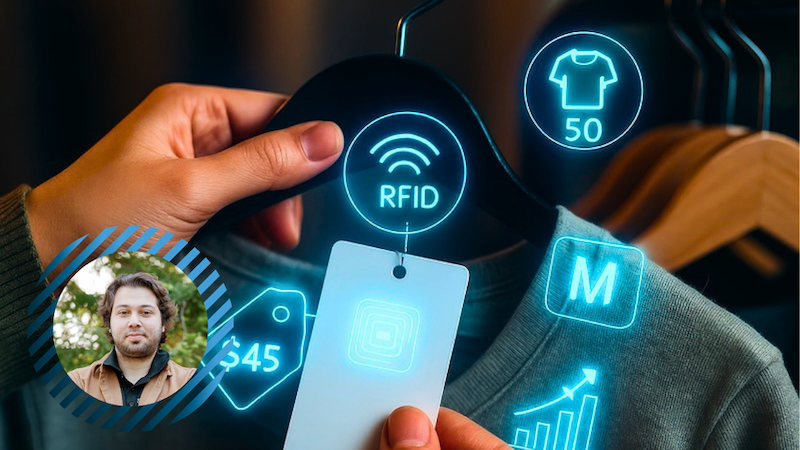
Engineering the Perfect Fit: How Fashion Retailers Can Build a Holistic RFID Ecosystem
In modern fashion retail, the days of questioning whether radio-frequency identification actually works are over. RAIN RFID reliably delivers rapid stock counts, item-level transparency, and tighter control over daily operations. The real hurdle has shifted. Retailers no longer need to prove that a scanner can detect a tag; they must engineer an entire operational ecosystem that relies on that detection.
The Foundation: Why Your Label Must Match Your Product
Apparel is not a monolith. A pair of heavy denim jeans, a delicate silk blouse, a boxed leather belt, and a garment packed with metallic hardware all interact with radio waves in completely different ways. A winning labeling strategy goes far beyond simple read-distance tests. Retailers need to evaluate how a tag behaves during every phase of its existence—from garment manufacturing and boxing, through shipping and receiving, all the way to the checkout counter and returns processing. The ultimate objective isn’t merely “Can we read it?” but rather “Can we read the correct item, at the exact moment it’s needed, within our specific business workflow?”
The Physical Layer: Matching Technology to Environment
While portable scanners are the most visible component of an RFID deployment, they represent only a fraction of the necessary infrastructure. Point-of-sale terminals might require fixed desktop scanners to verify items at checkout, while dock doors and warehouse aisles demand permanently mounted readers to manage incoming and outgoing transfers. Crucially, hardware must be tailored to the physical space. A configuration that yields perfect accuracy in a wide-open warehouse might cause overlapping reads in a cramped boutique due to differences in wall structures, product density, or antenna angles. If the setup isn’t designed around the environment, stores will suffer from false positives or missed reads, quickly eroding team confidence in the technology.
Turning Data into Decryption: The Role of Integration
An isolated identification code holds no business value on its own. It becomes actionable intelligence only when linked to the product’s size, color, current location, sales status, and transfer history. The software layer is where most implementations either thrive or falter. A rapid scan is impressive, but a rapid scan tied to real-time stock accuracy, missing-item alerts, replenishment triggers, and shipment verifications is transformative. The system shouldn’t just display a list of scanned items; it should interpret the data. It needs to tell a store manager which recorded items are vanishing from the floor, or inform a warehouse team exactly which boxes are incomplete in a transfer.
The Human Element: Workflows and Education
Technology fails when the people using it aren’t aligned with its purpose. Staff must understand not just the mechanics of a scanner, but the logic behind the exceptions it surfaces. If a backend system flags an incomplete shipment, the receiving team must know the precise steps to correct it. If a store associate sees an inventory discrepancy, they must be empowered to locate the missing garment. Training must move beyond basic device operation to focus on process ownership. The goal is to simplify daily tasks—such as counting specific zones, verifying deliveries, or investigating alerts—rather than adding a screen that employees learn to ignore.
From Automation to Intelligence
As systems mature, the next frontier is predictive and prescriptive intelligence. With a stable stream of item-level data, retailers can ask deeper questions: Which product categories consistently show stock inaccuracies? Which store entrances generate the most false security alarms? When used correctly, artificial intelligence acts as an interpreter for this data, cross-referencing RFID reads with sales trends and historical exceptions. However, AI is only as good as the foundation beneath it. Without clean, consistent, and connected data, automated insights will simply accelerate confusion rather than resolve it.
Frequently Asked Questions
Q: Why do RFID read rates vary so much between different clothing items?
A: Different materials interact with radio frequencies in distinct ways. Dense fabrics like denim can block signals, while metallic components like zippers and buttons can reflect them, causing interference. Additionally, items packaged in liquids or foil-like wrappers present unique challenges that require specific tag and antenna tuning to overcome.
Q: Is handheld scanning enough to maintain store inventory?
A: Handhelds are excellent for cycle counts and locating specific items on the sales floor, but relying solely on them limits visibility. A complete ecosystem incorporates fixed readers at receiving docks to verify shipments automatically and EAS gates at exits to differentiate between sold and unsold items, creating a seamless flow of data across the store.
Q: How does RFID software integrate with existing retail systems?
A: Effective RFID software acts as a bridge. It takes the raw electronic product codes captured by the readers and maps them to the existing product master data in your backend system. It translates physical reads into business events—such as a completed transfer, a received shipment, or a missing item—allowing existing store and warehouse workflows to react to real-time inventory truth.
Conclusion
The true power of RFID in fashion retail is not found in any single piece of hardware or label; it is realized when every component functions as a unified process. When product labeling matches the physical item, hardware fits the spatial layout, software translates raw reads into business logic, and employees understand the workflow, retailers unlock a real-time operational backbone. The retailers who see the greatest return are not those who purchase the most advanced equipment, but those who design their entire operation around the desired business outcome. By building this holistic ecosystem, fashion brands can achieve unparalleled visibility, speed, and decision-making capabilities across their entire supply chain.
Thank you for reading
