



# Understanding Arcanum Wave: A Manual-Assist Crypto Futures System Explained
## Introduction
Deciding when to open and close a position is one of the most challenging aspects of crypto trading. While automated bots can handle both tasks, many traders prefer to retain final control over how their capital is deployed. This is where tools that offer algorithmic support without full automation come into play.
Arcanum Wave is one such system. Developed by the Dubai-based Arcanum Foundation, Wave is a signal-assisted trading platform designed specifically for crypto perpetual futures. Rather than executing trades on behalf of the user, Wave generates structured setups every four hours and hands the decision-making power entirely to the trader.
Arcanum Foundation has built a broader ecosystem that includes Pulse (a fully automated futures bot), Arcanum Broker, educational resources, and Web3 development services. Wave represents the company’s shift toward giving traders more agency while still leveraging algorithmic analysis.
—
## How Arcanum Wave Operates
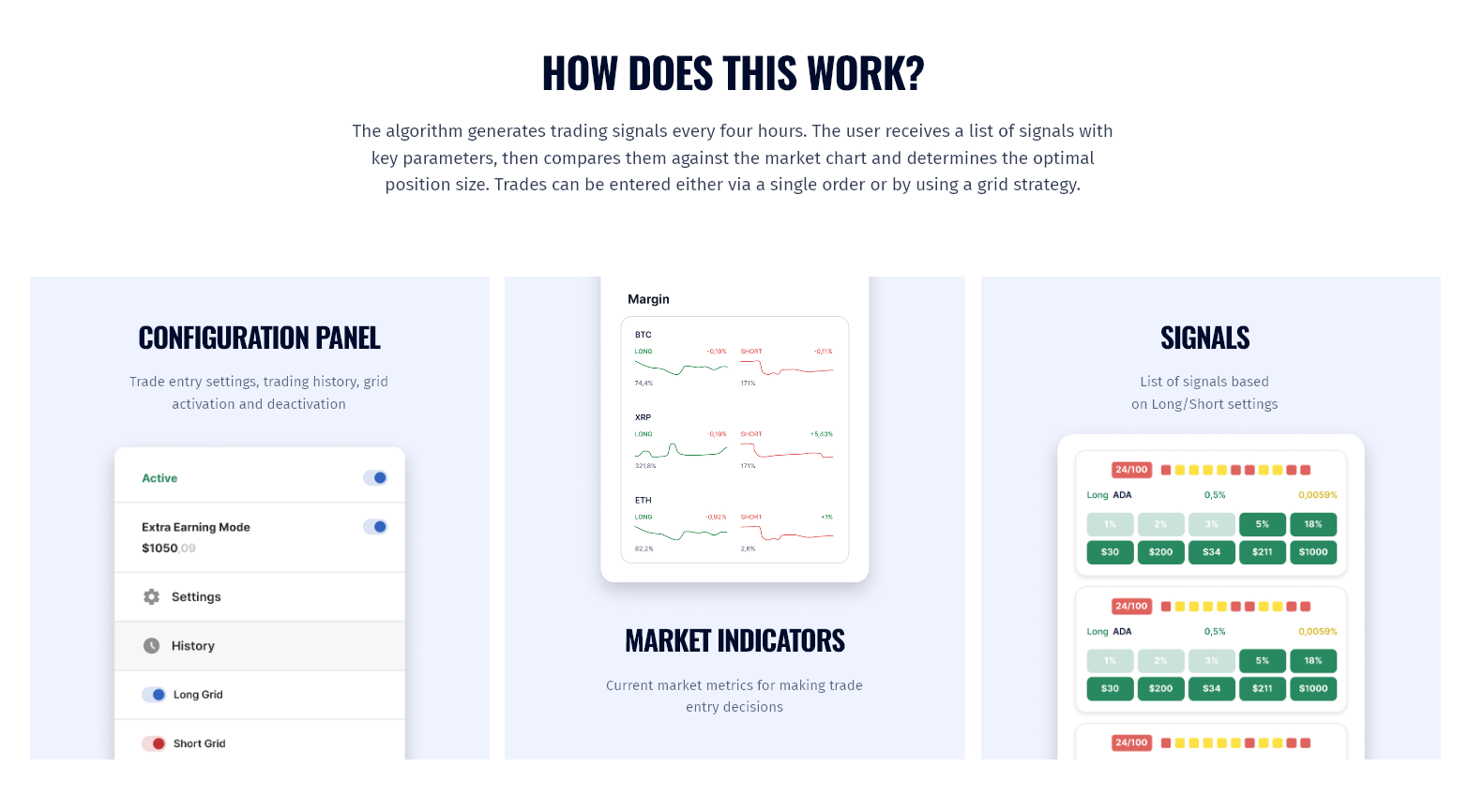
Wave functions as a signal-assisted platform, not an automated bot. Here is a breakdown of its core operational mechanics:
– **Timeframe:** The system analyzes 4-hour candles, producing up to six potential trading sessions per day.
– **Scoring System:** Each supported asset receives a strength score between 1 and 100, based on a combination of 14 parameters, including market behavior and candle volume. Some inputs are proprietary.
– **Grid Setup:** Wave provides a configurable grid for each signal, allowing traders to set position sizes and layer entries.
– **Risk Indicators:** Traders can view liquidation data alongside Arcanum’s proprietary Buy Risk and Fear indicators.
– **Margin Options:** Users can employ isolated margin, which limits potential loss to the margin assigned to a specific position rather than using the entire account balance as collateral.
– **Leverage Control:** Traders adjust leverage themselves, meaning the risk profile is entirely in their hands.
This approach reduces the time spent scanning charts manually. Instead of reviewing dozens of assets, a trader receives a curated, ranked list of structured setups. The four-hour timeframe also steers users away from the constant monitoring that scalping demands.
—
## The Appeal and the Risk of Retaining Control
Wave’s design philosophy places the trader in the driver’s seat for every critical decision — entry, position sizing, leverage selection, and exit. This control is what gives the platform its appeal and its inherent risk.
### Why Traders Choose This Model
– Structured signals replace hours of manual market scanning.
– Configurable grids allow traders to tailor setups to their personal risk tolerance.
– The four-hour timeframe strikes a balance between opportunity frequency and manageable screen time.
– Bybit’s infrastructure handles execution, so users benefit from the exchange’s liquidity and order-matching engine.
### Why This Model Carries Risk
– Every decision rests with the user. Two traders receiving the identical signal can produce vastly different outcomes based on leverage, timing, grid configuration, and exit discipline.
– Isolated margin can lead to faster liquidation than cross-margin, since each position is limited to its own assigned margin without support from the broader account balance.
– Opening multiple grids simultaneously reserves margin for each one, reducing the free balance available for new positions.
– The four-hour cycle means missed signals can translate into missed opportunities or forced entries at less favorable prices.
—
## Performance and Transparency Considerations
One of the most important aspects of evaluating any trading system is understanding the evidence behind its claims. Wave’s transparency profile deserves careful examination.
### What Is Published
Arcanum shares weekly ecosystem updates through its Telegram channel. These posts include closed position counts and win rates. For example, a mid-August update reported 46 Wave closes between August 10–16 and 56 between August 17–23, with a win rate near 99% for July. Another post from September 2026 claimed roughly 280% total profit across 141 Wave closes over one week.
The Arcanum Trader Make Money profile, which syncs with exchange data, showed 1,446 closed positions at the time of review. Visible trades were long-only, with individual gains ranging from 1.43% to 2.41%. One position in CHZ remained open for 92 days before closing at a 1.87% gain.
### What Is Missing
The published figures come with significant gaps:
– No starting equity or ending balance is disclosed.
– No realized return percentages tied specifically to Wave signals alone.
– No accounting for funding costs, slippage, or cumulative fee drag.
– No open-position drawdown data is visible.
– No distribution of wins versus losses is provided.
Because the trader makes every final decision, there is no single, trackable “Wave return.” The system’s output depends entirely on how each individual trader acts on the suggestions it provides.
### Proprietary Scoring
The 1-to-100 strength score draws on 14 parameters, but Arcanum has not publicly disclosed how signals at different score levels have performed historically. A score of 90 may look highly reliable, but without a transparent track record of its accuracy across score brackets, users cannot independently verify whether higher scores truly correlate with better outcomes.
—
## Arcanum Broker and Bybit Integration
Wave operates within the Arcanum Broker ecosystem, which is built on top of Bybit’s exchange infrastructure. This architectural choice has several implications.
### Onboarding and Fund Management
Users connect through Bybit OAuth rather than creating a separate exchange account. Funds remain held at Bybit at all times. Arcanum supplies the signals, the terminal interface, and the broker layer — but does not directly custody trading balances. This means:
– Users still bear Bybit’s centralized-exchange counterparty risk.
– There is no additional custodian risk introduced by Arcanum.
– Withdrawals and deposits follow Bybit’s standard processes.
### Fee Advantages
Arcanum users access Bybit VIP 3 through VIP 4 fee tiers. On perpetual contracts, VIP 3 charges 0.0350% for takers and 0.0140% for makers. By comparison, Bybit’s standard non-VIP schedule charges 0.0550% for takers and 0.0200% for makers.
To put this in perspective, a round-trip taker order on a $100,000 position costs $70 before funding and slippage at the standard rate, but only $28 at VIP maker rates. However, in practice, both fills posting as maker orders represents the best-case scenario rather than the typical outcome.
Achieving VIP 3 directly would require either $500,000 in assets or $50 million in derivatives volume over 30 days. The Arcanum broker relationship effectively unlocks this access for traders who would not otherwise qualify.
### Geographic Restrictions
Perpetual trading availability on Wave depends on Bybit’s regional policies. Restrictions exist for users in the United States and the European Union. Prospective users should verify current eligibility before connecting their accounts.
—
## Wave Versus Pulse: A Side-by-Side Comparison
Arcanum offers two distinct products. Pulse is the company’s original offering — a fully automated futures bot that trades Bybit perpetuals using daily signals and spreads positions across a broad group of assets without requiring user approval for each trade. Wave, in contrast, is manual-entry and manual-exit, operating on four-hour signals.
### Key Differences
| Feature | Wave | Pulse |
|—|—|—|
| Execution Style | Trader enters and exits manually or via trailing stop | Fully automated |
| Signal Interval | 4-hour candles | Daily candles |
| Time Commitment | Multiple checks per day | Periodic monitoring |
| Decision Authority | Trader controls entry, leverage, grid, and exits | Mostly configuration; system handles execution |
| Trackability | Outcomes vary by trader; no unified strategy record | Single shared strategy with a public trade history |
| Fee Structure | 30% fee on profitable closed trades | 30% fee on profitable closed trades |
| Primary Risk | User decision-making and leverage choices | Long drawdowns and capital trapped in open positions |
| Ideal User | Active, experienced traders | Users seeking passive execution |
### Pulse’s Track Record
Pulse’s public profile shows a 7.66 profit factor, a two-day average trade duration, and a fully long-biased record. The visible trade history cannot be edited, as it syncs directly from exchange data. Arcanum has claimed a 97% win rate across more than 11,250 closed positions and over 20,500% in cumulative trade returns. It is important to note that summing the percentage result of thousands of individual trades does not represent a 20,500% return on any single account.
### The Tracking Advantage
Pulse benefits from a unified strategy that can be evaluated over time. Wave’s outcomes remain fragmented, since each trader interprets and executes signals differently. This makes Wave harder to assess as a standalone system, even though it may offer more trading opportunities through its shorter signal cycle.
—
## Who Should Use Arcanum Wave?
### Best Fit
Wave is designed for traders who want the work of active trading but appreciate a structured framework for decision-making. The ideal user:
– Is comfortable monitoring the market several times per day
– Keeps a performance journal and tracks their own results
– Maintains consistent leverage discipline
– Wants organized, algorithm-prepared setups rather than raw chart analysis
– Prefers to retain full control over execution and risk management
### Who Should Avoid It
Wave is not the right fit for traders seeking a hands-off solution. Users who prefer automation should look at Pulse or other fully managed systems. Similarly, traders who cannot commit the time to actively manage multiple grids and leveraged positions may find Wave more demanding than it is worth.
—
## FAQ
**What is Arcanum Wave?**
Arcanum Wave is a signal-assisted trading system for crypto perpetual futures. It generates structured trading setups every four hours, scoring assets from 1 to 100 based on algorithmic analysis, and provides configurable grid setups. The trader makes all entry and exit decisions.
**Is Wave an automated bot?**
No. Wave is not an automated bot. It produces signals and prepared grids, but the user must manually enter trades, manage leverage, and decide when to exit.
**How often do Wave signals appear?**
Wave works on 4-hour candles and can produce up to six trading sessions per day, meaning signals are generated roughly every four hours during active market hours.
**What exchange does Wave use?**
Wave operates through the Arcanum Broker ecosystem, which is built on Bybit’s exchange infrastructure. Funds remain at Bybit, and users connect via Bybit OAuth.
**What are the fees?**
Arcanum charges a 30% fee on profitable closed trades. Additionally, Bybit trading fees apply at VIP 3 through VIP 4 rates, which are lower than standard retail fees.
**Can Wave users access VIP fee rates?**
Yes. Arcanum Broker provides users with Bybit VIP 3–VIP 4 fee rates, which would otherwise require $500,000 in assets or $50 million in derivatives volume over 30 days to achieve independently.
**Are there geographic restrictions?**
Yes. Perpetual trading on Wave is restricted in the United States and the European Union due to Bybit’s regional policies. Users should verify current eligibility before connecting.
**How does Wave compare to Pulse?**
Pulse is fully automated and trades on daily signals. Wave is manual-entry and manual-exit, operating on four-hour signals. Pulse offers a single trackable strategy, while Wave outcomes vary by individual trader.
**Is there a publicly verifiable Wave performance record?**
Arcanum publishes weekly ecosystem statistics, including closed position counts and win rates. However, because each trader controls their own execution, there is no unified Wave return. Published figures also exclude starting equity, funding costs, slippage, and drawdown on open positions.
**What is the main risk of using Wave?**
The primary risk is user-dependent. Since the trader makes every decision, poor leverage choices, inadequate risk management, or undisciplined exits can lead to significant losses. Isolated margin can also result in faster liquidation compared to cross-margin.
**Does Arcanum hold user funds?**
No. Funds remain at Bybit. Arcanum provides signals, the terminal interface, and the broker layer, but does not directly custody trading balances.
—
## Conclusion
Arcanum Wave occupies a specific and deliberate niche in the crypto trading landscape. It offers algorithmic structure without surrendering control — a middle ground for traders who want prepared signals and organized grids but refuse to hand their capital over to a fully automated system.
The platform’s strengths are clear: reduced research time, four-hour signal cadence, configurable risk parameters, Bybit VIP fee access, and transparent infrastructure that keeps funds within a major exchange. These features make Wave a practical tool for active traders who are willing to invest the time and discipline the system demands.
However, significant transparency gaps remain. The lack of a unified performance record, the absence of drawdown data that accounts for open positions, and the proprietary nature of the scoring methodology make it difficult for new users to evaluate Wave independently. The 30% fee on profitable trades, while standard in the industry, further eats into returns — and users bear all execution risk, including slippage and funding costs.
For traders already active on Bybit who want to systematize their approach without surrendering decision-making authority, Wave provides a credible framework. Its value lies in organizing information and reducing friction — not in generating guaranteed profits. The responsibility for whether those organized decisions translate into an edge remains squarely with the trader.
Prospective users should weigh the demand for active involvement against their own trading experience, risk tolerance, and available time. Wave is a tool for engaged traders, and like any tool, its value depends entirely on the skill of the person wielding it.
Thank you for reading
