



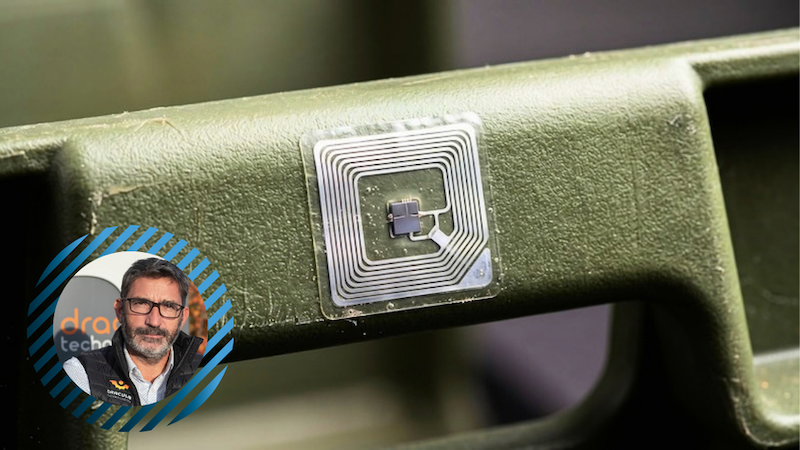
# The Power Revolution Inside Tomorrow’s Smart Labels: How Harvested Energy Is Unlocking a New Era for RFID
The global supply chain is drowning in data — but the tools collecting that data have long been constrained by a single, stubborn limitation: power. Passive RFID tags, which have quietly moved trillions of items across warehouses and retail shelves for decades, operate on a single principle: respond when pinged, identify what they are. The moment those tags need to sense temperature, report location, or transmit data continuously, the model fails — because there is no battery, and no outlet to plug into.
A new generation of energy-harvesting technologies is now stepping in to fill that gap. At the forefront of this shift is organic photovoltaic (OPV) technology, which converts even the faintest indoor light into electricity small enough to keep a smart tag alive, functioning, and connected — without ever needing a disposable battery replaced or a charging cable.
## The Real Bottleneck: It Was Never the Chip
For years, the RFID industry has debated silicon costs, antenna design, and read-range improvements. But according to experts working at the practical frontier of connected tagging, none of those technical details matter as much as one factor: available energy.
Every additional feature a tag takes on — whether that’s real-time geolocation, environmental sensing, or active data transmission — demands a corresponding supply of electricity. In the past, that meant a battery. But batteries are heavy, they expire, they cost money to replace at scale, and they introduce sustainability problems that grow worse as deployments reach into the millions. When a battery dies in a tag attached to a pallet of goods somewhere in the middle of a global shipping network, that tag becomes silent, its data disappears, and the value it was supposed to deliver evaporates.
The hidden cost, experts argue, is not the tag itself but the loss of information. A tag that cannot power its sensor is a tag that cannot report — and reporting is the entire reason these devices exist.
## Harvesting Light in the Darkest Corners
OPV technology works by absorbing photons from ambient light — whether sunlight streaming through a warehouse window, fluorescent tubes overhead, or the dim glow of a stockroom — and converting them into a small but usable electrical current. The key breakthrough in recent OPV modules is their ability to generate meaningful power at remarkably low light levels. Some advanced OPV solutions are designed to begin producing energy at light intensities as low as 5 lux, which is roughly the brightness of a dimly lit hallway at night.
This is critical because it means the technology does not depend on ideal conditions. In logistics environments where goods may sit in dark corners, inside opaque packaging, or in areas with limited artificial lighting, traditional solar cells would produce nothing. OPV, by contrast, keeps working.
A recent collaboration between two technology firms demonstrated this in a real-world context. One partner developed a battery-free smart label that had to operate reliably under light levels as low as 20 to 25 lux — in a significantly reduced module area — while still meeting the energy demands of its integrated functionality. The project required extensive testing across varied environments, pushing the technology well beyond the comfort of laboratory conditions and into the unpredictability of actual supply chains.
## Why Pairing Two Energy Sources Beats Relying on One
The most promising path forward is not to pick one energy source and bet everything on it, but to combine multiple harvesting methods into a single tag. In most logistics and warehouse settings, two energy sources are almost always available: light (via OPV) and radio-frequency energy already broadcast by existing RFID reader infrastructure (via RF harvesting).
When these two sources are paired — along with a small energy storage element like a supercapacitor — the reliability of detection improves dramatically. Large logistics operators are increasingly setting 94% read accuracy as a minimum benchmark. Hybrid energy harvesting has been shown to push detection performance past that threshold by extracting additional power from whichever source is most available at any given moment.
The approach works because RF energy is ubiquitous in environments where RFID systems are already deployed, and light is ubiquitous wherever people work. Neither source is perfectly reliable on its own in every scenario, but together they provide a much more consistent energy supply.
## From Lab Samples to Real Products: Two Partnerships Worth Watching
One of the clearest examples of OPV technology moving from prototype to product involves a collaboration that produced a lightweight, battery-free tracker with a module capable of sustained energy generation in dim settings. That tracker was paired with an Android application and a cloud-based monitoring platform, allowing customers to locate and monitor tagged assets in near real time — all powered by the ambient light in the room.
In parallel, another partnership between an OPV developer and a contract manufacturer specializing in high-volume label production is focused on bringing light-powered smart labels to mass-market deployment. That manufacturer has deep expertise in producing inlays and integrating electronic components into circuits at scale, and it has begun releasing samples of its first light-powered trackers. The strategic rationale is clear: for millions of devices distributed worldwide, there is no practical way to send service teams out to replace batteries, and once a battery dies, the device is effectively lost. Energy harvesting removes that entire failure mode.
## Designing Around the Power Budget, Not the Battery
Perhaps the most fundamental shift introduced by energy-harvesting tags is a change in how engineers think about design. With a battery-powered device, the starting point is “how much energy can we store?” With a harvested-energy device, the starting point is “how much energy do we actually need to complete each function, and how often?”
This reframing has cascading effects. It forces teams to define realistic duty cycles — how often a sensor actually needs to wake up and transmit — and to size the harvesting module precisely to match that need. There is no benefit to oversizing. In practice, this almost always requires an electronic redesign of the tag itself, as engineers strip away features that consume power without delivering proportional value and optimize circuits to run on far less energy than their battery-powered predecessors.
It is similar to the difference between a car with a large fuel tank and one with a small tank used for short, efficient trips around town. The energy source matters less than how the system uses what it gets.
## What Needs to Change for Harvested Tags to Compete at Scale
Energy harvesting is not about replacing passive RFID. Passive RFID is mature, dirt cheap, and excellent at what it does — fast, massive identification at the lowest possible cost. Harvested-energy tags are a different category of product, designed for applications where identification alone is not enough.
Commercially, the path forward requires several things. First, continued reductions in manufacturing cost as production volumes grow and materials improve. Second, realistic expectations from customers: a harvested tag will not do everything a battery-powered tag can, but it can do enough for the right application at the right price point. Third, a shift in how buyers evaluate total cost of ownership — factoring in not just the price per tag but also the hidden costs of battery replacement, device loss, and data gaps.
Supply chain considerations, notably, are not a major obstacle. The printed electronics industry already has the tools and processes to manufacture OPV modules and energy storage elements at scale, and integration into existing label production lines is feasible.
## Where This Is Heading in the Next Few Years
The markets expected to see traction first are logistics and supply-chain asset tracking — environments where warehouses already have RF infrastructure and ambient light is everywhere, but where visibility into the location and condition of goods remains incomplete. Industrial environments and healthcare settings follow closely behind.
Looking ahead, the vision is of an integrated “energy unit” printed directly onto the tag substrate, combining the photovoltaic harvester, a small supercapacitor for storage, and eventually printed sensors — all manufactured using techniques the printed electronics industry has already refined. The goal is to deliver autonomous, self-powered connected tags that require zero maintenance and can be deployed at the same scale as today’s passive RFID, but with a vastly richer set of capabilities.
The bridge from billions of simple identification tags to a smarter, more connected world runs on harvested energy. And that bridge is already under construction.
—
## Frequently Asked Questions (FAQ)
**Q: What is OPV technology, and how does it differ from traditional solar panels?**
A: Organic photovoltaic (OPV) technology uses carbon-based materials to convert light into electricity. Unlike traditional silicon solar cells, OPV cells are thin, flexible, and capable of generating power from very low light levels — including dim indoor lighting — making them suitable for embedded applications like smart labels and tags.
**Q: Can energy-harvesting tags really work in a dark warehouse?**
A: They can work in dim conditions down to approximately 5 lux, but extremely dark environments with no light or RF energy present remain a challenge. The hybrid approach — combining OPV with RF energy harvesting — addresses this by drawing power from whichever source is available, making the tags more reliable across varied environments.
**Q: How accurate do these tags need to be for logistics use?**
A: Many large logistics operators are setting 94% detection accuracy as the minimum acceptable threshold. Hybrid energy-harvesting approaches have demonstrated the ability to exceed this benchmark, with even small improvements in detection reliability delivering meaningful value at scale.
**Q: What is the total cost of ownership advantage of removing the battery?**
A: Beyond eliminating the cost of the battery itself, removing the battery removes the costs associated with battery replacement, the risk of device failure when the battery dies, and the hidden cost of lost data when a silent tag cannot report. In mass deployments, these factors compound significantly.
**Q: Will energy-harvesting tags replace passive RFID tags?**
A: No. Energy-harvesting tags are designed for applications where basic identification is not sufficient — such as asset tracking, environmental sensing, and connected monitoring. Passive RFID will continue to serve its role for high-volume, low-cost identification tasks where those capabilities are unnecessary.
**Q: What industries will benefit most from harvested-energy tags in the near term?**
A: Logistics, supply-chain asset tracking, retail inventory management, and healthcare are expected to see the earliest widespread adoption. Industrial and warehouse environments are particularly well-suited because they already have RF infrastructure and consistent ambient light.
**Q: How do engineers determine the right size for an OPV module in a given application?**
A: The process starts with a realistic power budget based on the required functions, duty cycle, and expected light conditions. Engineers use data from on-site measurements, simulations, or dedicated monitoring systems to size the module precisely — ensuring it generates only the energy needed without oversizing or wasting space.
**Q: Is the supply chain ready to produce these tags at scale?**
A: Yes. The printed electronics industry already has established processes for manufacturing OPV modules, supercapacitors, and integrated circuits at scale. Partnering with contract manufacturers experienced in high-volume label production accelerates the path from prototype to mass deployment.
—
## Conclusion
The evolution of RFID from simple identification to truly intelligent, connected sensing depends on solving a single, fundamental problem: energy. Organic photovoltaic technology, combined with hybrid harvesting strategies and thoughtful engineering around realistic power budgets, is proving that self-powered smart tags are not a distant aspiration — they are shipping products today. As production costs fall and integration into existing manufacturing lines becomes seamless, these tags are poised to extend the reach of connected devices into supply chains, warehouses, and healthcare settings where batteries have always been impractical. The era of maintenance-free, data-rich tagging is no longer on the horizon. It is arriving now.
Thank you for reading
