



# How AI-Powered Web Scrapers Simplify Recurring Data Collection at Scale
## The Challenge of Extracting Data from Dynamic Websites
Collecting structured data from the web has always been a core need for businesses, researchers, and automation teams. Whether it’s tracking competitor prices, monitoring product availability, or gathering supplier details, the process often involves navigating through search results, applying filters, paging through multiple results, and combining information from different pages. While these tasks can be straightforward on a static HTML page, modern websites introduce layers of complexity that traditional scraping methods struggle to handle.
Dynamic content rendered by JavaScript, pop-up overlays, region-specific page variations, and human-verification steps create a constantly shifting landscape of page states. Each of these factors multiplies the difficulty of reliably extracting the data you need.
## Why Traditional Scraping Methods Fall Short
When developers build custom scraping scripts, they must write and maintain CSS or XPath selectors, manage browser instances and proxy configurations, and troubleshoot failures every time a target website changes its layout or structure. These scripts break silently, return incomplete data, or fail entirely when a page is updated — and the maintenance burden compounds as tasks expand across multiple categories, regions, or data sources.
Existing web scraping APIs and visual scraping tools offer alternatives, but they still require significant upfront configuration. APIs demand that users build extraction logic manually, while visual scrapers rely on pre-selected page elements that can drift out of alignment when sites are redesigned. One-off AI agents that explore a website on demand are great for ad hoc research, but they re-examine the site from scratch every time they run, consuming tokens and processing time with each execution.
## The Power of a Reusable Extraction Path
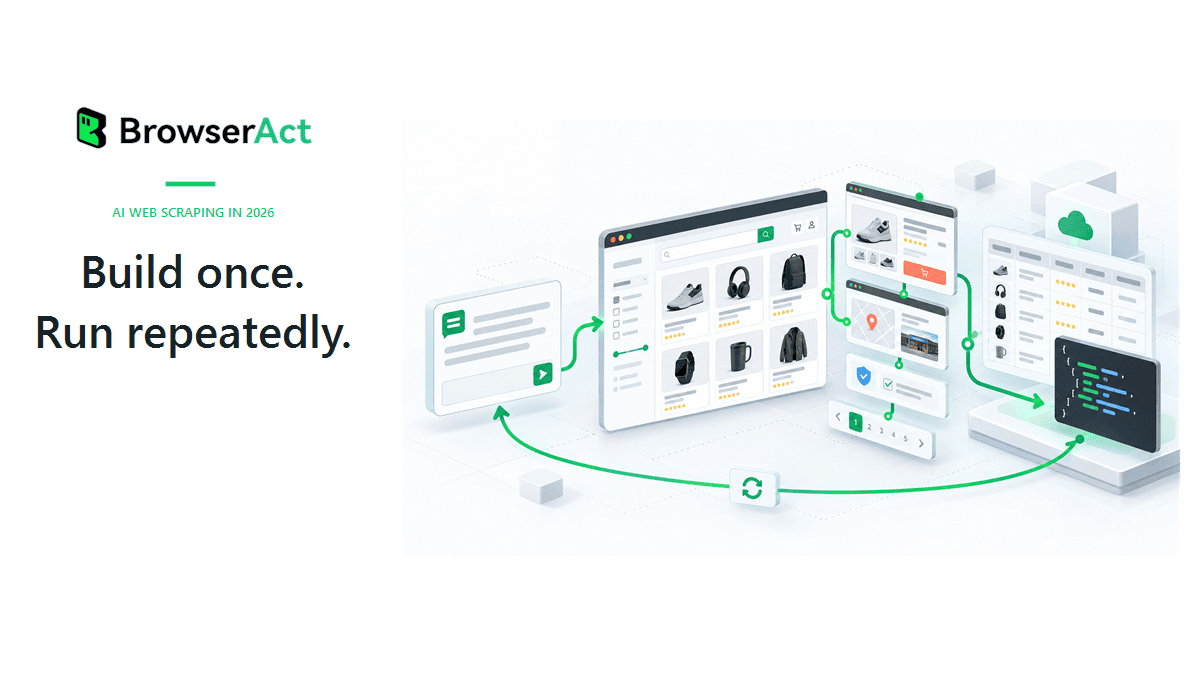
The key advantage that modern AI-driven scraping platforms bring to the table is the ability to convert a one-time exploration into a reusable, tested extraction path. When a user describes a goal — for example, searching for wireless keyboards, filtering to only products rated four stars or higher, and returning names, prices, sellers, and availability — an AI scraper can navigate the site and extract the requested fields.
However, completing a task once is not the same as establishing a reliable, repeatable process. Without a saved and validated path, every subsequent run requires the AI to re-explore the site, re-plan its actions, and re-validate the extraction logic. For tasks that need to run weekly or daily, this repeated reasoning becomes expensive and unpredictable. A reusable bot solves this problem by locking in the tested extraction logic, so future runs focus only on fetching fresh data rather than re-imagining the entire workflow.
## How AI Web Scraping Platforms Work
### Step 1: Choose from Prebuilt Templates
Many platforms offer a library of prebuilt scraping templates covering popular websites and common use cases. Users can select a template, fill in the required parameters such as marketplace, category, or number of results, and launch the extraction with a single click. The output typically includes structured fields like rankings, product names, links, prices, ratings, and review counts, ready for download or integration.
### Step 2: Build a Custom Bot Using Natural Language
For websites or tasks not covered by templates, users can describe what they need in plain language. The platform translates that description into a custom extraction bot through a three-step process: the user specifies the target website, filters, and desired fields; the platform explores the live pages, tests the extraction path, and constructs a reusable bot; and finally, the user enters run parameters and receives structured data for export or downstream use.
### Step 3: Schedule and Automate Runs
Once a bot is published, it can be rerun at any time with updated inputs — a different URL, keyword, category, or region. Because the extraction logic has already been validated, subsequent runs are fast and cost-effective. The initial build uses platform credits, while routine runs typically cost a fraction of that, keeping ongoing expenses predictable and manageable.
## Key Capabilities for Complex, Recurring Tasks
### Cost-Efficient Repeated Runs
AI handles the heavy lifting of exploration and validation during the initial build. Routine runs then reuse the saved extraction logic, reducing repeated reasoning, token consumption, and waiting time. This model makes it practical to collect data on a daily or weekly cadence without watching costs spiral.
### Built-In Infrastructure for Dynamic Sites
The platform manages the underlying infrastructure, including real cloud browsers with stealth fingerprinting, residential and dynamic proxies, and region selection. This combination enables reliable extraction from pages that rely on JavaScript rendering and multi-step navigation. Many platforms also handle supported CAPTCHA and human-verification flows, removing the need for teams to build and maintain their own anti-bot bypass systems.
### Adapting to Website Changes
Websites evolve, and extraction paths can break when layouts change. A good platform provides visibility into failure records, allowing users to identify disrupted extraction points, optimize the bot’s logic, test the updated path, and publish a new version — keeping data pipelines alive even as source sites change.
### Seamless Data Integration
Extraction results can be exported in standard formats like CSV and JSON, or delivered through APIs and webhooks. Many platforms also support integrations with popular automation tools, enabling extracted data to flow directly into databases, reports, dashboards, and AI-driven workflows. Some platforms extend this further by allowing published bots to be configured as tools for compatible AI clients, creating a direct bridge between web data and AI applications.
## Practical Use Cases
– **Ecommerce teams** can monitor product rankings, pricing, ratings, and availability across categories and regions, enabling faster competitive pricing decisions.
– **Research and data teams** can keep supplier directories, job boards, and industry datasets current without manual effort.
– **Automation and AI builders** can feed structured web data into downstream systems — databases, analytics pipelines, AI agents, and reporting tools — through APIs and supported integrations.
## Choosing the Right Approach for Your Needs
| Approach | Getting Started | Recurring Collection |
|—|—|—|
| Custom scripts | Write code and configure the browser environment | Rerun scripts; the team maintains the code and environment |
| Web scraping APIs | Connect to an API and build extraction logic | Reuse supported API capabilities; complex navigation may need extra development |
| Visual scrapers | Select page elements and configure steps | Rerun saved configurations; page changes may require adjustments |
| One-off AI agents | Describe the task in natural language | Later runs may explore the site again if no reusable path is saved |
| AI web scraping platform with reusable bots | Choose a template or build a bot with natural language | Change parameters and rerun in the managed cloud; optimize the bot when its path changes |
The right choice depends on how much setup and maintenance each update will require and whether the tool can reliably retrieve the data you need. For one-time research projects, a one-off AI agent may suffice. But for recurring data collection — especially on complex, dynamic websites — a platform that saves and reuses extraction logic delivers better consistency, lower long-term costs, and less ongoing maintenance overhead.
## Frequently Asked Questions
**What types of websites can AI web scrapers handle?**
AI web scrapers are designed to work with dynamic, JavaScript-heavy websites as well as simpler static pages. They can navigate search results, apply filters, handle paginated content, and extract data from detail pages. The success rate depends on the specific site’s structure and any anti-bot protections in place.
**Do I need coding skills to use an AI web scraping platform?**
No. These platforms are built to be no-code solutions. Users describe their extraction goals in natural language or select from prebuilt templates, and the platform handles the underlying technical work of navigating pages and extracting data.
**How do costs work for recurring extractions?**
The initial build of a custom bot typically consumes platform credits as the AI explores and validates the extraction path. Once a bot is published, routine runs are significantly cheaper because they reuse the saved logic rather than re-exploring the site. This makes scheduled, recurring data collection much more cost predictable than running fresh AI agents each time.
**What happens when a website changes its layout?**
When a site update disrupts extraction, the platform provides failure records that help identify which parts of the extraction path broke. Users can then optimize the bot, test the updated logic, and publish a new version to restore data collection.
**Can extracted data be integrated with other tools?**
Yes. Most AI web scraping platforms support exporting results as CSV or JSON, as well as delivering data via APIs and webhooks. Many also offer native integrations with popular automation platforms, enabling data to flow directly into reports, databases, and AI workflows.
**Is it legal to scrape websites?**
Web scraping legality depends on the specific website’s terms of service, the type of data being collected, and the jurisdiction. It is important to review a site’s terms, respect robots.txt directives, and ensure that scraping activities comply with applicable data privacy regulations.
## Conclusion
AI-powered web scraping has transformed the way teams collect and maintain data from the internet. By converting ad hoc extraction tasks into reusable, validated bots, modern platforms eliminate the repetitive reasoning costs that make recurring scraping expensive and unpredictable. With prebuilt templates for common use cases, natural language bot creation for custom needs, and built-in infrastructure for handling dynamic pages and anti-bot protections, these tools bridge the gap between one-time research and reliable, ongoing data pipelines. For any team that depends on fresh, structured web data, an AI web scraping platform with reusable extraction paths offers a compelling combination of ease of use, cost efficiency, and long-term reliability.
Thank you for reading
