



# Trezor Safe 7: A Comprehensive Look at the New Generation of FOSS Hardware Wallets
## A Balanced Approach to Self-Custody
The landscape of hardware wallets has long been divided by philosophy. On one side, there are open-source, user-assembled devices built for privacy purists and industry professionals. On the other, closed-source wallets that prioritize polished design and intuitive guardrails, aiming for mass adoption much like Apple reshaped personal computing. The Trezor Safe 7 appears to have charted a course between these two camps, offering a device that respects the principles of Free and Open Source Software (FOSS) while delivering an experience that feels modern and approachable.
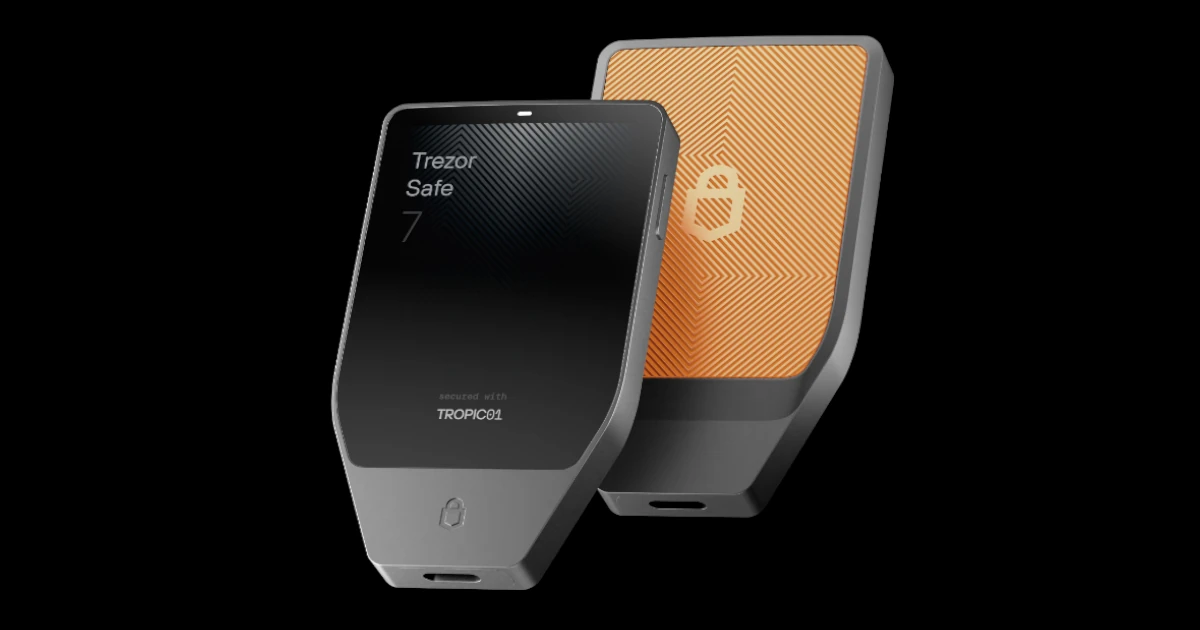
The physical design of the Safe 7 immediately signals a departure from older generations of hardware wallets. Its metal exterior, edge-to-edge display, and deliberate tactile feedback create an experience that makes digital money feel tangible and real. Few other devices manage to bridge that psychological gap between abstract cryptography and the physical world the way this wallet does.
## Multi-Coin Flexibility Meets Bitcoin Focus
One of the standout features of the Safe 7 is its dual firmware architecture. The device ships in two variants: a standard multi-coin version available in black and green, and a Bitcoin-only edition in orange. Users are free to switch between firmware stacks at any time, regardless of which variant they purchase. This means Bitcoin enthusiasts can order the orange edition and avoid unnecessary firmware updates that don’t pertain to their preferred asset, while multi-coin users retain full flexibility.
The Bitcoin-only firmware is deliberately leaner than its universal counterpart. According to available documentation, fewer routine updates are required, and the reduced feature surface leads to a smaller attack window for bugs and security vulnerabilities. For users who are certain Bitcoin is their focus, this offers a cleaner, more streamlined experience.
## The 20-Word Backup and SLIP-39 Innovation
Perhaps the most technically distinctive feature of the Safe 7 is its use of a 20-word backup seed, deviating from the more common 12-word or 24-word standards found in other wallets. This choice is rooted in Trezor’s longstanding work on the SLIP-39 standard, which was first introduced in 2019 alongside the Shamir backup feature.
Shamir backup allows users to split their wallet seed into multiple shares — for example, a two-of-three configuration where three lists of 20 words are stored in different physical locations. Any single share found by an attacker or destroyed by an accident cannot restore the wallet. Only when the required threshold of shares is combined can the wallet be recovered. This redundancy provides a safety net that traditional single-seed backups lack.
The 20-word list uses 128 bits of entropy, equivalent in security to the more common 12-word standard. However, Trezor has carefully curated the vocabulary to minimize confusion between similar-sounding words, reducing the risk of user error during backup and recovery. Additionally, SLIP-39 supports extensibility — a user who initially creates a simple single seed can later generate Shamir shares for enhanced redundancy without needing to move funds on-chain, though it is advisable to destroy the original single seed once shares are created.
Wallet software such as Electrum and Sparrow supports SLIP-39, though adoption remains more limited compared to the older BIP-39 standard.
## A New Standard in User Experience
The Safe 7 invests heavily in making the experience of signing transactions and managing security settings feel satisfying and intuitive. When confirming a critical action — such as approving a Bitcoin transaction or changing the security PIN — the device activates a distinctive feedback sequence. The user presses and holds a digital button, triggering a slow vibration from an internal gyro while two green lights flow from the button along the edges of the screen. As the lights converge at the top, the gyro accelerates, producing a rising mechanical sensation before the screen illuminates fully and a small green LED confirms completion.
The entire process takes only a second or two, but it transforms what is typically a cold digital interaction into something that feels visceral and real.
The interface also features larger, finger-sized digital buttons compared to older Trezor models, significantly reducing the chance of mistyping the security PIN — a critical improvement given that repeated PIN failures on many hardware wallets can result in complete data erasure. The metal casing further distinguishes the Safe 7 from the plastic shells of previous generations, lending it a sense of durability and maturity.
## Security Features and Considerations
The Safe 7 includes a “Wipe PIN” — a special code that, when entered during device login, deletes all user data. While this feature exists in the documentation, its purpose is not prominently explained. Some users speculate it addresses extreme scenarios such as forced extraction of funds, though its practical effectiveness is debatable since the deletion is immediately visible on screen. More sophisticated implementations exist elsewhere in the hardware wallet market, where a decoy wallet can be revealed alongside the deletion of the primary wallet.
Connectivity on the Safe 7 includes Bluetooth and an internal battery compatible with Qi2 wireless chargers. The device can also operate via USB-C with Bluetooth disabled, offering a cable-free experience that reduces friction during transaction signing. For users who prioritize maximum security, a physical hardware switch for the Bluetooth antenna would be a welcome addition.
## The Airgap Question
Integrating Bluetooth and an internal battery represents a significant design decision. While these features enhance convenience and modern usability, they also move the Safe 7 away from strict air-gapped cold storage. Bluetooth introduces a wireless communication layer that, while encrypted, is harder to fully audit than a purely physical connection.
Trezor addresses this concern through its Trezor Host Protocol, which encrypts all data in transit over both Bluetooth and USB-C connections. The company does not trust cables or the Bluetooth stack with unencrypted private key material. Nevertheless, the wireless capability places the Safe 7 closer to what is typically classified as a high-security warm wallet rather than a true cold storage device.
## Entropy and Key Generation
Cold storage is only as good as the randomness used to generate the wallet keys. The Safe 7 draws from four independent entropy sources:
– The entropy of the host computer or phone
– A hardware true random number generator (TRNG) in the STM32 microcontroller
– The Optiga secure element chip
– The TROPIC01 independently auditable secure element
These four sources are combined during wallet creation, and the firmware governing this process is released under the GPL 3 open-source license.
The Safe 7 does not currently support user-generated entropy (such as physical dice rolls), though users can add a passphrase or “25th word” to existing keypairs for additional security. Trezor’s leadership has noted that while user-generated entropy is a valuable concept, the broader user base may find it burdensome given that they already manage a 20-word backup.
## Shipping Security and Privacy
A notable incident involving the shipping partner ShipMonk resulted in the compromise of 67,000 U.S. customer records from a large hardware wallet provider. While the affected company stated that most records were supposed to have been deleted, the breach underscores the risks associated with purchasing hardware wallets online.
For users concerned about operational security, using a P.O. Box for crypto-related purchases or attending industry conferences to buy hardware with cash or bitcoin are practical alternatives. Trezor has announced plans for an “Anonymous Delivery” service, initially launching in the European Union with U.S. availability to follow.
## Verdict
The Trezor Safe 7 represents a meaningful evolution for a product line with a long history in the hardware wallet space. Its combination of metal construction, a refined user experience, dual firmware flexibility, and the innovative Shamir backup system makes it a compelling option for both Bitcoin-focused users and multi-asset self-custodians. Whether deployed as part of a multi-vendor multisig setup or used as a daily warm wallet, the Safe 7 delivers a mature and thoughtfully designed package.
—
## Frequently Asked Questions
**What firmware options come with the Trezor Safe 7?**
The Safe 7 offers two firmware stacks: a standard multi-coin version (available in black and green) and a Bitcoin-only version (available in orange). Users can switch between them at any time, though the Bitcoin-only variant receives fewer updates and carries a reduced risk of bugs.
**How secure is the 20-word backup compared to 12 or 24-word seeds?**
The 20-word SLIP-39 backup uses the same 128 bits of entropy as the 12-word standard. The main advantage is the ability to split the seed into Shamir shares, adding redundancy and requiring multiple physical locations to store backup components.
**Can the Safe 7 be used as a cold storage device?**
Due to its Bluetooth and internal battery capabilities, the Safe 7 is best classified as a high-security warm wallet rather than a fully air-gapped cold storage device. However, all wireless and wired communications are encrypted end to end.
**What battery does the Safe 7 use and is it safe?**
The Safe 7 uses a LiFePO₄ battery, which Trezor describes as having more stable and safer chemistry compared to common lithium-ion batteries. The company states that swelling is extremely unlikely.
**Does the Safe 7 support user-generated entropy like dice rolls?**
No, the Safe 7 does not currently support user-generated entropy input. Users can add a passphrase or 25th word to existing keypairs for enhanced security.
**What happened with the ShipMonk data breach?**
A breach at ShipMonk, the shipping partner used by major hardware wallet providers, compromised 67,000 U.S. customer records. Trezor has since been developing an Anonymous Delivery service for users concerned about shipping privacy.
**Which wallet software supports SLIP-39?**
SLIP-39 is supported by Electrum and Sparrow, among others, though adoption is still growing compared to the more established BIP-39 standard.
—
## Conclusion
The Trezor Safe 7 strikes a careful balance between open-source principles and modern user experience. Its thoughtful design choices — from the dual firmware architecture to the SLIP-39 Shamir backup system to the satisfying tactile feedback — demonstrate a deep understanding of what self-custody hardware needs to be in 2026. While it is not without trade-offs, particularly regarding its wireless connectivity and the limitations of its shipping infrastructure, the Safe 7 is a strong contender for anyone looking to take meaningful control of their digital assets.
Thank you for reading
