



# Julia 1: A Lightweight Decision Model That Runs Anywhere
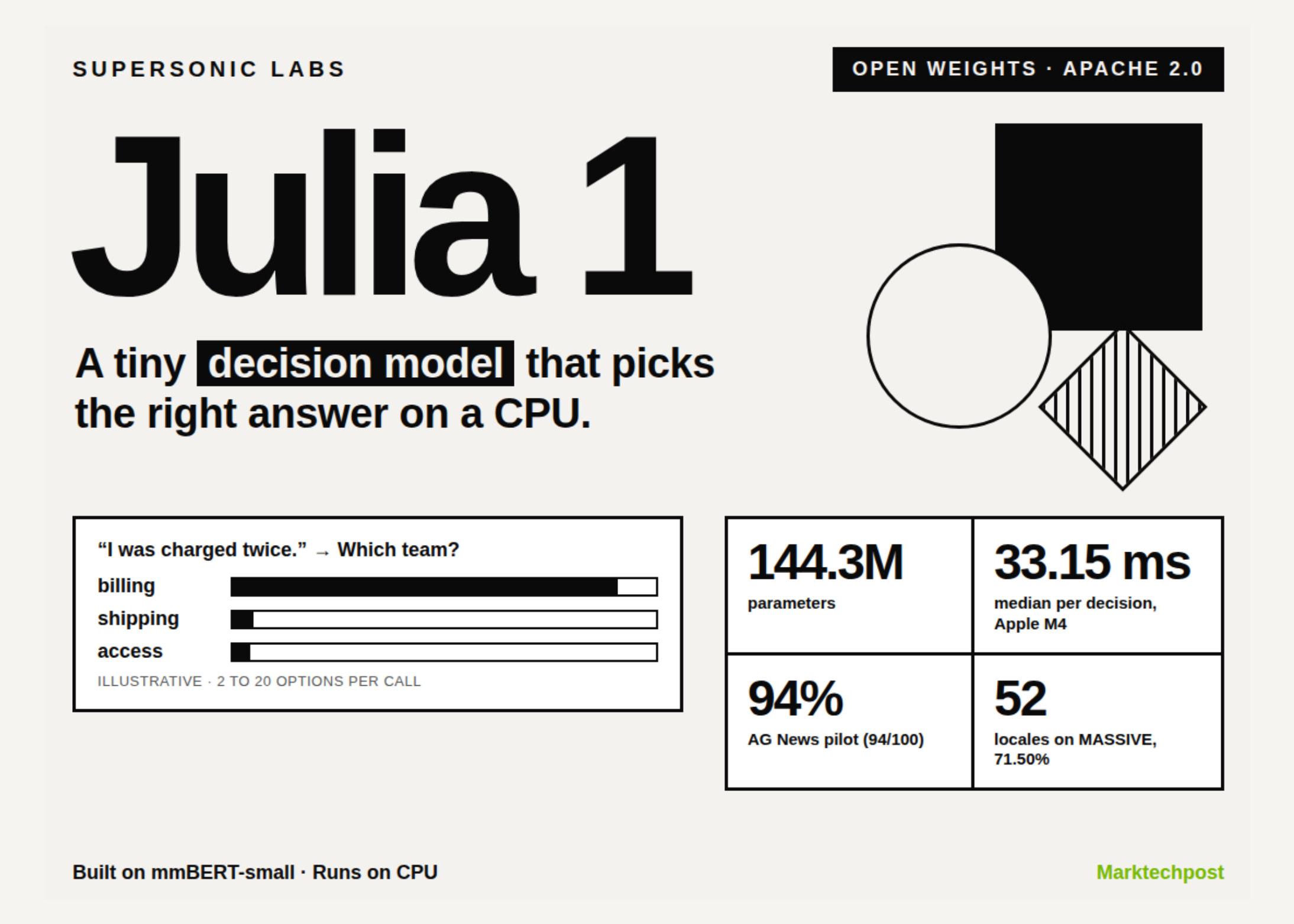
A Brazilian AI research team called Supersonic Labs has introduced a compact model called Julia 1 that tackles a specific but important problem in machine learning — structured decision-making. Unlike the chatbots and generative models that dominate the headlines, Julia 1 is a purpose-built classification engine designed to take a piece of context, a question, and a set of candidate answers, then return the most likely option along with a confidence score for every possibility.
## What Makes Julia 1 Different
Most language models today are conversational agents that generate free-form text. Julia 1 takes a fundamentally different approach. It does not produce prose or answers in natural language. Instead, it receives a structured prompt containing a scenario description, a decision question, and between 2 and 20 labeled options, then outputs a probability distribution over those options.
This design makes it exceptionally well-suited for tasks like routing customer support tickets, assigning severity levels, detecting whether a statement is true or false, and any other scenario where you need a clear, probabilistic decision from a fixed set of choices. The model returns results in the exact order the options were provided, which simplifies downstream logic significantly.
## Technical Specifications
Julia 1 contains 144.3 million parameters and is built on the encoder architecture from JHU CLSP’s mmBERT-small model — a multilingual ModernBERT variant trained on over 1,800 languages. Rather than building from scratch, the team preserved the existing encoder and tokenizer, then added a custom decision head trained on decision-format examples. The model supports sequences of up to 8,192 combined tokens, though published benchmarks used a 1,024-token limit.
The full FP32 weights occupy 550.5 MiB of storage. Training and experimentation across cloud GPU infrastructure cost approximately R$540, equivalent to roughly US$104. The private training pipeline used to build the model has not been released publicly.
## Deployment and Accessibility
The model weights are available on Hugging Face under the Apache 2.0 license, which permits commercial use. It runs natively on a standard CPU with Python 3.11 or later, and can also leverage a BF16-capable GPU for faster inference. An ONNX-exported version exists that runs directly in web browsers through WebGPU, opening the door to client-side decision making without server round trips. A hosted API has been announced but is not yet publicly accessible.
## Decision Types
Julia 1 handles three distinct decision formats through a single interface:
– **Choice**: Select a single label from 2 to 20 described options. This is ideal for classification tasks and routing workflows.
– **Score**: Return the expected position on an ordered scale, such as low, medium, and high urgency levels.
– **Noul**: Return the probability that a yes-or-no statement is true, effectively functioning as a binary sentiment or factuality checker.
## Benchmark Performance
The model was evaluated on September 24, 2026, on an NVIDIA H200 GPU using BF16 precision with strict encoding. The comparison baseline uses reference values from the Jev benchmark protocol published by TypeSafe, rather than a freshly run Jev evaluation.
Julia 1 delivered strong results on several benchmarks:
| Benchmark | Julia 1 Score | Reference Score |
|—|—|—|
| Typed Decisions | 73.15% | 72.70% |
| AG News (4 labels) | 94% | 91% |
| DAIR Emotion (6 labels) | 86% | 48% |
| Banking77 (72 labels) | 64% | 87% |
| MASSIVE (18 scenarios, macro) | 71.50% | — |
The model excelled on the DAIR Emotion task, dramatically outperforming the reference baseline at 86% versus 48%. It also showed strong multilingual capability on MASSIVE, achieving 86.25% accuracy in Portuguese (Portugal) and 86.75% in English (US).
Banking77, which involves 72 fine-grained banking intent categories, was the clear weak point at 64%. A follow-up CPU run on September 25 confirmed the overall pattern, scoring 72.55% on Typed Decisions and 60% on Banking77, though the Banking77 result included 3 abstentions where the model declined to commit. The classification pilots used only 100 training examples each, which may partly explain the variance on complex, fine-grained tasks.
## Latency and On-Device Performance
Supersonic Labs published latency measurements across several devices:
– **Apple M4**: 33.15 milliseconds median per decision call
– **Samsung SM-X510 tablet (via ONNX Runtime)**: 203 milliseconds median, with 393.1 MB peak memory usage
– **Intel Core i5-1235U**: 107.83 milliseconds median for AG News (4-label classification)
– **Intel Core i5-1235U**: 3,713.54 milliseconds for Banking77, which is significantly slower because it must narrow down among 72 labels through a two-stage process
The team claims Julia 1 classifies five times faster than the Jev baseline on an Intel i5 laptop. However, this comparison should be interpreted with caution, as the Jev pilot measured latency from a hosted service called from France, making direct hardware-to-hardware comparisons difficult.
## Looking Ahead
Supersonic Labs has indicated that Julia 2 is in active development and will feature the lab’s own foundation architecture rather than relying on an existing encoder backbone. This suggests a trajectory toward even more specialized and potentially more capable decision models in the future.
The combination of a small parameter count, CPU compatibility, permissive licensing, and browser deployment support positions Julia 1 as a practical option for teams that need reliable, fast, and private decision-making without the infrastructure overhead of large generative models.
—
## Frequently Asked Questions
**What exactly is Julia 1?**
Julia 1 is a compact decision model designed to pick the best option from a set of 2 to 20 candidates given some context and a question. It is not a chatbot and does not generate text — it outputs probability scores for each option.
**How many parameters does it have?**
Julia 1 has 144.3 million parameters.
**Can I run it on my own hardware?**
Yes. The weights are available on Hugging Face under Apache 2.0 and can run on any CPU with Python 3.11 or later. It also supports BF16-capable GPUs and has an ONNX build that runs in web browsers via WebGPU.
**What is the model built on?**
It uses the encoder and tokenizer from JHU CLSP’s mmBERT-small, a multilingual ModernBERT model, with a custom decision head added on top.
**How much did it cost to train?**
The total cloud GPU spend for training and experiments was approximately R$540, or about US$104.
**What are the three decision types?**
Choice (pick one label from multiple options), Score (return the expected position on an ordered scale), and Noul (return the probability that a yes-or-no statement is true).
**How accurate is Julia 1?**
It performs competitively on typed decision tasks (73.15%) and excels on emotion classification (86%). It struggles with fine-grained categories like Banking77 (64%), likely due to the 100-example training pilot and the complexity of 72-way classification.
**Is it faster than other models?**
On an Apple M4, a single decision call takes about 33 milliseconds. The team claims significant speed advantages over hosted alternatives, though direct comparisons depend heavily on the baseline setup.
**Can I use it commercially?**
Yes. The model is released under the Apache 2.0 license, which allows commercial use, modification, and distribution.
**What is next for this project?**
Julia 2 is in development and will use the lab’s own foundation architecture instead of relying on the existing mmBERT encoder.
—
## Conclusion
Julia 1 represents a refreshing departure from the trend of ever-larger generative models. It demonstrates that a 144-million-parameter model, trained for under US$110, can deliver strong classification performance across multiple decision formats — and run on anything from a cloud GPU to a tablet browser. Its structured, non-generative output makes it straightforward to integrate into production pipelines where reliability, interpretability, and speed matter more than conversational fluency.
The Banking77 results serve as a reminder that fine-grained, many-class classification remains a hard problem, especially with limited training data. Still, the overall picture is promising: a lightweight, transparent, and accessible tool for one of AI’s most practical use cases — making decisions from a set of options.
Thank you for reading
