



# A New Wave of Automation Aims to Transform Carbon Fiber Manufacturing at Scale
## The Challenge of Making Advanced Composites Affordable and Fast
Carbon fiber composites have long been prized in aerospace, defense, and robotics for their exceptional strength-to-weight ratio. Yet for decades, the process of turning raw carbon fiber into finished parts has remained stubbornly slow — often taking months from design to delivery. Manual layup, mold preparation, and lengthy curing cycles have made high-volume production of composite components nearly impossible.
A Los Angeles-based manufacturing startup is now aiming to change that equation entirely. By combining robotics, automation, and a fundamentally reimagined production workflow, the company is building systems designed to compress manufacturing lead times from half a year or longer down to roughly two weeks.
## From Rockets and Drones to Factory Automation
The company’s chief technology officer, Edmundo Sanz-Gadea, traces his passion for automation back to his early years in Madrid, where he spent his youth building rockets and drones. That curiosity eventually led him to an internship at the European Space Agency in Paris and later to studies in aerospace engineering at TU Delft in the Netherlands.
During his academic career, Sanz-Gadea collaborated with MIT on a Formula Student self-driving team, bridging hardware design in Delft with autonomous algorithms developed at MIT. The team grew to over 100 part-time engineers, backed by sponsors including major technology and automotive firms. The experience shaped his belief that autonomous systems could be applied far beyond vehicles — into the factory floor itself.
After working on autonomous drones for infrastructure inspection in the Netherlands and later at ETH Zurich, where he developed a diffusion policy enabling robotic quadruped systems to perform human-to-machine handovers, Sanz-Gadea set out to tackle an even bigger challenge.
## Why Carbon Fiber? Why Now?
The choice to focus on carbon fiber was deliberate. Sanz-Gadea explains that composite manufacturing remains one of the most labor-intensive industrial processes in existence. Unlike metal stamping or injection molding, working with flexible carbon fiber textiles requires careful layering, precise placement, and controlled curing — steps that have historically resisted automation.
Traditional aerospace primes like Boeing and Lockheed Martin have long relied on these manual methods, but that model works only when production runs are measured in the hundreds and each component costs tens of thousands of dollars. A new generation of drone manufacturers, robotics firms, and aerospace startups is now looking to produce composite structures in the hundreds of thousands — and the old methods simply cannot keep up.
“Most companies are still buying flat carbon fiber sheets from overseas suppliers, cutting them to shape by hand, and assembling them with fasteners,” Sanz-Gadea said in a discussion about the company’s vision. “It’s an inefficient way to build a structure, it creates enormous assembly burden, and it makes domestic mass production of high-performance parts impractical.”
The company envisions a future where robotic cells handle every step of the process — picking up flat material, placing it with precision into a mold or forming tool, removing the cured part, and passing it along for trimming, inspection, and finishing. By designing the entire production cell around repeatability and speed, they aim for cycle times under 15 minutes, compared with the hours-long timelines of conventional layup and autoclave processes.
## From London to Los Angeles: Building the Foundation
The startup was co-founded by Sanz-Gadea and CEO Alex Niehaus with a broader mission of helping reindustrialize Western manufacturing. The pair began their work in London, spending months developing core technology, forging relationships with material suppliers, and identifying early customers across aerospace, defense, robotics, and advanced manufacturing sectors.
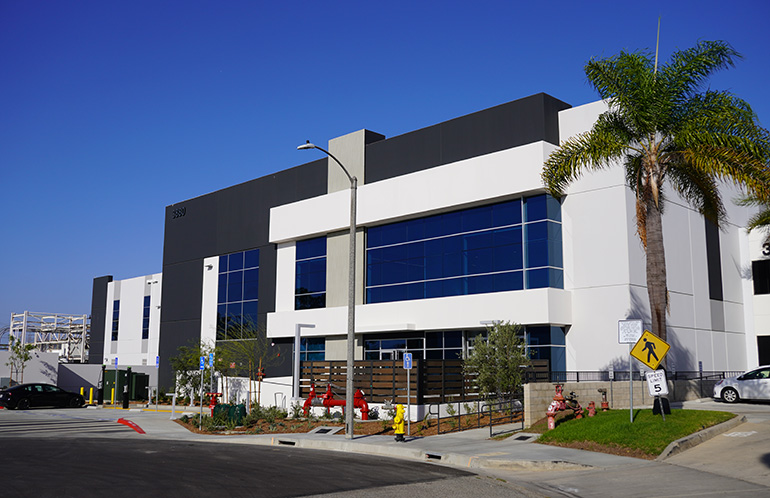
The team later spent time in the San Francisco Bay Area engaging with investors, potential customers, and ecosystem partners before settling on Los Angeles as the home for their manufacturing operations. The company has since leased a 36,000-square-foot facility in Torrance, California, where it is building out a fully automated production line from the ground up.
The company’s initial funding came from angel investors, but a subsequent seed round raised $16 million and was led by AlleyCorp. The oversubscribed round gave the founders the freedom to be selective about their investors. Sanz-Gadea cited Brannon Jones, a deep-tech principal at AlleyCorp with a background in SpaceX and advanced manufacturing, as a key ally who grasped the company’s mission almost immediately.
The company is now hiring aggressively across disciplines, including mechanical engineering, structural engineering, robotics, software, and manufacturing operations.
## A Broader Vision for Advanced Materials
While aerospace and defense certifications remain a priority, the company sees demand for its composite manufacturing capabilities across a wide range of industries. Robotics, in particular, is a major opportunity. Most robotic systems today are constructed from aluminum, but composites offer stiffness comparable to metal at roughly 40% less weight. That reduction translates into longer battery life, smaller and lighter actuators, and higher payload capacity — all critical factors as humanoid and mobile robots move toward mass production.
Sanz-Gadea draws a historical analogy: carbon fiber today is a bit like steel was before the Industrial Revolution. The material’s properties are extraordinary, but the manufacturing infrastructure has not yet caught up. Steel only became a transformative, mass-produced material once companies built the production systems to make it reliably at scale. Carbon fiber, the argument goes, is at that same inflection point now.
The company’s ambitions extend well beyond making any single type of carbon fiber part. Its long-term goal is to create the manufacturing capacity to produce advanced composites at genuine industrial scale, serving customers in aerospace, defense, robotics, logistics, maritime, and beyond.
—
## Frequently Asked Questions
**What does the company do?**
The company builds fully automated manufacturing systems for carbon fiber and other advanced composites, enabling high-volume production of composite parts with dramatically reduced lead times.
**Who are the founders?**
The company was co-founded by Edmundo Sanz-Gadea, who serves as chief technology officer, and Alex Niehaus, who serves as CEO. Both bring extensive backgrounds in robotics, aerospace, and autonomous systems.
**How much funding has the company raised?**
The company emerged from stealth with $16 million in seed funding, led by AlleyCorp. The round was oversubscribed, and the founders were selective about the investors they brought on board.
**Where is the company based?**
The company is headquartered in Los Angeles, California, and is currently setting up manufacturing operations in a 36,000-square-foot facility in Torrance, California. The company initially began its work in London before relocating its manufacturing base to Southern California.
**What industries is the company targeting?**
The company is focused on aerospace and defense in the near term, but also sees significant demand from robotics, logistics, maritime, and other sectors that require lightweight, high-performance structures.
**How does the company make manufacturing faster?**
By designing entire robotic production cells around automation from the ground up, the company replaces manual layup and lengthy autoclave curing cycles with faster, repeatable processes that aim for sub-15-minute cycle times.
**What is the significance of this technology for the industry?**
The company argues that advanced composites are at a similar stage to steel before modern industrialization — the material is exceptional, but the manufacturing infrastructure has not kept pace with demand for mass production. The company aims to close that gap.
—
## Conclusion
The race to make advanced composite manufacturing scalable and economically viable is one of the most consequential challenges in modern industry. Companies in robotics, aerospace, and defense all need lightweight, high-performance components — but traditional methods of production cannot meet the demand for large volumes. Startups like this one are proving that automation, thoughtful process design, and a focus on speed can fundamentally change what is possible.
With $16 million in backing, a world-class founding team with deep experience in autonomous systems, and a clear vision for reindustrializing domestic manufacturing, the company represents a compelling new chapter in the story of composites. If the company can execute on its promise of compressing production timelines from months to weeks, it could reshape not just one industry, but many.
Thank you for reading
