



# How AI-Powered Vision Guidance Is Transforming Robotic Assembly Lines
For nearly three-quarters of a century, automotive manufacturing plants have relied on robotic systems to handle repetitive tasks like fastening, dispensing adhesives, and picking components from pallets. However, robots have always faced a fundamental limitation: they can only perform tasks within the precise parameters for which they are programmed. When a part shifts even slightly on the line, a robot may fail to complete its assigned task — leading to rework, higher labor costs, and production delays.
A recent breakthrough in artificial intelligence and 3D vision technology is changing that equation.
## The Challenge of Repeatability
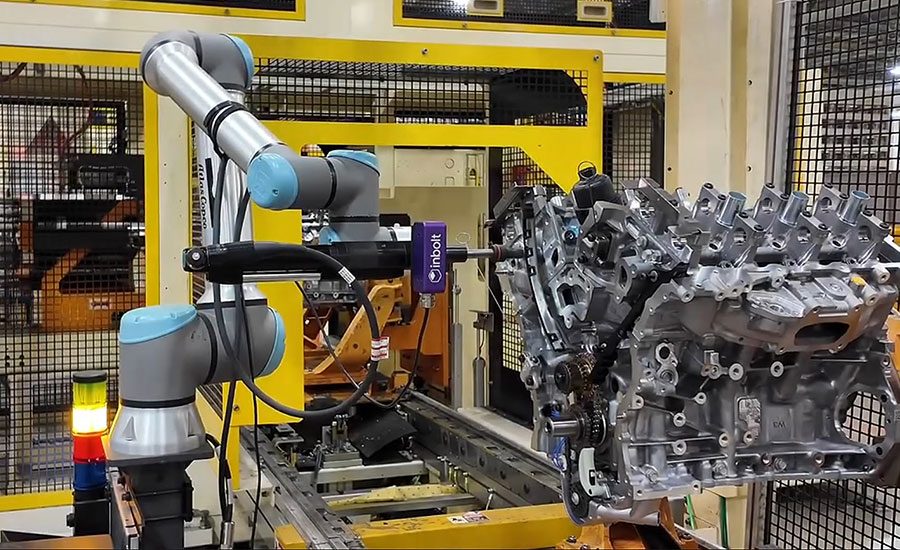
In automotive engine assembly, robotic stations are commonly used to tighten bolts on moving production lines. A lift-and-locate mechanism positions each engine so that a six-axis robot can access and fasten critical bolt sequences. While this infrastructure works well in theory, it has long been plagued by a specific issue: slight variations in engine positioning caused the robot to miss fastening points at a rate of approximately 2.55 percent.
The consequences were significant. Every missed bolt required manual correction by a human worker stationed at the end of the line, inflating labor expenses and slowing throughput. Traditional approaches like upgrading lift-and-locate mechanisms or modifying conveyor systems introduced their own problems — higher infrastructure costs, longer cycle times, and gradually worsening repeatability due to mechanical wear and tolerance drift.
The core problem boiled down to a mismatch between how robots and skilled workers handle variability. An experienced operator can visually adjust a tool to a fastener even when the part is slightly off-target. A robot, by contrast, follows a fixed coordinate system and cannot compensate for unexpected positional shifts.
## A New Approach: Real-Time AI Vision Guidance
Engineers found the solution by integrating an AI-driven 3D vision guidance system directly onto the robot arm. The technology uses a standard 3D camera to capture real-time depth data of each assembly station, allowing the robot to perceive the exact position and orientation of a part — even when that part is in motion on the line.
What makes this system distinct from traditional machine vision is its ability to operate in unstructured, real-world environments. There is no need for fixed lighting rigs, controlled ambient conditions, or rigid part fixtures. An AI model, pretrained on a library of CAD data and fine-tuned for specific geometries, rapidly identifies parts, calculates their exact spatial coordinates, and dynamically recalculates the robot’s path in fractions of a second.
The result is a robot that can adapt to X, Y, Z, yaw, pitch, and roll variations on the fly — engaging fasteners in any orientation, including hard-to-reach positions, without any modifications to the existing production floor.
## Measurable Results
When the vision guidance system was deployed at a major engine manufacturing facility in Michigan, the improvements were dramatic. The rate of missed bolt engagements fell from 2.55 percent to just 0.24 percent — a reduction of over 90 percent. Overall part rejections dropped by 90.5 percent, and the need for manual rework was virtually eliminated.
Perhaps most impressively, the company achieved a full return on its investment within 12 months. The system was installed without any costly infrastructure changes, and the human operator who had previously served as a safety net at the end of the line was able to focus on higher-value tasks that required genuine judgment and dexterity.
## Beyond Bolt Tightening
The success at the Michigan plant prompted the company to explore additional applications for AI vision guidance across its global manufacturing network. Several new use cases quickly demonstrated the versatility of the technology:
### Adhesive Dispensing Reliability
At a major assembly complex in Detroit, a robotic adhesive dispensing station suffered from intermittent misalignments between the programmed tool path and the actual position of each workpiece. Even minor deviations of just 4 millimeters were enough to disrupt the dispensing trajectory, triggering manual cleanup and recalibration events. After installing the vision guidance system, the robot continuously detected the real-time position of each part and adjusted its path accordingly. Unplanned downtime dropped by 70 percent, and the investment paid for itself in just six months.
### Picking and Placement of Cylinder Heads
At a factory in Szentgotthárd, Hungary, autonomous mobile robots delivered pallets of cylinder heads to an assembly station. The problem was twofold: the mobile robots could not stop at exactly the same position each time, and the cylinder heads were often arranged unevenly on flat surfaces, making their positions impossible to predict.
With vision guidance, the system could locate each cylinder head individually, recalculate the robot’s trajectory, and execute precise pick-and-place operations. This eliminated the need to redesign or replace the dunnage that held the heads, dramatically reducing the total cost of automation.
### Loading and Unloading Machined Components
At a transmission assembly plant in Valenciennes, France, the challenge involved raw gears arriving with inconsistent positioning and pallets that had undergone heat treatment, causing unpredictable variations in pin alignment. To make matters more complex, the robots used in the operation were collaborative robots mounted on mobile carts, meaning their positions shifted slightly every time they were relocated to a different machine.
The vision guidance system resolved both challenges by detecting the exact position of each part before pickup and recalculating the position of each pallet during unloading to prevent collisions and ensure accurate insertion. The result was a fully automated solution that replaced an otherwise unreliable manual process.
## What This Means for Manufacturing
The adoption of AI-powered vision guidance represents a significant step forward in robotic automation. By giving robots the ability to perceive and adapt to their environment in real time, manufacturers can deploy automation in situations that were previously considered too variable or too complex for machines. This expands the range of tasks that robots can handle, reduces dependence on rigid fixturing and specialized infrastructure, and makes automation investments more accessible and faster to pay back.
—
## Frequently Asked Questions
**Q: How does AI vision guidance differ from traditional machine vision systems?**
Traditional machine vision typically relies on fixed cameras, controlled lighting, and carefully positioned parts. The AI-based approach mounts the 3D camera directly on the robot and uses deep learning models trained on CAD data to identify parts in any orientation, under variable lighting, and in cluttered environments. It requires no fixed infrastructure or environmental controls.
**Q: Does installing this technology require major changes to existing assembly lines?**
No. In all of the case studies described, the systems were deployed without modifying existing infrastructure such as conveyor systems, lift-and-locate mechanisms, or fixture layouts. The technology attaches directly to the robot arm and works with the existing equipment.
**Q: Can vision-guided robots handle parts that are still in motion?**
Yes. One of the key advantages of the technology is its speed and accuracy. The AI model processes 3D data fast enough that the robot can engage fasteners, apply adhesives, or pick up components while they are still moving along the production line.
**Q: What types of manufacturing applications benefit most from this technology?**
Any application where parts arrive with unpredictable positioning, where fixturing is difficult or expensive, or where mobile robots operate in variable locations can benefit. Common examples include bolt tightening, adhesive dispensing, pick-and-place operations, and machine loading and unloading.
**Q: How quickly can manufacturers expect to see a return on investment?**
Based on the documented deployments, payback periods ranged from six months to one year, depending on the complexity of the application and the extent of manual labor being replaced.
**Q: Is this technology limited to automotive manufacturing?**
While the case studies highlighted here come from the automotive sector, the underlying technology is applicable to any industry that uses robotic automation in unstructured environments, including aerospace, electronics, heavy equipment, and consumer goods manufacturing.
—
## Conclusion
Robotic automation has always promised efficiency, consistency, and scalability. However, its real-world impact has often been constrained by a single vulnerability — the inability to handle variation. Parts move. Fixtures wear. Positions shift. And traditional robots have not been equipped to cope with that reality.
AI-powered 3D vision guidance addresses that vulnerability directly. By giving robots a form of situational awareness, the technology bridges the gap between the precision of machines and the adaptability of human workers. The results speak for themselves: fewer missed operations, dramatically lower rejection rates, elimination of manual rework, and fast returns on investment — all without the need to overhaul existing production lines.
As more manufacturers adopt this approach, the boundaries of what can be automated will continue to expand, opening the door to smarter, more flexible, and more cost-effective production systems across every sector.
Thank you for reading
